
Investment Toys That Last for Years: Practical Buying Guide

What if the best toy isn’t the newest or most exciting one on the shelf, but the one your child still reaches for months later? Choosing investment toys that last for years is about more than sturdy construction. A toy needs to suit your child now, adapt as their interests change and fit the way your family lives. Otherwise, even a promising purchase can end up ignored or taking up valuable space.
It’s understandable to want lasting value, especially when it’s hard to judge quality, safety and care needs before buying. A practical checklist can help you compare construction, versatility, suitability and everyday upkeep before deciding.
This guide explains what to look for, how to account for changing stages of play, and how to make a toy easier to care for and enjoy over time. It also compares soft play ball pits, mats and sensory toys, taking space and typical use into account for homes, nurseries and playgroups. The aim is simple: choose for lasting play, not novelty alone.
Investment toys that last for years: what to assess
Compare four things separately: how the toy is made, how often it is likely to be used, whether it offers different ways to play, and how well it fits your space and care routine. A toy that scores well on one point may not suit your household overall. The best choice is the one that matches the way children will actually use it.
Key Takeaways
- Compare durability, lasting interest, adaptability and resale value separately to judge what “investment” really means.
- Use a practical checklist to assess seams, joins, surfaces and finish, then follow the toy’s cleaning instructions.
- Compare ball pits, soft play mats and sensory toys by play opportunities, space, care and likely users.
- Choose investment toys that last for years by considering your child, who else will use the toy, and where it will be played with and stored.
- Handmade soft play toys from a West Yorkshire manufacturer offer options for homes, nurseries and playgroups.
What makes a toy an investment that lasts for years?
An investment toy isn’t simply an expensive one. It’s a toy that earns repeated use and offers enough play value to justify the space and care it needs. A child returning to it over time matters more than a high price tag or a promise that it will last indefinitely.
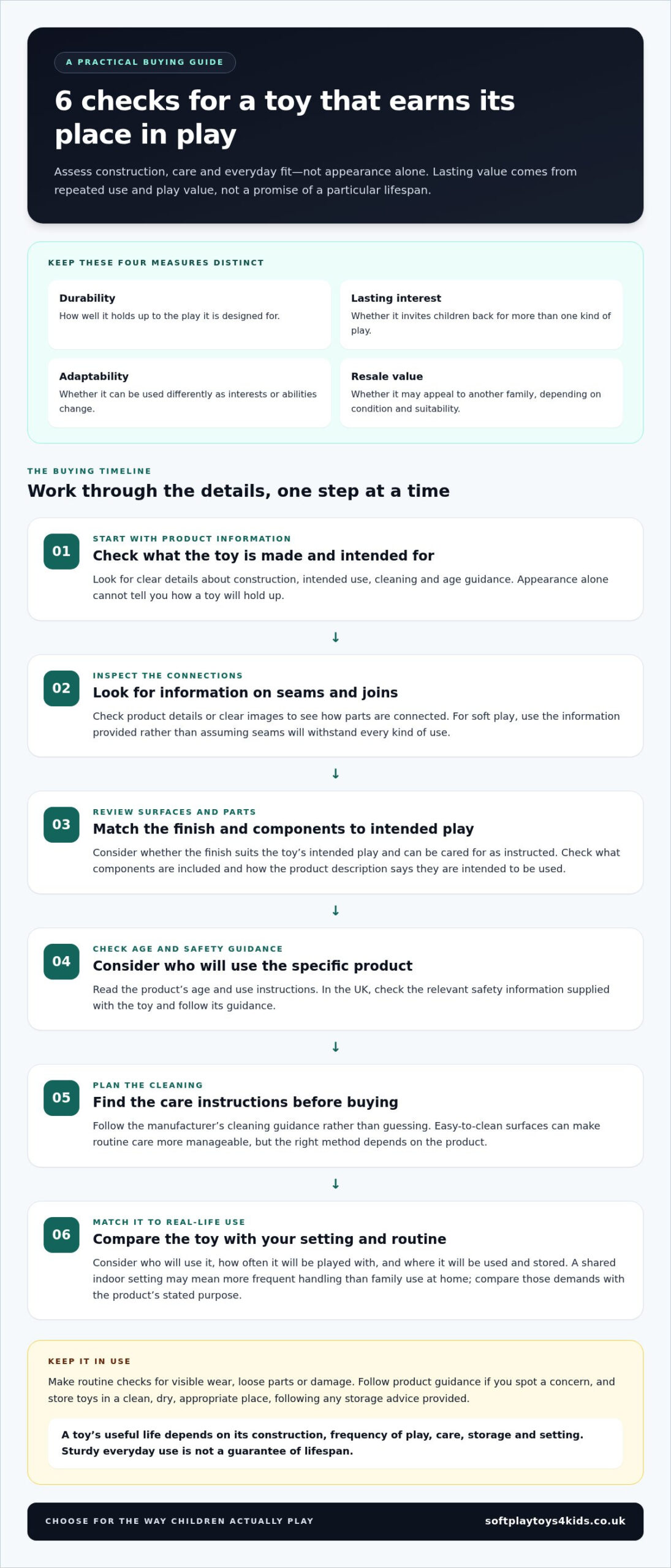
Four qualities can contribute to lasting value, but they measure different things:
- Durability: How well the toy holds up to the kinds of play it is designed for.
- Lasting interest: Whether it invites children back for more than one kind of play.
- Adaptability: Whether it can be used differently as a child’s interests or abilities change.
- Resale value: Whether it may appeal to another family, depending on its condition and suitability.
A toy may be sturdy but quickly lose its appeal, or offer varied play while needing extra care. Its useful life also depends on the child, frequency of use, cleaning and storage. A toy used daily by a group in a nursery or playgroup faces different demands from one used occasionally at home.
Lasting play value means a toy keeps earning a place in play. It isn’t a guarantee of a particular lifespan.
How do you recognise lasting play value?
Look for opportunities to play in different ways, rather than relying on a single novelty or activity. Building blocks, for example, can be stacked, sorted and used for imaginative construction. The history of building blocks offers context for this enduring form of play. Soft play equipment can also support different activities, depending on the child and setting, from exploring a ball pit to using a mat as part of a play area.
Consider whether the toy could stay engaging if your child’s interests shift. Open-ended play can help, but no toy suits every child or stage. Think about what your child already enjoys, how they like to play and whether the toy fits into your everyday routine.
What does durability mean for children’s toys?
Durability means construction suited to intended use, not indestructibility. Read product information about joins, seams, finishes and other components, along with guidance on care and use. Don’t assume a toy is robust simply because it looks substantial.
For soft play toys, use the product details and follow the specific care instructions. A product used frequently in a commercial setting may face more regular use than one in a family home, so consider the users, setting and routine. Investment toys that last for years are those whose construction and play value match real life, without confusing sturdy everyday use with a lifespan guarantee.
Which features help investment toys stand up to regular play?
Good buying decisions start with product information, not assumptions. Appearance alone can’t tell you how a toy will hold up. Look for clear details about construction, intended use, cleaning and age guidance. A well-matched toy is more likely to suit the play it is made for, whether it will be used occasionally at home or regularly in a nursery or playgroup.
What should you check before buying a toy?
Use this checklist to focus your comparison:
- Seams and joins: Look for product details or clear images that show how parts are connected. For soft play, use the information provided rather than assuming seams will withstand every kind of use.
- Surfaces and finish: Consider whether the finish is suited to the toy’s intended play and can be cared for as instructed. Don’t infer a particular material or performance from appearance alone.
- Components: Check what the toy includes and whether its description explains how those components are intended to be used.
- Age and safety information: Read the guidance for the specific product and consider who will use it. In the UK, check the relevant safety information supplied with the toy and follow its age and use instructions.
- Care instructions: Find out how the toy should be cleaned before buying. Easy-to-clean surfaces can make routine care more manageable, but the right method depends on the product.
Match the product category to expected use, too. A toy in a shared indoor play setting may be handled more often than one used by a family at home. Consider the likely number of users and frequency of play, then compare those demands with the product’s stated purpose. Don’t assume that a feature suited to one setting automatically makes it right for another.
How can maintenance help a toy stay in use?
Care is part of long-term value. Follow the manufacturer’s cleaning instructions rather than guessing, since an unsuitable method could affect the toy’s condition. Make routine checks for visible wear, loose parts or damage, and follow the product guidance if you spot a concern. Store toys in a clean, dry, appropriate place between play sessions, following any storage advice provided.
How long a toy remains usable depends on its construction, frequency of play, care, storage and setting. Assess investment toys that last for years by how their product information matches real-life routines, not by a promise of indestructibility. If soft play suits your setting, compare soft play products for everyday use with your needs.
How do soft play toys compare for lasting value?
Soft play isn’t one-size-fits-all. A ball pit, play mat and sensory toy each invite different kinds of play, so the best fit depends on your child, available space and how the toy will be used. No category can be said to last longer without evidence about the individual product and its use.
| Category | Play opportunity | Space and storage | Care | Likely users |
|---|---|---|---|---|
| Ball pit | Filling, exploring, moving balls and imaginative play. | Needs room for the pit and a plan for storing loose balls. | Follow the product’s cleaning guidance; consider how balls and the pit will be kept clean. | Children who enjoy active, hands-on play, with suitability guided by the product’s age information and supervision needs. |
| Soft play mat | Creates a defined floor-play area for activities suited to the child and setting. | Needs clear floor space in use; consider where it can be stored between sessions. | Check the specific product’s instructions for cleaning and care. | Children who benefit from a dedicated floor-play space at home or in a shared setting. |
| Sensory toy | Invites children to explore different sensory experiences through play. | Space needs depend on the toy. Smaller items may be easier to put away, but check the product details. | Care requirements vary, so follow the manufacturer’s instructions. | Children drawn to sensory exploration, subject to product-specific age guidance. |
Could a ball pit be a good long-term play choice?
A ball pit can support varied play: a child might move, sort or gather balls, invent games, or explore the space. Those possibilities can keep play fresh, but they don’t guarantee continued interest. Think about where it will sit, where the balls can be stored and how supervision will work during play. For more selection pointers, see The Ultimate Ball Pit Guide: How to Choose the Perfect One for Your Child, also titled Ultimate Guide to Ball Pits for Kids.
When might a play mat or sensory toy suit better?
A play mat can define a floor-play area, particularly if you want a clear spot for play at home, in a nursery or in a playgroup. A sensory toy may suit a child who enjoys exploring different sensations and play experiences. Compare each option with your available space and routine, and read the care and age guidance for the specific item. For more mat-selection advice, look for Ultimate Guide to Choosing the Perfect Baby Play Mat.
When choosing investment toys that last for years, focus on the category that fits your child and setting, not on assumptions that one type is inherently more durable. Ball pits, mats and sensory toys each offer a different way to make play space useful and inviting.
How can you choose a toy your child will keep using?
Start with the child and the place the toy will be used. A toy that fits their interests, available space and everyday routine is more likely to become part of regular play than one chosen on appearance alone. Use this process to narrow your options.
- Start with the users and setting. Who will play with the toy: one child, siblings or a changing group? Think about the child’s current interests and the room where play will happen, whether that’s a family home, nursery, school or playgroup.
- Match play to your child. Notice favourite activities, such as building, moving, exploring or imaginative games. Toys with open-ended uses can invite children to play in different ways, though no design guarantees lasting interest. In a shared setting, consider whether the equipment can suit children with different interests.
- Measure the space. Picture the toy in use, not just where it will sit when packed away. Allow room for children to move around it, and consider whether it could obstruct a walkway or another activity.
- Plan for storage and cleaning. Decide where the toy and any separate components will go between sessions. Compare the product’s care instructions with the cleaning routine you can realistically maintain.
- Think about frequency of use. A toy used regularly by several children faces a different pattern of use from one brought out occasionally at home. Match the manufacturer’s stated intended use to your setting and routine.
- Compare product details before deciding. Read the construction and care information, check the product’s age guidance and review relevant safety details. If key information is unclear, don’t rely on assumptions based on appearance.
What should families and organisations weigh differently?
At home, floor space and easy storage may shape the decision. A play mat can create a defined floor-play area, while a ball pit needs room for the pit and a plan for its balls. For schools, nurseries and playgroups, consider shared use, supervision arrangements, and how the toy fits into daily cleaning and storage routines.
For a larger play area, planning the layout alongside the equipment can help the space work for its intended users. SoftplayToys4kids is a UK-based manufacturer in West Yorkshire, serving families and commercial settings. Larger commercial projects can include design and installation, bringing product choice and layout planning together.
Once your checklist points towards a ball pit, play mat or sensory toy, explore soft play options suited to your home or shared setting. Investment toys that last for years are choices grounded in how children will actually use them, and how well the toy fits the space and routine.
Explore handmade soft play toys designed for everyday use
Once you’ve considered who’ll use a toy, how often it will be played with and where it needs to fit, you can narrow your choices to the kind of play space you want to create. SoftplayToys4kids is a UK-based manufacturer and supplier with a factory in West Yorkshire. Its handmade soft play products serve families as well as schools, nurseries and playgroups.
Ball pits, play mats and sensory toys each offer a different way to shape play. Choose according to the activity you want to invite and the practical needs of your setting, rather than assuming one type will suit every child. As with any purchase, read the specific product’s age guidance and care information before deciding.
Which soft play options could fit your setting?
- Ball pits: Consider a ball pit if you want an immersive play feature that gives children a dedicated space for exploring and moving balls. Think through where it will sit, how it fits the room and how loose balls will be managed.
- Play mats: A mat can help define a floor-play area in a home, nursery or playgroup. Consider the available floor space and where the mat will be kept when it isn’t in use.
- Sensory toys: These can suit children who enjoy varied, hands-on play experiences. Compare the specific toy’s intended use and care guidance with the children’s interests and your setting’s routines.
These categories support different play preferences, from a larger shared feature to a dedicated floor area or hands-on exploration. For families, the right choice may depend on the room and the child’s favourite ways to play. In a nursery, school or playgroup, consider how the toy fits shared use and daily routines. No category comes with a guaranteed lifespan; usefulness depends on how well the product suits its setting and users.
How can you take the next step?
Start with the play need you’ve identified. Browse ball pits for an immersive feature, mats for a defined floor-play space, or sensory toys for varied hands-on play. Compare product information with your available space, expected use and care routine. This makes it easier to choose for a play corner at home or a group setting.
For larger commercial play areas, SoftplayToys4kids provides design and installation as part of a project. The team’s experience as a UK manufacturer serving home and commercial customers connects product choice with the needs of the intended setting. If you’re ready to explore options, Explore SoftplayToys4kids products and find soft play ideas for your space. Thoughtful choices can help investment toys that last for years earn a regular place in everyday play.
Choose a toy that earns its place in play
The best investment toys that last for years aren’t defined by price alone. Look for a good match between your child’s interests, the toy’s construction and the way it will be used. Consider how play might change over time, then read product details, age guidance and care instructions before making your choice.
Soft play offers options for different spaces and routines: ball pits for an immersive play feature, mats for a dedicated floor-play area, and sensory toys for varied hands-on experiences. The right fit depends on your child and setting, whether at home, in a nursery or in a playgroup.
SoftplayToys4kids is a UK-based manufacturer with a factory in West Yorkshire, making handmade soft play products for families and commercial settings. Larger projects can also include design and installation. Ready to explore options for your space? Explore SoftplayToys4kids products and take the next step towards play that feels right for your child or group.
Frequently Asked Questions
Which types of toys are most likely to stay interesting as a child grows?
Toys that invite more than one kind of play may stay engaging as a child’s preferences change. Soft play equipment, mats and sensory toys each offer different play experiences, but suitability depends on the child and setting. Think about what your child enjoys and how they might use the toy in different ways. Compare the specific product’s intended use and age guidance rather than assuming a whole category lasts longer.
Are soft play toys suitable for everyday use at home?
Soft play toys can suit everyday home use if their size, intended use and care requirements fit your household. Before choosing, consider the floor space needed, where the toy will be stored, who will use it and how often. Read the product’s age guidance and follow its care instructions. Regularly inspect the item for visible wear, using the manufacturer’s advice to guide checks and any action needed.
How can I tell whether a toy is well made?
Start with clear product information about construction, intended use, age suitability and care. Look for relevant details for that particular toy, such as how its seams, joins or surface finishes are described. No single feature proves that a toy will withstand every kind of play. Use the product’s published information and instructions to understand how it’s designed to be used and maintained, and avoid relying on appearance alone.
Can one soft play toy work for both home and nursery use?
It depends on the product, available space and how many children will use it. A toy in a nursery or playgroup may experience more frequent shared play than one at home, so compare its intended use with the setting’s routines. Read its age guidance and cleaning instructions, too. For a larger commercial play area, tailored design and installation planning can help align the equipment with the space and its users.
How do I keep soft play toys in good condition?
Follow the cleaning and care instructions for the specific product, and store it appropriately between play sessions. Make routine checks for visible wear, then follow the manufacturer’s guidance if you notice a concern. Avoid cleaning products or methods unless the product instructions say they’re suitable. Care requirements vary, so don’t automatically apply one item’s instructions to another.
Leave a Reply