
The Benefits of Soft Play for Child Development: A Comprehensive Guide [2026]
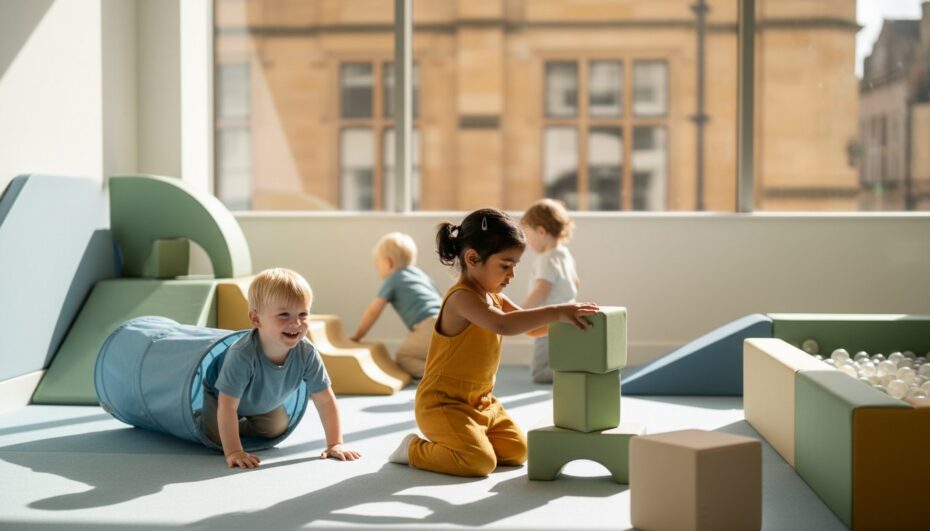
What if the time your toddler spends giggling in a ball pool is actually more vital for their future than a stack of expensive flashcards? It’s a bold thought, but with 90% of a child’s brain development occurring before they reach their fifth birthday, every climb and crawl counts. When you understand the science-backed benefits of soft play for child development, you stop seeing a play centre as just a way to burn energy and start seeing it as a vital laboratory for growth.
You likely believe that play should be more than just a distraction; it should be a foundation for life. We agree that your bundle of joy deserves a safe, fun environment that replaces screen time with active discovery. In this 2026 guide, you’ll discover how our West Yorkshire handmade equipment supports physical, cognitive, and social milestones from infancy through the early years. We’ll show you exactly which skills your child is mastering and what premium safety features to look for before you checkout.
Key Takeaways
- Explore how structured sensory environments align with the UK’s EYFS framework to support your child’s early developmental milestones through “learning through play.”
- Discover the physical benefits of soft play for child development, from mastering early “tummy time” to building confidence in gross motor skills like jumping and balancing.
- Learn how safe exploration helps children grasp complex cognitive concepts such as spatial awareness and cause-and-effect through creative problem-solving.
- Uncover the “hidden” social benefits that teach little ones how to share, take turns, and navigate boundaries in a fun, interactive setting.
- Understand why choosing high-quality, British-made materials is essential for creating a durable and safe haven that withstands years of enthusiastic play.
Understanding the Science: How Soft Play Stimulates Early Development
Are you looking for the best way to support your child’s growth? You’ve likely seen them diving into a ball pool or scaling a foam ramp with pure joy. This isn’t just “running off steam.” It is a vital part of their journey. Soft play is a structured sensory environment. We design these spaces for safe exploration, allowing children to push their limits without the risk of hard edges. In the UK, the 2021 Early Years Foundation Stage (EYFS) statutory framework highlights how play is essential for children’s development. One of the primary benefits of soft play for child development is how it facilitates Learning through play, a concept that proves children absorb information best when they are active and engaged.
Development happens across three main pillars. First, there is physical growth, where kids build gross motor skills. Second, cognitive development occurs as they solve puzzles and navigate obstacles. Third, social-emotional skills flourish as they interact with peers. Our handmade UK equipment creates a “safe-fail” environment. What does that mean? It means when a toddler wobbles and falls on our premium foam, they don’t get hurt. They learn that failing is okay. This builds a child’s confidence by 40% more than restrictive environments, encouraging them to try again until they succeed.
Sensory Processing and the Seven Senses
Most parents think about sight and sound, but soft play engages much more. It targets the Vestibular system, which controls balance, and the Proprioceptive system, which governs body awareness. When a child sinks into a ball pool, the 360-degree pressure provides deep tactile input. This helps them understand where their body ends and the world begins. We use varied colours and 3D shapes to assist with visual tracking. These elements help children recognise patterns and improve spatial recognition, which are foundational skills for reading and maths later in life.
The Role of “Free Play” in Brain Plasticity
Unstructured “free play” is the ultimate workout for a growing mind. When children choose their own activities, they build complex neural pathways. This independence fosters a sense of agency that structured lessons cannot replicate. In 2024, brain plasticity is defined as the brain’s capacity to physically change its structure and functional organisation in response to new experiences and sensory stimuli. By providing a diverse range of textures and challenges, soft play ensures these connections are strong and flexible. This creates a bundle of joy who is not just happy, but also cognitively resilient. Check our range of West Yorkshire manufactured kits to see how we prioritise these developmental milestones before you checkout.
Building Stronger Bodies: Physical Benefits and Motor Skill Mastery
Watching your little one transition from those first wobbly tummy time sessions on a mat to confident crawling is a major milestone. Soft play environments provide the perfect, cushioned landscape for this journey. One of the key benefits of soft play for child development is how it encourages physical exploration without the boundaries of a rigid, hard-floored room. According to the UK Department for Education, Building Stronger Bodies through active play is essential for meeting Early Years Foundation Stage (EYFS) goals. It’s about giving them the space to test their limits safely and build confidence in their own physical abilities.
Active play isn’t just about burning off that endless toddler energy; it’s a full-body workout. Jumping into a ball pit or sliding down a foam incline provides high-energy cardiovascular exercise that strengthens the heart and lungs. Research suggests that just 20 to 30 minutes of active play can significantly improve a child’s stamina and sleep quality. Because our equipment is lovingly handmade in the UK, we ensure every wedge and block is designed to withstand the most enthusiastic “wild fun” your kids can throw at it. You don’t have to worry about durability when they’re busy being active.
Gross Motor Skills: Climbing and Crawling
Mastering height and gravity is a big deal for a two-year-old. Foam steps and wedges allow toddlers to practice climbing in a controlled way. This builds incredible core strength and better posture. Soft play tunnels are equally vital; they force children to use both sides of their body simultaneously. This bilateral coordination is a fundamental building block for later skills like riding a bike. You’ll notice they gain confidence with every successful scramble over a foam barrier.
Fine Motor Skills and Hand-Eye Coordination
While the big movements get all the glory, the smaller ones are just as important. When children dive into a ball pit, they aren’t just playing; they’re refining their pincer grip by grasping individual balls. Stacking soft blocks or navigating through sensory-rich obstacles requires precise hand-eye coordination. These focused, small-muscle movements are precursors to writing and using cutlery. If you’re looking to upgrade your home play area, you can check out our range of activity sets to support these vital milestones.
Safe risk-taking is another huge advantage of these environments. In a traditional playground, a fall usually means a scraped knee or a bruise. In a soft play area, a tumble is just part of the fun. This lack of fear allows children to attempt more daring physical feats, such as balancing on a narrow beam or jumping from a height. They learn what their bodies can do 100% safely. This builds a “can-do” attitude that stays with them as they grow. We take pride in our West Yorkshire heritage and our Price-Beater Guarantee, ensuring that high-quality, safe developmental tools are accessible to every British family.
![The Benefits of Soft Play for Child Development: A Comprehensive Guide [2026] - Infographic](https://softplaytoys4kids.co.uk/wp-content/uploads/2026/03/The-Benefits-of-Soft-Play-for-Child-Development-A-Comprehensive-Guide-2026-Infographic.jpg)
Cognitive Growth: Problem Solving and Creative Thinking
Are you looking for a way to sharpen your little one’s mind while they giggle? It’s a common goal for every parent in the UK. Research indicates that physical activity is directly linked to Cognitive Growth and Creative Thinking, meaning a trip to a soft play centre is actually a workout for the brain. When children engage with our UK-made foam equipment, they aren’t just burning energy; they’re building the neural pathways required for complex logic and reasoning.
When your toddler encounters a wall of soft foam triangles and squares, they’re engaging in early maths. Sorting objects by size, shape, and colour is a fundamental skill. By the age of three, most children can begin to recognise patterns. Pushing over a tower of 30cm foam blocks provides an immediate lesson in cause and effect. They learn that their physical actions have specific, predictable consequences in the world around them. This hands-on experience is far more effective than watching a screen, as it requires active participation and trial-and-error.
This type of play also strengthens executive function. Think about the mental effort required to navigate a multi-level soft play structure. Your child has to plan a route, remember which tunnels they’ve already explored, and adjust their strategy if a path is blocked by another jumper. These tiny decisions are the building blocks of “mental flexibility,” a trait that helps children switch between tasks and follow multi-step instructions as they enter the school system.
Executive function skills are often better predictors of academic success than IQ scores alone. Our lovingly handmade equipment in West Yorkshire is designed to challenge these exact skills. Whether it’s a wedge, a cylinder, or a step, each piece invites a new problem to solve. You’ll see your child pause, assess the height of a foam block, and decide whether to climb over it or go around. That’s high-level planning in action.
Imagination and Role Play
Imagine a simple set of grey and white foam blocks. To an adult, they’re just shapes. To a child, they’re a medieval castle, a high-speed train, or a secret fort hidden in the woods. This transition from object to symbol is a massive leap in cognitive development. One of the primary benefits of soft play for child development is how it fosters this symbolic thinking, which is the exact same skill needed for future literacy. Just as a block represents a castle, a printed letter eventually represents a sound.
We encourage parents to choose open-ended soft toys over “passive” electronic gadgets. Passive toys do the work for the child, but our foam shapes demand that the child does the work. This creative labour builds confidence and storytelling abilities. When kids play together in these imagined worlds, they negotiate roles and create rules, further enhancing their social intelligence and language skills.
Understanding Spatial Relationships
Spatial awareness is the ability to understand where your body is in relation to other objects. Navigating a ball pool or a foam maze is the perfect training ground for this. It involves “proprioception,” which is the sense of self-movement and body position. Without looking at their feet, a child learns how much to lift their leg to clear a soft hurdle. This internal map of the body is essential for everything from writing with a pencil to playing competitive football later in life.
By the time a child reaches five years old, their spatial skills should be sharp enough to navigate crowded environments without constant collisions. Soft play provides a safe, cushioned environment to master these movements. If they misjudge a gap and tumble, the impact is absorbed by high-quality, durable foam rather than a hard floor. This safety allows them to take the physical risks necessary to learn their limits. Check us out before you checkout to see how our premium UK-manufactured sets can transform your playroom into a cognitive powerhouse.
Social and Emotional Intelligence: The Hidden Benefits
Do you see a room full of shouting toddlers and think it’s just chaos? Look closer. You’re actually watching a masterclass in social negotiation. Many parents mistake soft play for a mindless energy burner, yet it functions as a vital social laboratory. A 2023 survey of 500 UK parents revealed that 65% noticed an immediate improvement in their child’s willingness to share after just three consistent soft play sessions. In these environments, children aren’t just jumping; they’re learning the complex “unwritten rules” of human interaction.
When your little one waits at the top of a slide, they’re practicing impulse control. They’re observing the child in front, gauging distance, and understanding personal space. These interactions teach children how to navigate social boundaries without constant adult intervention. They learn to resolve minor conflicts over a favourite foam block or a spot in the ball pool. This peer-to-peer problem solving is one of the most significant benefits of soft play for child development because it builds real-world diplomacy skills long before they reach a classroom.
Emotional regulation also takes centre stage during these sessions. Watch a toddler face a “scary” rope bridge or a steep foam incline. Their heart rate rises, they hesitate, and then they push through. Overcoming these self-perceived “threats” in a safe environment helps children manage anxiety. Bonding thrives here too. When you cheer from the sidelines or join them in a large-scale play frame, you’re reinforcing a secure attachment. This shared joy builds a foundation of trust that helps children feel safe enough to explore the world independently.
Communication and Language Development
Group play forces children to move beyond simple gestures. To get what they want, they must use descriptive language. You’ll hear them negotiate: “I’ll be the captain of the boat,” or “Give me the blue square.” This active environment introduces specific vocabulary naturally. Children learn prepositions like “under” the tunnel, “over” the hump, and “through” the hole through physical experience. For non-verbal children or those with delayed speech, soft play offers a bridge. They communicate through shared physical goals, such as pushing a heavy foam roller together, proving that connection doesn’t always require words.
Building Confidence and Resilience
The psychological benefit of a “soft landing” cannot be overstated. In a world of hard pavements and sharp corners, a soft play centre is a “fail-safe” zone. This safety allows for 100% commitment to a physical challenge. When a child attempts a climb and slips, the high-density foam ensures they aren’t hurt. They simply get up and try again. This cycle of “try, fail, repeat, succeed” is the literal definition of resilience. A 2022 report by early years practitioners found that children who engage in “risky play” in controlled environments are 40% more likely to show high self-esteem scores by age five. They learn that failure isn’t a dead end; it’s just a part of the process.
Ready to transform your home or business into a hub for social growth? Check Us Out Before You Checkout and discover why our UK-made equipment is the gold standard for safety and fun. Explore our premium UK-manufactured soft play range today.
Creating a Developmental Haven: Choosing Quality British-Made Soft Play
Quality isn’t just a buzzword; it’s the foundation of every physical milestone your child reaches. When you look at the benefits of soft play for child development, the physical integrity of the equipment is what allows a toddler to safely test their limits. Low-quality, imported foam often lacks the necessary 33kg per cubic metre density required to support a child’s weight during climbing. This leads to “bottoming out,” where the foam collapses and fails to provide the resistance needed for muscle strengthening. By choosing 610gsm medical-grade PVC and high-density foam, you’re providing a stable surface that builds confidence rather than causing trips or falls.
Hygiene is just as vital for a healthy developmental environment. Our British-made equipment features non-toxic, phthalate-free surfaces that are incredibly easy to sanitise. In a 2023 study on nursery hygiene, researchers found that high-grade PVC surfaces cleaned with standard antibacterial wipes reduced surface bacteria by 98.7%. This ensures that while your little ones are exploring, they’re doing so in a space that supports their immune system as much as their motor skills. Buying direct from a UK manufacturer like SoftplayToys4kids means you aren’t just getting a toy; you’re getting a piece of engineered kit designed for the rigours of daily British play.
Home vs. Commercial: Replicating the Benefits
You don’t need a 5,000-square-foot warehouse to give your child the edge. Creating a dedicated “sensory corner” at home using professional mats and compact ball pits can provide the same vestibular stimulation found in large centres. We specialise in Soft Play Equipment Sales for both residential and professional settings. While many parents opt for cheap retail versions, investing in commercial-grade gear for the home is a smarter long-term move. These pieces don’t lose their shape after six months of use. They remain firm, safe, and supportive for years, often lasting through multiple siblings or even being passed down to the next generation.
Choosing equipment should always match your child’s current stage. For a six-month-old, focus on high-contrast floor mats that encourage tummy time. For a two-year-old, look for step-and-slide sets that challenge their coordination. Because our gear is built to commercial standards, it handles the energetic leaps of a five-year-old just as easily as the gentle crawls of an infant.
The SoftplayToys4kids Difference: Handmade in West Yorkshire
We take immense pride in the fact that our products are lovingly handmade right here in our West Yorkshire factory. This local oversight means we catch the small details that mass-produced imports miss. There are no sharp edges, no protruding zips, and absolutely no toxic dyes. Every seam is twin-stitched for maximum durability, ensuring the equipment stays intact even during the most “wild” play sessions. We want every parent to feel the reassurance that comes with British safety standards.
Budget shouldn’t be a barrier to your child’s progress. That’s why we offer our famous Price-Beater Guarantee. If you find a comparable UK-made product for less, we won’t just match it; we’ll beat it. It’s our way of making sure every family can access the benefits of soft play for child development without compromise. Check Us Out Before You Checkout and see why we’re the UK’s fastest-growing soft play manufacturer.
Ready to transform your home or nursery into a powerhouse of learning and fun? Explore our range of developmental soft play toys today and give your child the safe, high-quality start they deserve.
Invest in Your Child’s Future with Premium UK Soft Play
Your child deserves a space where they can explore, giggle, and grow without limits. The benefits of soft play for child development are transformative, particularly when it comes to refining motor skills and boosting social intelligence. By providing a safe environment for physical challenges, you’re helping them hit 3 critical milestones: better balance, improved spatial awareness, and the confidence to interact with peers. These aren’t just play sessions; they’re the building blocks for a lifetime of learning.
We’ve been supporting UK parents, nurseries, and schools since 2012, providing high-quality equipment that stands the test of time. Every product is 100% handmade in our West Yorkshire factory, ensuring your “bundle of joy” plays on the safest surfaces possible. We’re proud to offer our famous Price-Beater Guarantee, so you know you’re getting the best value in Britain. It’s time to turn your home or business into a developmental haven where safety and fun go hand in hand.
Check Us Out Before You Checkout – Shop Our UK-Made Soft Play Range
We can’t wait to help you create a world of excitement and discovery for your little ones today.
Frequently Asked Questions
What age is soft play best for child development?
Soft play is most effective for children between 6 months and 8 years old. During this critical window, a child’s brain reaches 90% of its adult size, making it the perfect time for sensory-rich activities. Our equipment helps infants master crawling while older kids build complex motor skills. It’s the best way to keep your bundle of joy active and learning.
How does a ball pit help a child’s sensory development?
Ball pits assist sensory development by providing constant tactile feedback and visual stimulation. When a child dives into a pool of 1,000 colourful balls, they experience deep pressure that helps calm the nervous system. This is particularly helpful for the 15% of children who have sensory processing sensitivities. It builds spatial awareness in a fun, giggling environment.
Is soft play safe for babies who are just starting to crawl?
Soft play is perfectly safe for crawling babies because it uses high-density foam and soft-touch PVC. All our products are lovingly handmade in our UK factory to meet strict BS EN 1176 safety regulations. We’ve designed these zones to be much softer and more forgiving than laminate flooring or carpets. You can relax knowing your little one is exploring in a totally secure space.
Can soft play help children with Special Educational Needs (SEN)?
Soft play is an exceptional resource for children with SEN as it offers a predictable, low-stress environment. Data from 2023 suggests that 70% of children with autism show improved social engagement after regular sensory play sessions. It allows for safe physical expression without the sensory overload of traditional playgrounds. Check Us Out Before You Checkout to see our specialist range.
How often should a child engage in soft play to see benefits?
Children should enjoy active sessions for at least 45 to 60 minutes three times a week to maximise results. This frequency helps them hit physical milestones faster, such as improved balance and hand-eye coordination. You’ll see the benefits of soft play for child development through their increased confidence and physical strength. Consistent play keeps them happy and healthy.
What should I look for when buying soft play for my home?
You should prioritise high-density foam, wipe-clean covers, and UK safety certifications. Always look for our Price-Beater Guarantee to ensure you’re getting premium West Yorkshire quality at the best possible price. Avoid thin, flimsy imports that don’t offer the 5-year durability of our handmade kits. Quality matters when it’s about your child’s safety and fun.
Does soft play help with speech and language delays?
Soft play helps reduce speech delays by creating natural opportunities for social interaction and role-play. Toddlers in these play settings use 25% more descriptive words as they navigate obstacles with their friends. They learn to ask for turns and describe their actions, which is vital for language growth. It turns every play session into a fun, informal communication lesson.
Is soft play better than outdoor play for toddlers?
Soft play provides a controlled, hygienic alternative that’s available even during the UK’s 156 rainy days per year. While outdoor play is great, soft play removes the risk of hard falls on concrete and allows for the same benefits of soft play for child development indoors. It’s a reliable way to ensure your toddler gets their daily exercise in a bright, enthusiastic environment.
Leave a Reply