
Foldable Soft Play Mats: A Clutter-Free Playroom Guide

What if the play area could be ready in moments, then tucked away when the room needs to serve another purpose? Foldable soft play mats can help make that possible, but choosing one is about more than finding a mat that folds. You’ll want a surface that fits the play area, a storage spot that fits the folded mat, and a set-up routine that works for the people using it.
When a mat takes over the room after playtime, it can make a living room, dining area or home office harder to use. To avoid that, start by thinking about how children will use the space, where the mat will be stored and how often you’ll need to set it out and put it away.
This guide explains what to consider when comparing foldable soft play mats, from size and surface details to cleaning and storage. You’ll also find practical ways to plan a play area and account for fold creases. SoftplayToys4kids makes soft play products in West Yorkshire for families and group settings, including soft play mats for creating welcoming places for little ones to play.
Key Takeaways
- See how foldable soft play mats can make room for play without permanently occupying the floor.
- Plan a simple set-up and put-away routine for your home or shared play space.
- Compare foldable mats, non-folding mats and a cleared floor area against your room layout and routine.
- Use a practical checklist to plan your play area, storage and intended use before comparing mat details.
- Explore how SoftplayToys4kids’ soft play mats can suit play spaces at home, in schools, nurseries and playgroups.
Why foldable soft play mats can make a playroom easier to manage
A play space needs room to spread out, but a mat left on the floor can make a living room, dining area or home office feel crowded. A fold-away surface offers another way to organise the room: set it out for play, then put it away when the space needs to do something else. For this to work well, the mat needs to suit both the play area and the place where you’ll store it.
A foldable soft play mat is a play surface designed to fold for handling or storage, unlike a fixed surface that stays laid out.
That feature can make a room easier to reset, but it doesn’t automatically mean the mat will take up little space once folded. It may still need room in a cupboard, on a shelf or in a clear corner. Measure the storage spot before choosing, and compare it with the folded dimensions provided for the mat.
What makes a soft play mat foldable?
Folding describes how a mat is handled or stored, not a particular material or construction. Some designs fold into sections, while others may fold differently. Check the product details rather than assuming all mats fold in the same way. Compare the mat’s dimensions when laid out with its folded dimensions, where provided. These measurements help you judge whether it will fit the play area and the storage space you actually have.
Who might benefit from a fold-away play surface?
Families who use one room for play, meals and relaxing may appreciate being able to reclaim floor space after playtime. The same flexibility can help nurseries and playgroups adapt a room as activities change during the day. Foldable soft play mats can make that transition more manageable, but the right format depends on the available space both during play and between sessions.
Before choosing, picture the whole routine. Decide where the mat will be laid out, who will move it and where it will be kept afterwards. If storage is limited, compare folded dimensions with the space you can spare. If the room is shared, think about how often you’ll need to clear the floor and whether putting the mat away will be straightforward. Planning these details helps keep the play area welcoming without letting equipment take over the room.
How foldable soft play mats work in a busy home or shared play space
A mat is easiest to use when it fits a simple daily rhythm: clear a suitable patch of floor, set up the play area, then fold the mat away when the room needs to change purpose. In a living room, that might mean making space for play before lunch and clearing the floor afterwards. In a nursery or playgroup, it could mean putting the area away before a different activity.
How much space you save depends on the mat’s design and folded size. Think through the routine before choosing: who will move it, how often the room layout changes and where the mat will go afterwards. A foldable format is useful only if setting it out and storing it are practical in your space.
Setting up a mat for everyday play
Choose a clear area with enough room around it for children to move. Check that furniture, doorways and walkways won’t interfere with the play zone or make the rest of the room awkward to use. In a multipurpose room, the mat can help define a play area without assigning the whole floor to toys. Follow the product’s use and care instructions so your routine suits the specific mat.
For a broader look at arranging a child-friendly space, explore this guide to creating a soft play area at home.
Putting the play area away between activities
A consistent put-away routine makes it clear what happens when play ends: gather loose toys, fold the mat as directed, and return it to its designated storage spot. In a shared setting, this can make it easier to switch from play to meals, group activities or another use of the room. Keep the routine manageable for the people who’ll do it, whether that’s a parent or a member of staff.
Choose a storage spot before choosing a mat. A cupboard, shelf or clear corner may work, but measure the space and compare it with the product’s stated folded dimensions, where provided. Don’t assume every folded mat will fit neatly out of sight. Foldable soft play mats can help a room adapt, but the storage benefit depends on matching the design to your space.
If you’re considering a mat for home or a shared play setting, browse soft play mats as part of planning a play area that suits your routine.
Foldable soft play mats compared with other ways to organise play space
There’s no single best way to make room for play. A fold-away mat may suit a room that changes purpose during the day, while a non-folding mat can be convenient if you have a dedicated play area. A clear floor is another option if you’d rather not store a mat. Compare the trade-offs with your room layout and routine.
| Option | Setup | Storage | Flexibility and space fit |
|---|---|---|---|
| Foldable mat | Needs setting out and folding away. | Can be stored between uses, but the folded size varies. | May suit rooms that change purpose, if there’s a suitable storage spot. |
| Non-folding mat | Can stay laid out or be moved as needed. | Needs floor or storage space in its full format. | May work well in a dedicated play area with room for it to remain in place. |
| Cleared floor area | No mat to set up. | No mat storage needed. | Leaves the floor open, but doesn’t provide a separate mat surface. |
The best format depends on your room layout and how often the play space needs to change. A compact shared room and a dedicated play corner call for different decisions. Start with how you’ll use the space, then compare options against the floor area and storage you can spare.
Foldable or non-folding: which suits your routine?
Foldable soft play mats can be put away between play sessions, but check the stated folded dimensions and consider whether the intended person can manage the set-up and storage routine. If the mat will usually stay in one place, a non-folding option may be simpler. Neither format is automatically better. The deciding factors are available floor space, storage and how often the room layout changes.
How to compare mat size, surface and storage
Measure the intended play area and storage space before comparing products. Then check each mat’s stated dimensions and the product-specific details for its surface, thickness and cleaning suitability. These features vary, so don’t assume that mats share the same properties just because they’re designed for play. Use the product information to compare what’s stated with your needs.
For wider considerations when choosing a mat for a young child, read this baby play mat guide. Use it alongside your measurements to narrow down a format that works in your home.
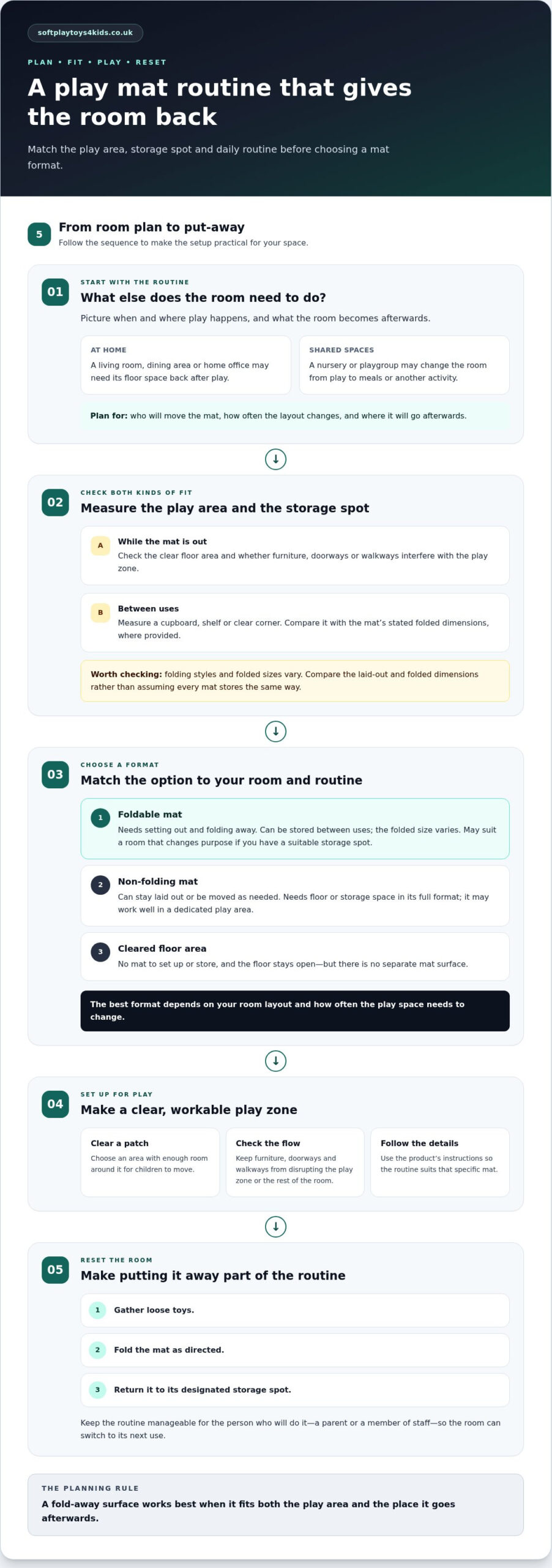
How to choose and organise a foldable soft play mat
Choose from the room outwards, not just from a product photo. The mat needs to fit the play area when it’s open and have a practical place to go afterwards. Consider who’ll use the space, how often the room needs to change and who will put the mat away. Then compare the product details that matter to that routine.
A room-first checklist for parents and caregivers
Start with these steps before comparing foldable soft play mats:
- Measure the play area. Check how much floor space you can set aside while leaving the rest of the room usable.
- Measure the storage spot. Compare its available space with the mat’s stated folded dimensions, where provided.
- Define how you’ll use it. A mat brought out occasionally should be easy to access and put away. One used daily should fit a routine you can maintain.
- Compare product information. Check the stated dimensions, surface details and care instructions for the specific mat.
Think about the whole household, too. A play zone in a living room may need to leave clear routes through the space and make way for other activities. Choose a layout that feels welcoming for play without making the room awkward to use afterwards.
Planning mats for nurseries and playgroups
In a shared setting, the mat is part of a wider room plan. Consider where it fits alongside other activities, how the space is shared and how staff will move or store it as the day changes. A routine that works at home may not suit a group room, so base the decision on the organisation’s actual layout and use.
Include the setting’s cleaning, storage and supervision routines in the decision. Follow the mat’s use and care instructions, and rely on product-specific details rather than assumptions about its surface or construction. This helps set clear expectations for the people setting up and putting away the play area.
Measure, plan, define, compare. That short sequence keeps the focus on the space and routine before you assess the mat. Explore soft play mats for your play space as you consider options for home or group use.
Find soft play mats that fit your playroom and routine
The right mat is one that works with your room, storage options and everyday routine. Before choosing, consider how much floor space you can set aside, where the mat will go between play sessions and how often the layout needs to change. If you’re comparing foldable soft play mats, look at the folding details and dimensions for each product rather than assuming every design folds or stores in the same way.
What to look for in a soft play mat range
Start with the product details that matter to the way you’ll use the mat. Check its stated size against the play area, then review the surface, construction and care information for that specific product. If foldability matters, look for details on how the mat folds and its folded dimensions. Avoid relying on general assumptions about materials or cleaning suitability. Follow the instructions for the mat you choose.
SoftplayToys4kids is a UK manufacturer and supplier of soft play products, including soft play mats, made in West Yorkshire. Its customers include families as well as schools, nurseries and playgroups. Those settings have different needs: a mat for a family living room may need to suit a different layout and routine from one used in a shared group space.
Making the play space work for children and adults
For a family, the priority may be a welcoming play zone that can be put away to make room for meals or everyday living. A nursery or playgroup may need to plan around shared activities, staff routines and the way the room is used throughout the day. In either setting, consider who will set up, use and store the mat, and make the play area practical for everyone sharing the space.
Planning helps balance children’s play with the needs of the room. Match the mat format to the available floor area, identify a realistic storage spot and use product-specific information to guide your choice. The goal isn’t to fill every corner with play equipment. It’s to create a cheerful, child-friendly space that fits into the day and can be tidied away when needed.
Ready to explore options for your space? Explore soft play mats from SoftplayToys4kids and compare the product details with your playroom or group setting.
Make room for play, your way
The right play mat should suit the space you have and the way you use it. Foldable soft play mats can make it easier to switch between playtime and everyday life, but compare the mat’s dimensions, folding details and storage needs before choosing. A simple set-up and put-away routine can help keep a shared room welcoming without letting play equipment take over.
SoftplayToys4kids is a UK manufacturer and supplier based in West Yorkshire, providing soft play products for families, schools, nurseries and playgroups. Whether you’re organising a play corner at home or planning a shared space, choose a mat that fits your layout and routine.
Explore soft play mats and take the next step towards a play area that works for children and adults alike. With a little planning, you can make room for joyful play and still enjoy a room that feels easy to live in.
Frequently Asked Questions
Are foldable soft play mats suitable for everyday use?
They can suit everyday use when the mat’s stated features and care instructions fit your routine. Consider how often you’ll set it out, who will fold and store it, and whether its dimensions suit your play area and storage spot. Follow the product’s use and care guidance, and check the mat before play so it remains in suitable condition.
Do foldable play mats save more space than non-folding mats?
Not necessarily. A foldable mat can be put away between play sessions, but its storage footprint depends on its design and folded dimensions. A non-folding mat may suit a dedicated play area where it can stay in place, while a clear floor needs no mat storage at all. Compare the open and stored footprint with the space you have available.
How do I choose the right size foldable soft play mat?
Measure the floor area where the mat will be used, allowing room for children to move and for the rest of the household to use the space. Then measure the cupboard, shelf or corner where you plan to store it. Compare both measurements with the product’s stated open and folded dimensions, where provided. Choose a size that fits your layout and put-away routine.
Can foldable soft play mats be used in a nursery or playgroup?
They may suit a nursery or playgroup if the mat fits the room layout and the organisation’s routines. Consider how the play area shares space with other activities, who will set up and store the mat, and how it fits the setting’s cleaning and supervision practices. Check the product’s specific use and care information, and assess it in the context of the group using it.
How should I clean a foldable soft play mat?
Follow the cleaning and care instructions supplied for the specific mat. Surfaces and materials can differ, so don’t assume a method suitable for one product will work for another. Check the instructions before using cleaning products or applying moisture, and pay attention to any guidance for folds or joins. Use the method specified for the mat rather than relying on a general cleaning tip.
What should I check before buying a foldable soft play mat?
Check the mat’s open dimensions against your play area and its folded dimensions against your storage space. Review the product-specific information about folding, surface, thickness, materials and cleaning suitability, where provided. Also consider who will use and put away the mat, and how often the room needs to change purpose. These checks help you compare options with your actual space and routine.
Are foldable soft play mats the same as baby play mats?
Not always. “Foldable” describes a mat’s handling or storage format, while “baby play mat” describes how a product is presented or intended for use. The categories can overlap, but names alone don’t tell you a mat’s dimensions, surface, construction or care requirements. Read the product details and use guidance to decide whether a particular mat suits the child, play area and routine.
Leave a Reply