A Baby Sensory Toys List for Active Little Ones
A good baby sensory toys list should do more than fill a basket with bright plastic. Babies learn through touch, movement, sound and sight, but they also need room to roll, reach, crawl and test what their body can do. The best choices are safe, easy to clean and interesting enough to return to every day.
For parents, that may mean building a compact indoor play area that grows with your child. For nurseries, playgroups and early years settings, it means choosing hard-wearing equipment that can handle repeated use while giving babies varied, age-appropriate experiences. Here are the sensory play essentials worth considering.
Baby Sensory Toys List: 12 Playtime Essentials
1. Soft play mats
A padded play mat is the foundation of comfortable floor play. Before a baby can sit or crawl confidently, they need safe space for tummy time, rolling and reaching. A wipe-clean mat also gives parents and practitioners a practical base for toys, mirrors and sensory activities.
Choose a size that suits the room rather than trying to fill every inch of floor space. A small mat can be ideal in a living room, while a larger cushioned area gives nurseries more flexibility for group play. Firm, supportive padding matters more than novelty prints.
2. Baby-safe mirrors
Babies are fascinated by faces, including their own. A shatter-resistant mirror placed at floor level can encourage head lifting during tummy time and invite early social play. They may not understand that the reflection is themselves, but the movement, expression and eye contact hold their attention.
Look for mirrors designed specifically for children’s environments, with secure edges and a stable fitting. Never use a household mirror in a baby play zone.
3. Textured sensory balls
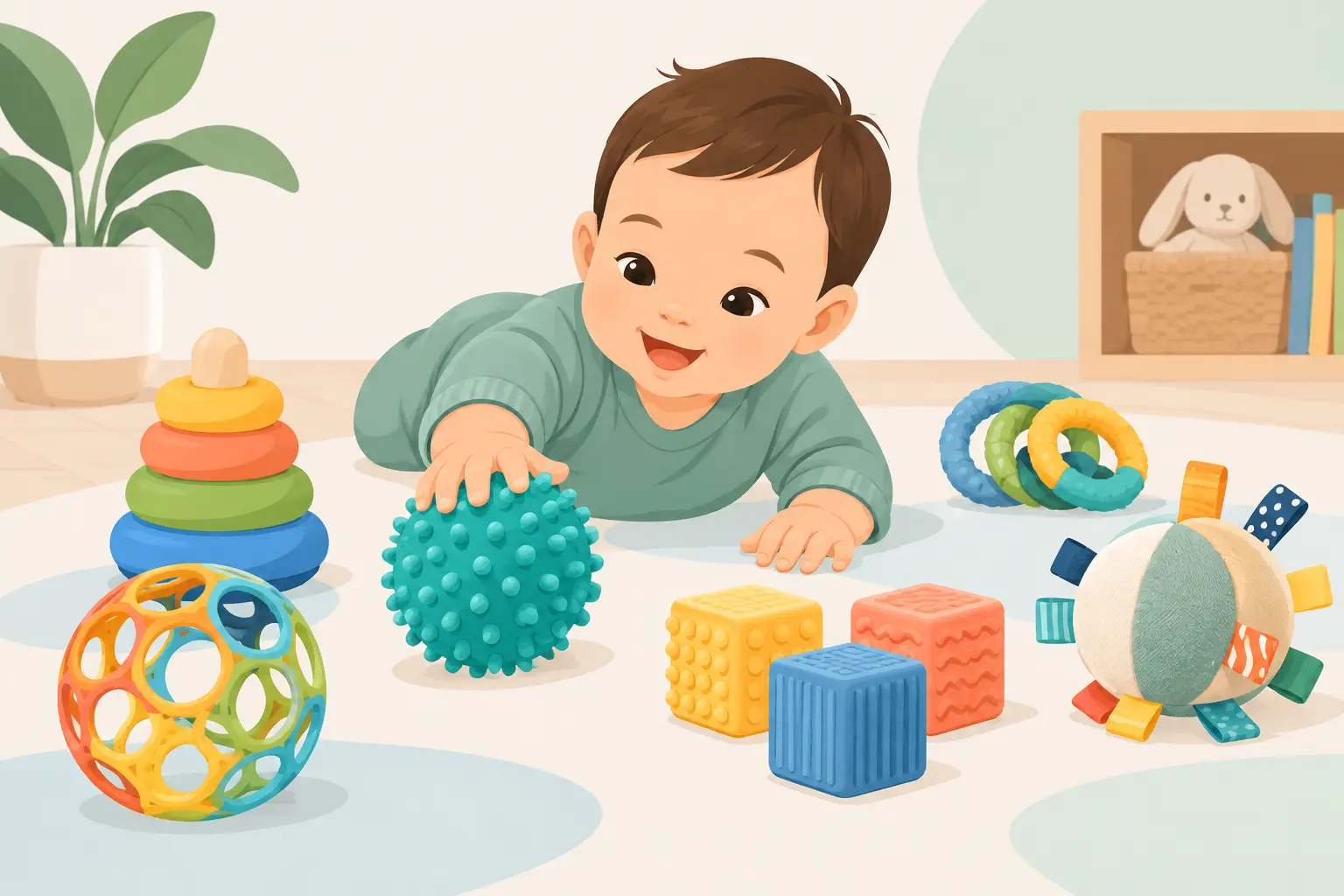
Soft balls with ridges, bobbles, smooth panels or varied fabrics offer an easy way to introduce different tactile sensations. They are simple, affordable and useful from early reaching stages through to rolling, throwing and chasing games later on.
For babies, larger lightweight balls are generally easier to grasp and less frustrating than tiny items. In a nursery setting, keep a small rotation of textures rather than putting out dozens at once. Too much choice can become background clutter.
4. Crinkle cloth books and fabric squares
The sound of a crinkly fabric page can be surprisingly rewarding for a young baby. Cloth books, soft activity squares and fabric tags give little hands something to scrunch, pull and explore without hard edges.
These are best used alongside conversation. Name the colours, copy the sounds your baby makes and describe what they are touching. The toy starts the interaction, but the adult response is where much of the value sits.
5. Soft blocks and foam shapes
Foam blocks bring movement into sensory play. Babies can lean against them, crawl over low pieces, knock down simple towers and explore differences in shape and size. As they become toddlers, the same equipment can support imaginative construction and more active climbing play.
This is where quality pays off. Soft play shapes should be strong enough to hold their form, covered in durable wipe-clean material and made with child-safe use in mind. For homes with limited room, a few versatile shapes often offer better value than a large set of single-purpose toys.
6. Ball pits
A ball pit offers visual stimulation, touch, movement and plenty of cause-and-effect play in one compact setup. Babies enjoy feeling the balls move around them, while older children practise scooping, posting, hiding and throwing.
The trade-off is maintenance. Balls need regular cleaning, and babies must always be supervised closely. Choose an appropriately shallow setup for the age group and avoid treating a ball pit as a hands-off activity. It is a brilliant addition to a sensory area when managed properly.
7. Rattles and gentle sound makers
Sound toys help babies notice that their actions can create a response. A rattle shaken in a hand, a soft bell rolled across a mat or a fabric toy that squeaks when pressed can encourage reaching and repetition.
Keep noise levels sensible. The loudest toy is rarely the best toy, especially in a busy early years room. Gentle, predictable sounds are more pleasant for babies and far easier on everyone else nearby.
8. Sensory bottles
Securely sealed sensory bottles filled with safe materials can provide a calming visual focus. Glitter, coloured liquid or lightweight shapes move slowly as the bottle turns, giving babies something to track with their eyes.
Only use bottles that are professionally made for the purpose or carefully constructed and checked regularly. The lid must be completely secure, the bottle should be sturdy, and the contents must not present a hazard if it is dropped. For commercial settings, purpose-made options are the straightforward choice.
9. Scarves and lightweight ribbons
Soft scarves can support peekaboo, waving, hiding games and early grasping. The movement of fabric through the air catches a baby’s eye, while different materials introduce gentle changes in texture.
Use these as a supervised activity, not as something left in a cot or unattended play space. Short, baby-safe fabric pieces are the sensible option, and loose ribbons should be avoided around very young children.
10. Crawl tunnels and low wedges
Sensory play is not only about what babies hold. It is also about how they move. A low foam wedge can encourage crawling and climbing, while a short soft tunnel adds a new visual and physical challenge once a baby is mobile.
Start low and simple. A baby who is still learning to crawl does not need a complicated obstacle course. One wedge, a tunnel and a clear padded landing area can provide plenty of repeat play without overwhelming them.
11. High-contrast cards and simple images
Young babies often respond well to bold black-and-white patterns and clear, high-contrast images. These can be placed near a play mat during supervised floor time or held at a comfortable viewing distance for a short interaction.
There is no need to turn this into a lesson. Follow your baby’s gaze, move the card slowly and stop when their attention shifts. Sensory play works best when it follows the child’s pace.
12. Activity panels and cause-and-effect toys
As babies develop stronger hand control, they enjoy pressing, sliding, spinning and lifting. Activity panels and securely mounted cause-and-effect features offer repeatable challenges without creating loose-parts chaos.
For nurseries and commercial play spaces, fixed sensory features can be a smart long-term investment. They reduce tidying time, stand up to frequent use and can be positioned at child height as part of a wider soft play layout.
How to Choose Sensory Toys Without Overbuying
The best baby sensory toys are not necessarily the most colourful, expensive or heavily marketed. Start with your baby’s current stage. A newborn benefits from visual contrast, gentle sounds and comfortable tummy time. A sitting baby may enjoy grasping, banging and transferring objects between hands. A crawler needs safe reasons to move across the floor.
Think about the play space as well. In a small home, a quality play mat, mirror, textured balls and a few soft shapes can create a complete sensory corner. In a nursery, a mix of floor-based resources, washable soft play equipment and storage-friendly activity toys makes more sense than relying on lots of small items.
Rotation is another money-saving tactic. Put out a small selection, then swap in different items every few days. Toys feel fresher, children focus for longer and the room stays calmer. You do not need twenty sensory products in view for a baby to be engaged.
Safety Checks for Baby Sensory Play
Every item on a baby sensory toys list should earn its place through safe use, not just visual appeal. Check the recommended age range, inspect toys frequently for damage and remove anything with loose parts, split seams or exposed filling. Babies explore with their mouths, so small detachable components are never worth the risk.
Keep sensory play supervised, particularly around balls, fabrics, water-based activities and climbing equipment. Soft play should be placed on a stable, level surface with enough clear space around it. In shared settings, cleaning routines matter just as much as product choice, especially for frequently handled balls, blocks and mats.
For parents and professional buyers alike, it is worth choosing equipment from a supplier that understands real play environments. Durable covers, easy-clean surfaces, dependable foam and practical sizing make daily use easier than cheap products that quickly lose shape or become difficult to maintain.
A well-planned sensory area does not need to be huge to be effective. Give babies a safe base, a few interesting textures, something to look at and a reason to move. Build from there as their confidence grows, and choose equipment that is ready for the next stage rather than the next five minutes.