
UK Manufactured Foam Ball Pits for Soft Play Spaces
The best ball pit isn’t simply the biggest one that fits. When comparing UK manufactured foam ball pits, match the footprint and wall height to your available space, then consider the ball size and quantity, materials, and cushioning beneath and around the pit.
A welcoming play space matters, but so do comfort and fit. A pit suited to the room and the children using it can make play more enjoyable and work well for everyday use.
To choose a pit, consider its dimensions, ball size and quantity, materials, foam walls and base. Think about how those details fit your setting, whether it’s a home or a shared soft play space, before deciding.
Key Takeaways
- Choose pit dimensions around the available floor space, intended use and wall height, rather than simply opting for the largest size.
- Use the pit’s capacity and intended play experience to guide ball diameter and quantity, so the fill feels suitable without overwhelming the space.
- Consider how ball and cover materials suit the setting, and how foam walls and a base layer can support a comfortable play area.
- Compare the factors that shape a pit’s cost, including its dimensions, materials and included components, before deciding which option fits your space.
How manufacturers determine foam pit dimensions
Pit dimensions depend on the footprint, intended users and play setting. Start with the usable floor area and access around the pit, then consider its length, width and wall height. For UK manufactured foam ball pits, the goal is to fit the play area, not simply maximise size.
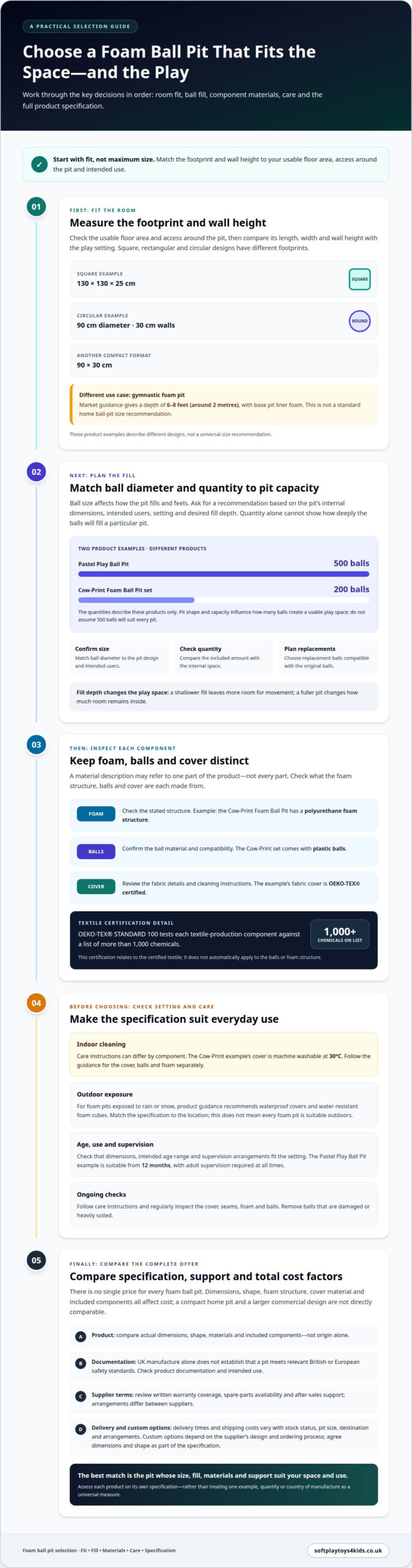
Product shapes can be square, rectangular or circular. For example, a square pit measures 130 x 130 x 25 cm, while a circular example has a 90 cm diameter and 30 cm walls. A 90 x 30 cm product shows another compact format. These dimensions describe different designs, not a universal size recommendation. A standard gymnastic foam pit is a different use case: the guidance in the market facts gives a depth of 6-8 feet, around 2 metres, with base pit liner foam.
Compare UK-manufactured and imported pits by their actual dimensions, materials and support, not origin alone. Where a pit is made doesn’t establish whether it suits your room or how it performs.
Warranty, spare parts and after-sales support depend on the supplier’s terms. Review the written coverage and support arrangements for the specific product, as warranty terms can differ between suppliers.
UK manufacture alone doesn’t establish whether a pit meets relevant British or European safety standards. Check the product documentation and intended use when assessing applicable standards.
Delivery times and shipping costs vary with stock status, pit size, destination and delivery arrangements. Custom-made options depend on the supplier’s design and ordering process, so agree on the dimensions and shape as part of the specification.
Follow the product’s care instructions for cleaning and maintenance, and regularly inspect the cover, seams, foam and balls. Use replacement balls compatible with the pit’s design, and remove any that are damaged or heavily soiled.
How suppliers recommend ball diameter and quantity
Ball diameter and quantity work together: the size affects how the pit fills and feels during play. Ask for a recommendation based on the pit’s internal dimensions, intended users and setting. Check both the ball size and quantity included, because quantity alone doesn’t show how deeply the balls will fill a particular pit.
Product examples show why quantities aren’t directly comparable. The Pastel Play Ball Pit includes 500 pastel pit balls, while the Cow-Print Foam Ball Pit set includes 200 plastic balls. These figures describe different products, not a universal fill level. The pit’s shape and capacity influence how many balls create a usable play space.
- Confirm the ball diameter: Match it to the pit design and intended users.
- Compare the included quantity: Consider it alongside the pit’s internal space.
- Plan replacement balls: Keep replacements compatible with the original balls.
For a practical recommendation, suppliers consider the pit’s internal length, width and wall height, plus the depth of fill wanted. A shallower fill leaves more room for movement; a fuller pit changes how much space remains inside. The right quantity depends on the design, so avoid assuming that 500 balls will suit every pit.
Are UK-made ball pits suitable for nurseries, schools, homes and sensory rooms? They can suit these settings when the pit’s dimensions, intended age range and supervision arrangements fit the space and use. For example, the Pastel Play Ball Pit is suitable from 12 months, with adult supervision required at all times.
For a sensory room, ball colour and tactile play can contribute to the experience, while a well-matched quantity keeps the pit usable. Pairing a ball pit with sensory play options can help shape a more engaging play area.
Choosing ball materials for a foam ball pit
Assess the balls, foam structure and cover as separate components. A product description may name a material for one part, not every part. For example, the Cow-Print Foam Ball Pit has a polyurethane foam structure and comes with plastic balls. Those details describe the structure and balls separately, helping you understand what the pit is made from.
For an indoor play space, consider how each material suits the setting and its cleaning routine. A fabric cover may have care instructions that differ from those for the balls or foam. The Cow-Print Foam Ball Pit’s cover is machine washable at 30°C, giving a specific example of why care guidance matters. Follow the instructions for each component rather than applying one cleaning method to the whole pit.
- Foam: Check the stated structure, such as polyurethane foam.
- Balls: Confirm their material and compatibility with the pit.
- Cover: Review its fabric details and cleaning instructions.
Fabric certification is another detail to interpret precisely. The Cow-Print Foam Ball Pit has an OEKO-TEX® certified fabric cover. According to OEKO-TEX, STANDARD 100 tests each textile-production component against a list of more than 1,000 chemicals. This relates to the certified textile, not automatically to the balls or foam structure, so keep the component distinction clear.
Outdoor exposure calls for different material considerations. For foam pits exposed to rain or snow, the product guidance recommends waterproof covers and water-resistant foam cubes. These choices suit those conditions, but don’t mean every foam pit is suitable outdoors. Match the cover and foam specification to the intended location, and follow the care instructions.
For a nursery or home, start with the intended setting, then compare the ball material, foam structure, cover fabric and cleaning instructions. Clear descriptions of each component help you choose a pit that fits your play space and routine.
How much do UK-manufactured foam ball pits cost?
There’s no single price for every foam ball pit. Cost depends on the specification, including dimensions, shape, foam structure, cover material and what’s included. A compact home pit and a larger commercial design use different amounts of material and components, so their prices aren’t directly comparable.
Separate features that affect the pit itself from optional additions. The price should clarify whether balls are included, along with the pit, cover and any base layer. Two similar-looking pits may differ in ball quantity or material, changing what the price covers.
For a useful comparison, review each specification in the same order:
- Dimensions and shape: Check the footprint and wall height.
- Materials: Note the foam structure, cover fabric and ball material.
- Included components: Confirm balls and any cushioning are part of the set.
Then match the specification to the play space. A school or nursery may need a different configuration from a home because the available floor area and intended use differ. A tailored design may also involve different materials or components. Compare like with like, rather than choosing by headline price alone.
Delivery contributes to the total purchase cost. Shipping charges can depend on the destination, product size and delivery arrangement. Check whether delivery is included in the displayed price or added separately, then compare the complete delivered cost for your UK purchase.
Choose the features that matter most, then use that specification to assess suitable options. Explore foam ball pit options for your play space and compare the product details that shape value.
SoftplayToys4kids
SoftplayToys4kids helps families and organisations choose soft play equipment to suit their space and intended use. If you’re weighing up pit dimensions, ball quantity or materials, consider how those decisions fit together before selecting a play setup. Sensory toys can also complement a soft play area, giving children more ways to explore and play.
Share the setting and your priorities, such as the available floor space and the kind of play experience you want. These details provide a practical starting point for choosing equipment for a home play area or a shared space.
Contact SoftplayToys4kids to discuss your soft play requirements.
Make your next play-space decision with confidence
Choosing UK manufactured foam ball pits helps shape a play area that feels welcoming and suits its users. Turn your priorities into a clear brief by describing the setting, available space and kind of play experience you want. This gives each product detail a purpose and makes it easier to compare options.
SoftplayToys4kids offers Soft Play Ball Pits, Soft Play Mats and Sensory Toys, helping you consider the wider play setup as well as the pit itself. Think about how children will move through the area and which elements would make it engaging for them. A well-planned space can bring active play and sensory exploration together in a way that suits your setting.
Ready to discuss your pit and the play space you have in mind? Contact SoftplayToys4kids and take the next step towards a play area children will love.
Frequently Asked Questions
Which UK manufacturers make foam ball pits?
SoftplayToys4kids is a UK-based manufacturer and supplier offering ball pits for home and commercial settings. Its products are handmade in the UK and manufactured in Bradford, West Yorkshire, England, United Kingdom. If you’re choosing a manufacturer, consider the pit’s intended setting and the product details that matter to you, such as its shape, dimensions and included components.
What types and sizes of foam ball pits are made in the UK?
UK-made options include round designs, baby ball pits and larger soft play pits. SoftplayToys4kids lists a “Ball pit for babies Multi Colours exclusive inner mat 5ft × 5ft” and a “Large ball pit 2 m × 2 m Soft play with 1000 balls mat”. A “Round Foam Ball Pit: Perfect Play for Your Child” is another listed type. These examples show the range of formats available.
Which UK manufacturers provide warranties, spare parts, and after-sales support?
Warranty, spare-parts and after-sales support depend on each supplier’s terms, so check the written coverage and support arrangements for the specific product. The Cow-Print Foam Ball Pit has a 2-year limited warranty against manufacturing defects.
What are the delivery times and shipping costs for foam ball pits in the UK?
Delivery times and shipping costs vary with stock status, product size, destination and delivery arrangements. UK delivery for most in-stock pieces is estimated at 4-10 working days; delivery for the Cow-Print Foam Ball Pit is free.
What materials and foam densities are used in UK-made ball pits?
Materials vary by component. One example uses a polyurethane foam structure, plastic balls and a fabric cover. For outdoor use exposed to rain or snow, the guidance recommends waterproof covers and water-resistant foam cubes.