

Custom Padded Post Wraps for Indoor Playgrounds
A post isn’t the only surface that may need padding in an indoor playground. Padded post wraps for indoor playgrounds can be planned around columns, walls, corners and fence posts, with colour, foam thickness, vinyl and shape chosen to suit the structure and play space. For awkward corners or posts close to a wall, a made-to-fit shape can provide a more practical fit than a simple wrap-around design.
Padding should feel reassuring while working with the look and layout of your venue. The right design depends on the surface, the area that needs covering and the finish you prefer. A bright colour can add a cheerful touch, while the pad’s shape and material help it sit neatly in place.
This guide explains what to consider when planning padded post wraps for indoor playgrounds, including colour, construction and shape. It also covers options for posts, columns, walls, corners and fence posts, and how to plan protection when a full wrap-around pad won’t fit.
Key Takeaways
- Choose colours that complement the play space while helping padded areas feel considered and cohesive.
- Match foam thickness and vinyl material to the surface being covered and the practical needs of the venue.
- For exposed posts and columns, accurate measurements help shape padding for a closer fit.
- Walls, corners and fence posts can call for bespoke shapes; SoftplayToys4kids’ Lamp Post Protectors are a relevant option for lamp posts.
Available colours
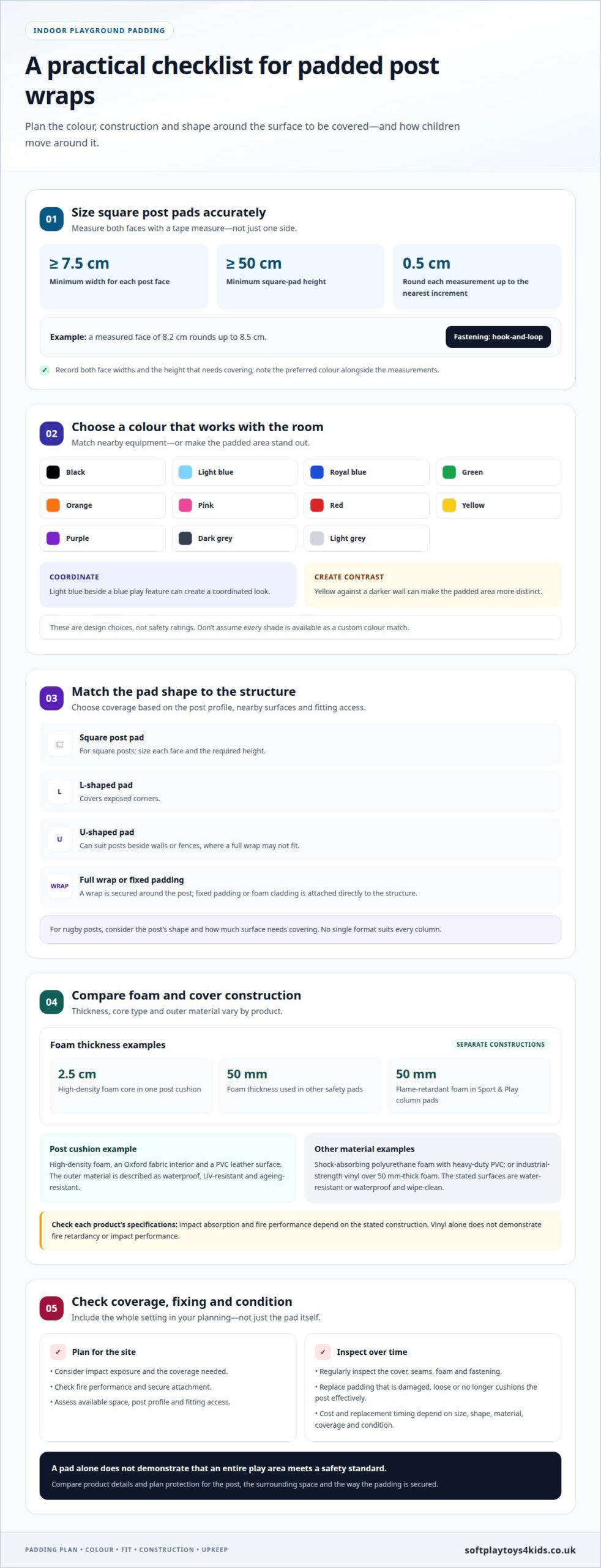
Colour affects how padding fits into a play area’s design. Square Post Pads are available in black, light blue, royal blue, green, orange, pink, red, yellow, purple, dark grey and light grey. These options can match existing equipment or create contrast around a post.
Start with the surrounding surfaces. Light blue beside a blue play feature can create a coordinated look, while yellow against a darker wall makes the padded area more distinct. Black and grey may suit neutral interiors; pink, orange or purple can add a brighter accent. These are design choices, not safety ratings.
For a custom colour scheme, map the colours already used across the room before choosing pad finishes. A simple palette can help: note the dominant floor colour, the largest nearby play feature and any colours used for wayfinding. Then choose a pad colour that either blends with those elements or stands apart. The available shades provide a starting point, but don’t assume every shade can be produced as a custom match.
Custom sizes need the same practical planning as colour. For a square post pad, measure both faces with a tape measure, rather than relying on one side. Each face must be at least 7.5 cm wide, and the pad must be at least 50 cm high. Round measurements up to the nearest 0.5 cm. For example, a measured face of 8.2 cm rounds up to 8.5 cm. These steps give a clear size specification while preserving the intended fit.
Record the post’s face widths and the height that needs covering, then note your preferred colour from the listed palette. Pairing measurements with a selected shade makes it easier to plan consistent padding for several posts, including posts with different dimensions.
Foam thickness and vinyl material
Foam thickness, core type and outer cover all affect a pad’s construction. Compare these details with the surface and impact exposure you need to address.
Foam thickness
The padded post wraps for indoor playgrounds come in different thicknesses, so compare the stated measurement rather than assuming all protectors cushion posts equally. One post cushion uses a 2.5 cm high-density foam core. Other safety pads use 50 mm-thick foam, creating a different construction. Sport & Play column pads use 50 mm-thick flame-retardant foam. These examples describe separate products, not one standard. Consider the post’s setting and required coverage alongside thickness.
Foam and cover construction
The core and cover have different roles. One post cushion combines high-density foam with an Oxford fabric interior and a PVC leather surface. Its outer material is described as waterproof, UV-resistant and ageing-resistant. Another design pairs shock-absorbing polyurethane foam with heavy-duty PVC. That surface is water-resistant and wipe-clean. A separate safety-pad design uses industrial-strength vinyl over 50 mm-thick foam. Its surface is also waterproof and wipe-clean. These details help compare materials and cleaning needs.
Fire retardancy and impact absorption
Impact absorption depends on the foam construction. Polyurethane foam is described as shock-absorbing, while other designs specify high-density foam. Sport & Play column pads use 50 mm-thick flame-retardant foam. That feature applies to this stated construction, not every vinyl-covered pad. For padded post wraps for indoor playgrounds, compare each product’s foam and cover details rather than treating vinyl as proof of fire retardancy or impact performance.
To explore padding materials for your play space, view foam and vinyl padding options.
Custom-made padding for exposed posts, columns and pillars
Exposed posts, columns and pillars may need different pad shapes and fixing methods. Measure the structure and consider how children move around it.
Wrap types and custom formats
Options include square post pads, full wraps and shaped pads for awkward structures. L-shaped pads cover exposed corners, while U-shaped pads suit posts beside walls or fences. For rugby posts, consider the post’s shape and how much surface needs covering. Fixed padding or foam cladding stays in place; a wrap is a separate cover secured around the post. The choice depends on access, shape and the required coverage.
Sizing square post pads
Square Post Pads need each face measured with a tape measure. Each face must be at least 7.5 cm wide, and the minimum pad height is 50 cm. Round measurements up to the nearest 0.5 cm when preparing the size. This gives the pad a defined fit around the post rather than relying on an approximate width. Hook-and-loop fastening is used to install these pads.
Wraps compared with fixed padding
Wraps can suit posts where a shaped cover is needed, while fixed padding or foam cladding describes padding attached directly to a structure. Compare the available space, post profile and access for fitting. No single format suits every column: a square post may take a square pad, while a wall-facing post may need a U-shaped design. These differences also affect the materials and fitting approach.
Safety standards and installation
For UK health and safety planning, consider impact exposure, pad coverage, fire performance and secure attachment. No pad alone demonstrates that an entire play area meets a safety standard. Square Post Pads use hook-and-loop fastening, which holds the pad around the post. UK suppliers include soft-play manufacturers and specialist safety-padding suppliers; product choice depends on the post and venue.
There is no single price or lifespan for every post wrap. Cost depends on its size, shape, material and coverage; replacement depends on its condition. Inspect the cover, seams, foam and fastening regularly. Replace padding that is damaged, loose or no longer cushions the post effectively.
Bespoke wall, corner and fence-post pads
A standard wrap may not fit when a post sits beside a wall or fence. L-shaped and U-shaped pads adapt coverage to the exposed sides, rather than assuming there is room to wrap every face.
An L-shaped pad covers two sides of an exposed corner, which can suit a projecting corner where children move close to both faces. A U-shaped pad is designed for a post where a wall or fence prevents full coverage. Its open side accommodates the obstruction, while the padded sides cover exposed areas.
Plan the shape around the structure, not just its name. For a post beside a wall, identify the exposed faces and where the wall blocks a wrap. At a fence post, account for the fence line and the direction children approach from. These details help distinguish an L-shaped corner pad from a U-shaped option.
Before specifying a pad, record the post profile and nearby obstacles. Note whether the post is square or another shape, which sides need padding, and where the wall or fence begins. Also consider nearby play equipment and the space children use to pass the post. These details help define the coverage and fastening position.
For example, a post set directly against a wall cannot take a full wrap on every face. A U-shaped pad can address that restricted layout; an exposed outside corner may suit an L-shaped, two-sided pad. Hook-and-loop fastening is used on Square Post Pads, while the pad’s shape determines how it fits around the structure. The practical takeaway: choose by exposed faces and obstructions first, then specify the pad format.
For a play area with exposed columns, explore column padding options as part of your protection plan.
SoftplayToys4kids: Lamp Post Protectors
SoftplayToys4kids offers Lamp Post Protectors for indoor play areas with exposed lamp posts. They’re a relevant option when a post sits beside a play route or activity space and needs protective padding. Consider the post’s position and shape alongside the surrounding layout, so the protection suits the area children use.
For other planning needs, Soft Play Mats can define comfortable play areas, while Sensory Toys add tactile and visual activities. These serve different purposes from post protection, so choose them according to the play experience you’re creating.
If an exposed lamp post needs padding in your indoor play space, contact SoftplayToys4kids to discuss Lamp Post Protectors.
Plan the next step for your play space
As your play space develops, think about how each piece of equipment supports the experience you want children to enjoy. The right place to begin is with your priorities: the areas that need attention, the activities you want to encourage and how new additions will sit within the existing layout. That broader view helps keep practical decisions connected to a welcoming, engaging environment.
For padded post wraps for indoor playgrounds, SoftplayToys4kids offers Lamp Post Protectors and column padding. Its wider range also includes Soft Play Ball Pits, Soft Play Mats and Sensory Toys, helping you plan complementary play features alongside padding.
Turn your priorities into a clear next step. Contact SoftplayToys4kids to discuss padding for your play space, and keep building a place where children can play with confidence and delight.
Frequently Asked Questions
What materials and thicknesses are used in indoor playground post padding?
Indoor post padding can combine high-density or polyurethane foam with a PVC-based cover. Examples include a post cushion with a 2.5 cm foam core and safety pads made with 50 mm-thick foam. Some constructions also use Oxford fabric inside the cover. Compare the foam type, thickness and outer material together, since each describes a different aspect of the pad’s construction.
How do you measure posts for custom-fitted padding?
For a square post, measure both faces with a tape measure and record the required pad height. Square Post Pad measurements are rounded up to the nearest 0.5 cm; each face needs a minimum width of 7.5 cm, and the minimum pad height is 50 cm. Also note nearby walls or fences, since these can affect the pad shape and coverage needed.
How do you clean and maintain padded post wraps?
Choose a wrap with a wipe-clean surface for routine upkeep. PVC covers on some safety pads can be wiped clean, which helps remove everyday marks without taking the pad off. Include the cover, seams and fastening in regular visual checks. If you see a tear, loose fastening or compressed foam, assess whether the pad still covers the post as intended.
Can padded post wraps be used outdoors or on different post shapes?
Some post protectors are described as suitable for indoor or outdoor use, but that doesn’t apply automatically to every design. Check the stated use and material properties for the specific pad. Different shapes are possible: square pads suit square posts, while L-shaped pads cover exposed corners and U-shaped pads fit where a wall or fence blocks a full wrap.
What do padded post wraps cost in the UK?
There is no single price for padded post wraps.
Which UK suppliers make padded post wraps for indoor play centres?
SoftplayToys4kids offers Lamp Post Protectors, and Post Protectors offers safety pads, including U-shaped and L-shaped options. UK suppliers also include soft-play manufacturers and specialist safety-padding suppliers.


