
Avoiding Common Playroom Hazards: A Practical Safety Checklist for 2026

Avoiding common playroom hazards starts with spotting small risks before play begins, not finding one “perfect” safety product. A safer playroom comes from repeatable checks: notice what children can reach, what could trip or topple, and what needs to change as they grow.
It can be hard to know where to start. Toys aren’t the only things to check: cords, furniture, small objects, cleaning products and slippery or cluttered floors can all affect how safely children play. A setup that suits a toddler may need a fresh look for an older child or one with different abilities.
This practical, room-by-room checklist will help you identify priority hazards and make manageable changes without taking the fun out of play. Check floors and storage, toys and small parts, furniture and cords, plus cleaning and supervision. Use it at home or in an early-years setting, then repeat the checks as children, activities and play spaces change.
Key Takeaways
- Make avoiding common playroom hazards part of a repeatable sweep of floors, furniture, toys, storage and supervision.
- Adapt checks to each child’s age, abilities and activity, and use product instructions alongside age guidance.
- Use before-play, during-play and end-of-day checks to catch changing risks and keep the room easier to supervise.
- Plan clear routes and practical play zones. Suitable mats or padding can be part of the layout, but they don’t replace supervision.
- Choose one practical change to make first, then build a routine that works for your home or early-years setting.
Avoiding common playroom hazards starts with a calm, practical check
A safer playroom doesn’t need to be perfectly padded or stripped of every challenge. The aim is to reduce preventable risks while leaving room for children to explore, move and play. A playroom hazard is any room feature, object or activity that could cause harm, from a slippery patch on the floor to a toy with a loose part.
Start with a calm walkthrough. Check the floor and routes through the room, then look over furniture, toys, storage and cords. Consider how play will be supervised, too. A safer setup combines a thoughtful layout, equipment suited to the children and activity, and attentive supervision. No single product replaces these layers.
Who should use this playroom safety checklist?
Parents and carers can use it at home, while staff can adapt it for nurseries, playgroups and schools. The room’s purpose matters: a space used for climbing or energetic group play needs different checks from a quiet area for books and sensory toys. Children’s ages, mobility, reach and individual abilities also affect which risks need attention first.
Use the checklist as a starting point, then tailor it to the children in the room. A toy or storage arrangement that works for one group may create a hazard for another.
How to prioritise hazards without creating unnecessary worry
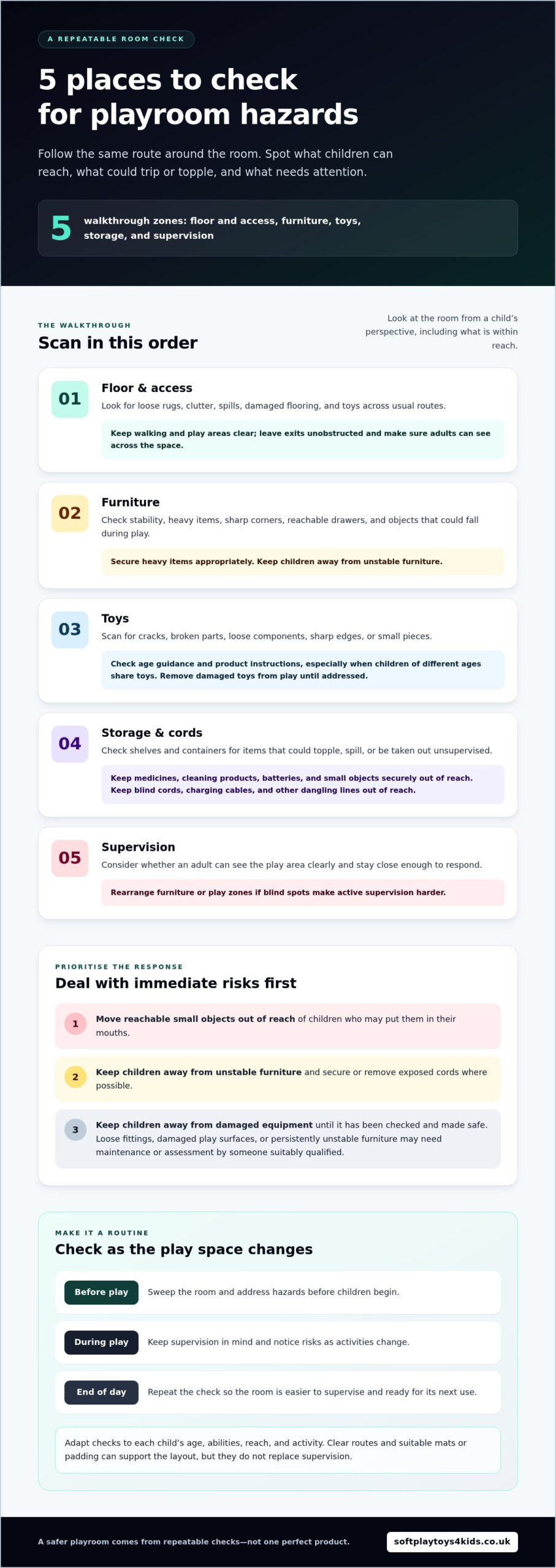
Address immediate risks first. Move accessible small objects out of reach of children who may put them in their mouths, keep children away from unstable furniture, and secure or remove exposed cords where possible. These steps can often be taken straight away.
Other concerns may need more than a quick tidy. A loose fitting, damaged play surface or piece of furniture that remains unstable after repositioning may need maintenance or assessment by someone suitably qualified. Keep children away from equipment that appears damaged until it has been checked and made safe.
Read product instructions for intended use, age guidance, assembly and care. For broader context on toy hazards and standards across different countries, see this overview of international toy safety standards. Use it as background, not a substitute for current UK guidance or product instructions. With a clear priority order, avoiding common playroom hazards becomes a manageable routine, not a reason to worry about every moment of play.
Which playroom hazards should you look for on every walkthrough?
Follow the same route around the room each time so familiar corners don’t get missed. Start at floor level, then inspect furniture, toys and storage children can access. Pay particular attention to reachable small objects, unstable furniture, dangling cords, and anything that could cause a slip or trip.
- Floor and access: Look for loose rugs, clutter, spills, damaged flooring and toys across children’s usual routes. Keep walking and play areas clear, make sure adults can see across the space, and leave exits unobstructed.
- Furniture: Check that furniture feels stable and that heavy items are secured appropriately. Look for sharp corners, drawers a child can reach or pull open, and objects that could fall during play.
- Toys: Scan for cracks, broken parts, loose components and damage that could expose sharp edges or small pieces. Check age guidance and instructions, especially when children of different ages share toys.
- Storage: Keep medicines, cleaning products, batteries and small objects securely out of children’s reach. Check shelves and containers for items that could topple, spill or be taken out unsupervised.
- Supervision: Consider whether an adult can see the play area clearly and stay close enough to respond. Rearrange furniture or play zones if blind spots make active supervision harder.
Floors, furniture and room layout
Pay particular attention to routes children use repeatedly, such as the path between the door, toys and seating. A mat or rug that shifts underfoot can create a trip risk, while clutter can make a fall more likely. Soft play mats or suitable padding may be part of the layout for active play, but they don’t replace clear routes, appropriate equipment or supervision.
Check corners and heavy items from a child’s perspective. Can a child pull on a drawer, climb onto a low shelf or reach something perched above them? Keep exits clear and arrange furniture so adults can see across the space.
Toys, cords and storage
Small-object risks depend on a child’s age, development and behaviour. An item that’s manageable for an older child may be unsafe for a younger one who explores by mouthing objects. Don’t rely on a universal size rule: follow current age-specific guidance and the toy’s instructions. Keep blind cords, charging cables and other dangling lines out of reach, and remove unsafe or damaged toys from play until they have been addressed.
A consistent sweep makes avoiding common playroom hazards easier. In active areas, thoughtfully chosen soft play mats and safety padding can form part of the room’s layout, alongside everyday checks and supervision.
How do playroom risks change with age, activity and equipment?
A room that suits a crawling baby may need a fresh safety check once the child starts pulling up, climbing and reaching. Children’s abilities affect what they can access, while the activity affects the space and supervision they need. Use this comparison as a prompt, not a substitute for individual judgement.
| Child or play stage | What to consider | Supervision and layout |
|---|---|---|
| Infant | Mouthing, rolling and early movement can bring small objects and nearby items within reach. | Keep the immediate play area clear, use equipment only as instructed, and stay close and attentive. |
| Mobile toddler | Crawling, walking, climbing and pulling up can make furniture, drawers and objects on low surfaces accessible. | Recheck the whole room from the child’s viewpoint. Keep routes clear and supervise active exploration closely. |
| Older child | More independent play, energetic movement and shared activities can introduce new layout and interaction risks. | Set clear boundaries for the activity, keep sightlines open and adjust supervision to the children and equipment involved. |
Why the same room can present different risks as children grow
As children develop, they can reach and interact with more of the room. A child who once stayed on a play mat may soon reach a shelf, pull open a drawer or climb onto furniture. Mouthing can make small objects a concern, while active movement brings furniture stability and clear routes into sharper focus. Repeat your checks after a developmental change, a new toy or a room rearrangement. For age-specific advice, consult current NHS or recognised UK child-safety guidance and follow the product’s instructions.
Activity matters, too. Quiet play may call for a comfortable, uncluttered space where small pieces can be kept separate from younger children. Active movement needs room to play without collisions with furniture or blocked routes. Shared play calls for extra thought about differences in age, size and ability, and how children may use the same equipment.
Choosing and arranging soft play equipment thoughtfully
Soft play mats, ball pits and padding can help define a play area when they suit the children and activity. They don’t remove fall risks or replace adult supervision. Consider the equipment’s condition and stability, where it sits in the room, nearby furniture and the maker’s instructions. Keep the layout visible and avoid creating hidden corners or obstacles in walking routes.
For more background, look for the related guides What is Soft Play? A Beginner’s Guide for Parents and the baby play mat guide. A thoughtful setup, regular checks and supervision work together. That’s the practical heart of avoiding common playroom hazards as children grow and play changes.
Use this playroom hazard checklist before play and during regular checks
A short, repeatable routine makes it easier to catch changes before they interrupt play. Adjust the checks to the room, children and equipment, and follow each item’s care and use instructions. If anything looks damaged or unstable, take it out of use until it can be assessed or repaired appropriately.
Before play
- Clear the floor: Remove small objects, loose clutter and anything that could trip a child. Clean up spills and make sure routes through the room are open.
- Check the play area: Look over toys, mats and soft play items for visible damage, loose parts or displacement. Check that equipment is set up and being used as its instructions describe.
- Secure restricted items: Make sure medicines, cleaning products, batteries and other unsuitable objects are stored out of children’s reach. Keep blind cords, charging cables and other dangling lines away from the play area.
- Plan supervision: Confirm who is supervising and whether they can see the children and respond. Think about the children’s ages, abilities and planned activity.
During play
- Keep routes clear as toys and equipment move around the room. Put misplaced items aside rather than leaving them underfoot.
- Pay attention to how children are using shared toys and equipment. Step in if play changes in a way that creates a risk or children need different levels of support.
- Recheck the area after a spill, a change of activity or any movement of furniture or soft play items.
At the end of the day
- Return toys and equipment to their storage places, keeping restricted items secure and small parts appropriately separated.
- Inspect items for damage and clean them according to the manufacturer’s instructions. Set aside anything that needs closer assessment. Don’t return it to play until it’s suitable for use.
- In nurseries, schools and playgroups, record recurring faults and follow the organisation’s procedures for reporting and addressing them.
A simple playroom routine is: scan the space, secure hazards, supervise play and review anything that changes. Build checks into the start and end of play, with additional inspections as needed based on use and product instructions. If a serious injury or immediate danger occurs, seek appropriate emergency assistance and follow your setting’s procedures.
Organise an active play area with soft play mats and safety padding suited to your layout, alongside regular checks and active supervision.
Build a safer playroom with thoughtful layout, supervision and suitable soft play
A well-considered playroom isn’t built around one product or a single inspection. It combines a layout that suits the activities, equipment appropriate for the children, repeatable checks and attentive supervision. That balance gives children space to move and explore while helping adults respond as play changes.
When soft play mats and padding may suit the room
Consider the play surface and its surroundings together. For active play, think about whether soft play mats suit the area and whether nearby hard edges or columns need attention as part of the overall layout. Safety pads and column padding may be useful components in some spaces, but they don’t remove every fall risk or replace supervision.
Check that equipment is in good condition, positioned appropriately and used according to its instructions. Keep routes through the room clear and maintain sightlines, so adults can supervise without furniture or play equipment creating hidden areas. For broader equipment considerations, read The Ultimate Guide to Buying Soft Play Equipment.
A simple next-step plan for families and settings
Don’t try to redesign the whole room at once. Choose one zone to review first, such as the floor area where children play most. Check the routes, equipment, surrounding edges and visibility. Make straightforward changes, then apply the same process to the rest of the room.
At home, make the walkthrough part of the play routine and repeat it when children’s abilities, activities or room arrangements change. In a nursery, school or playgroup, assign responsibility for checks and follow established procedures for reporting faults, maintenance and cleaning. A clear routine helps everyone know what to look for and what to do when something needs attention.
Avoiding common playroom hazards is an ongoing practice, not a search for a risk-free room. Keep the checklist accessible, make one practical improvement at a time and choose equipment with the room’s layout and intended play in mind. Soft play mats and safety padding can be elements of a thoughtful play space.
Make your next playroom safety check count
A safer playroom doesn’t depend on one perfect product. Keep routes clear, adapt checks as children grow and activities change, and include supervision in the plan. A simple routine before play and during regular checks can help you spot issues early without taking the joy out of play.
Thoughtful layout matters, too. Soft play mats, safety pads and column padding may suit particular areas, but they work as part of a wider approach, not as a promise of risk-free play. For families, nurseries, schools and playgroups, avoiding common playroom hazards starts with practical choices that fit the space and the children using it.
SoftplayToys4kids is a UK-based manufacturer in West Yorkshire, making handmade soft play products. Larger commercial projects can include design and installation. Explore SoftplayToys4kids soft play mats, safety padding and ball pits to find products for your playroom layout.
Small, repeatable steps help make play spaces easier to manage. Start with one area today, then build from there.
Frequently Asked Questions
What are the most common hazards in a playroom?
Common playroom hazards include cluttered walkways, unstable furniture, accessible small objects, damaged toys, dangling cords and unsuitable storage. The risks that matter most depend on the children’s ages, abilities and activities. Walk through the room at a child’s level and notice what they can reach, pull, climb or put in their mouth. Check toys and equipment against their instructions, and use current, trusted UK safety guidance for age-specific advice.
How often should I check a playroom for hazards?
Make a brief visual check before play, especially after the room has been rearranged or used by a group. Inspect equipment condition and cleaning needs regularly, following the maker’s instructions. No single schedule suits every playroom, so consider how often and how actively the space is used. In nurseries, schools and playgroups, record recurring issues and follow the setting’s procedures for reporting and addressing them.
Can soft play equipment prevent injuries?
Soft play equipment can be part of a thoughtfully arranged play area, but it can’t remove every risk or replace active supervision. Choose items suited to the children and planned activities, check their condition, and follow the product instructions. Consider the whole room, including surrounding furniture, clear routes, access points and hazards beyond the soft surface. Keep checking as play and layouts change.
What happens if I find a damaged toy or play mat?
Remove a damaged toy or play mat from children’s access while you assess the issue. Follow the maker’s care or repair instructions, and don’t assume a quick fix is suitable for that product. In a nursery, school or playgroup, record the fault and follow the setting’s procedures. Return the item to use only when it has been appropriately assessed or repaired and is suitable for play.
How do I make a playroom safer for a crawling baby?
Get down to your baby’s level and check for small objects, loose toy parts, cords, accessible storage and obstacles in the play area. Secure restricted items out of reach and choose equipment suited to the baby’s age and abilities. Stay close and supervise play. Recheck the room as your child becomes more mobile, and follow product instructions and current trusted UK guidance for age-specific advice.
Are playroom safety checks different for a nursery or playgroup?
The basic hazards are similar, but shared settings also need consistent routines, clear responsibility for checks and procedures for reporting damage or incidents. Consider how different children use the room and whether its layout and equipment suit those activities. A home checklist can be a useful starting point, but staff should also follow the organisation’s policies and relevant current UK guidance for the setting.
How can I reduce choking hazards in a playroom?
Keep small objects and loose toy components away from children who may mouth them, and check toys for damage before play. Age guidance is useful, but children develop differently, so consider each child’s abilities and behaviour as well. Store batteries, coins and other small items securely out of reach. For specific age-related recommendations, follow current recognised safety guidance and the instructions supplied with toys and equipment.
Leave a Reply