
DFG for Play Equipment: UK Guide (2026)

Could a Disability Facilities Grant for play equipment help create a safer, more accessible place for your child to play? A DFG may support eligible home adaptations, such as improving access to a garden, but it isn’t a general voucher for buying play equipment. If you’re planning a play space, separating the adaptation question from the equipment purchase is a useful first step.
The key is to explain how your child’s disability affects access, safety or independence in and around the home. An occupational therapist’s assessment and your council’s decision help determine which adaptations may be considered. Procedures and support differ across the UK, so the right next step depends on where you live.
This guide explains what a DFG is intended to fund, where play equipment fits, and how to describe your child’s practical needs clearly. You’ll also learn what to expect from a local assessment and which other funding routes may be worth exploring if the equipment itself isn’t covered. That way, you can plan the play space with a clearer picture of what grant support may provide.
Key Takeaways
- Understand what the Disability Facilities Grant for play equipment may mean in practice, and why the home adaptation is central to an application.
- Learn what to explain about your child’s needs and how to follow your council’s assessment process.
- Compare DFGs, charitable grants and direct purchase to identify a sensible route for the support you’re seeking.
- Use WellChild’s directory as a starting point for exploring charities, while remembering that each organisation sets its own criteria.
- Plan a play space around your available room, intended use and your child’s preferences once you’ve clarified the funding route.
What is a DFG and does it cover play equipment?
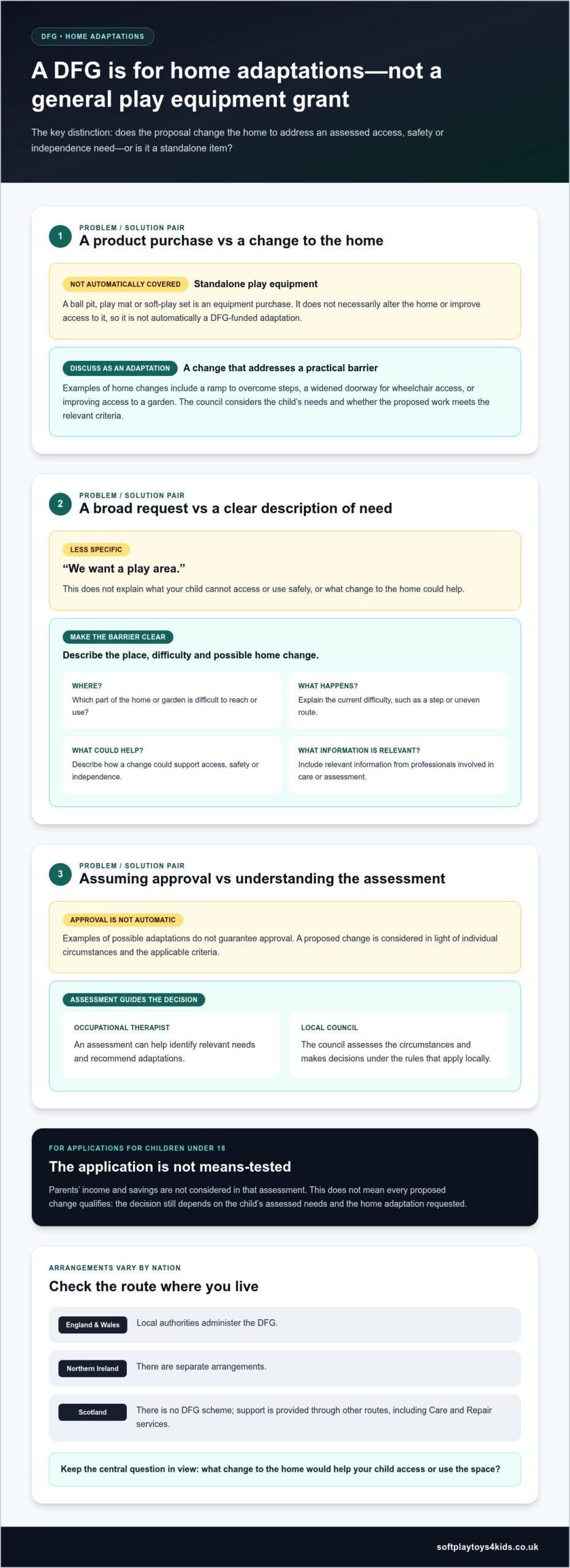
A Disabled Facilities Grant (DFG) helps pay for eligible adaptations to a disabled person’s home. It doesn’t automatically cover toys or play products. A home adaptation changes the property to address the disabled occupant’s assessed needs, for example by making an entrance accessible or helping them use rooms more safely and independently.
A DFG is funding for eligible changes to a home, not a general equipment grant for buying products. That distinction matters when you’re planning a play space. A portable item may be valuable to your family, but it isn’t necessarily a home adaptation under the grant scheme.
Focus on what the proposed work would change. Would it alter the home so your child can get in, move around or use an area more safely? Or is it an item that can be placed in a room without changing access to or use of the property? The council considers the disabled person’s needs and whether the proposed adaptation meets the relevant criteria. Local procedures and the rules where you live also matter.
What kinds of home changes does a DFG usually address?
Common examples include ramps to overcome steps, widened doorways to improve wheelchair access, and changes that make rooms easier to reach or use. Each addresses a practical issue, such as access, safety or independence at home. These examples don’t guarantee approval. The council assesses the individual circumstances and whether the proposed work is necessary and appropriate.
Outdoor access can be relevant too. GOV.UK includes improving access to a garden among the types of work a DFG may support. If your child can’t reach or use the garden safely, you could discuss an access change or suitable level area as part of the assessment. Describe the barrier and the adaptation needed to address it, rather than assuming a particular garden project will qualify.
Does play equipment count as a home adaptation?
A standalone ball pit, play mat or soft-play set isn’t automatically a DFG-funded adaptation. These are equipment purchases; they don’t necessarily alter the home or improve access to it. By contrast, a change to a doorway, route or garden area may be considered if it addresses an assessed access or safety need. Explain the barrier and the change you think could help when you discuss the proposal with your council.
For example, if your child can’t get from the house into the garden because of a step or uneven route, describe that specific difficulty. If you want to buy a play item for an existing space, treat it as a separate funding question rather than assuming the DFG will cover it. An occupational therapist’s assessment can help identify relevant needs and recommend adaptations; the council makes decisions under the rules that apply locally.
In England and Wales, local authorities administer the DFG. Northern Ireland has its own arrangements, while Scotland does not have the DFG scheme and provides support through other routes. So the most useful question isn’t simply, “Will the grant pay for play equipment?” It’s, “What change to our home would help my child access or use this space?” Starting with that question can make your conversation with the council more focused.
Who can apply for a DFG for a child’s needs?
A DFG application for a child focuses on the disabled child’s assessed needs and the changes required to their home. The decision isn’t based simply on the equipment a family hopes to buy. The council considers the circumstances, the proposed adaptation and whether it meets the relevant criteria. Parents or guardians can ask their local council how it handles applications made on behalf of a child, as forms and assessment steps can vary.
For a child under 18, the DFG application isn’t means-tested, so parents’ income and savings aren’t considered in that assessment. That doesn’t mean every proposed change will qualify: the decision still turns on the child’s needs and the home adaptation being requested. For current national information, use Official guidance on Disabled Facilities Grants alongside your council’s instructions.
What information may help explain a child’s needs?
Describe the barrier your child experiences at home and how it affects everyday activities. Rather than saying only that you want a play area, explain what your child can’t access or use safely, where the difficulty occurs, and what change you believe could help. These details give the council a clearer picture of the need behind your request.
It may help to note:
- Which part of the home or garden your child has difficulty reaching or using.
- What happens on the current route or during the activity, such as a step preventing access.
- How a proposed change could support access, safety or independence.
- Any relevant information from professionals involved in your child’s care or assessment.
Keep the description practical and centred on your child. Professional information may help explain the circumstances, but the council’s assessment determines what evidence and process apply.
How do rules differ across the UK?
DFG arrangements aren’t identical across the four nations. England and Wales operate DFG schemes, Northern Ireland has its own arrangements, and Scotland doesn’t have the DFG scheme. Support in Scotland is provided through other routes, including Care and Repair services. Eligibility details, financial assessment rules and application procedures can depend on the nation and the applicant’s circumstances.
Before relying on advice or starting an application, check the current guidance for your nation and ask your local council which process applies to a child in your situation. This is especially important if information you’ve found online refers to a different part of the UK. A rule, form or funding route used elsewhere may not apply locally.
Keep the grant question separate from choosing play products. If you’re planning a play space independently, you can explore handmade UK soft-play products as a separate purchase decision, without assuming they qualify for DFG funding.
DFG, charity grant or direct purchase: which route fits play equipment?
Start with the need you’re trying to meet. If a barrier in the home may require an adaptation, speak to the council about a DFG. If you’re looking for a piece of equipment, charitable funding or buying it separately may be more relevant. These routes have different purposes and decision-makers. The right fit depends on whether you need a home change or a product.
| Route | May suit | Who decides? |
|---|---|---|
| DFG | An eligible home adaptation connected to the disabled person’s assessed needs. | The relevant local authority, following its assessment and process. |
| Charitable grant | Equipment or other support covered by a charity’s current criteria. | The charity receiving the application. |
| Direct purchase | A product need that isn’t an eligible home adaptation or isn’t funded through another route. | The family decides whether and what to buy. |
This table explains the purpose of each route, not a promise that funding will be available. The Disability Facilities Grant for play equipment is best understood as a question about an eligible adaptation, not a general way to pay for play products. In Northern Ireland, application arrangements are set out in Disabled Facilities Grants in Northern Ireland. Elsewhere, use the guidance for your nation and council.
When might a charitable grant be worth exploring?
Some organisations support specialist equipment, but their priorities and eligibility rules differ. WellChild’s directory can be a starting point for finding organisations to research; it doesn’t guarantee that a particular family or item will qualify. Read each organisation’s current criteria and compare them with your child’s documented needs before applying.
An application may ask for supporting information, such as relevant professional input or a supplier quote. Requirements differ, so check what each organisation requests and whether it supports the kind of item you’re seeking. A clear description of your child’s needs can help you find a closer match than applying widely without reviewing the criteria.
When might buying soft play separately make sense?
If you want to add a product to an existing play space, direct purchase may be the straightforward route. Soft-play mats, ball pits and sensory toys are product choices, not automatically part of a DFG application. Before choosing, consider the space you have, how you plan to use it and your child’s preferences.
SoftplayToys4kids makes handmade soft-play products in Bradford, and you can customise product size and colour on order. Product planning remains separate from grant eligibility, so don’t assume an item will be funded. For more context as you weigh up product choices, use a guide to buying soft play equipment alongside your own space and needs.
How to ask your council about DFG eligibility for play-related changes
A clear enquiry starts with your child’s day-to-day experience, not the play product you hope to buy. The Disability Facilities Grant for play equipment isn’t an automatic route to funding a ball pit or mat. Instead, explain the home barrier, the change you think may address it, and how that change could support your child’s access, safety or independence. The council can then explain whether the proposal fits its current assessment process.
What should you prepare before making an enquiry?
Before contacting the council, write down what happens in everyday situations. Note where your child has difficulty moving around the home or reaching an outdoor area, and what makes that difficult. Describe the adaptation you have in mind and how it relates to that specific barrier. Relevant professional information can also help explain your child’s circumstances if the council requests it.
Keep the details practical: where the issue occurs, what your child is unable to do safely or independently, and what change you’re asking the council to consider. If your goal is a product for an existing space, say so. That helps distinguish an equipment enquiry from a request to change the home.
What should you ask the local authority?
Use this sequence to get a clear answer and understand what happens next:
- Describe the need. Explain the barrier your child faces at home and the adaptation you believe may help, without assuming a specific product is covered.
- Contact the council. Ask which scheme and assessment process currently applies in your nation and local area, and whether applications are being accepted.
- Follow the assessment steps. Find out what evidence is needed, whether an occupational therapist or other professional input is part of the process, and how household finances are treated in your circumstances.
- Review the decision. Ask for the outcome and reasons in writing, along with an explanation of any next steps available if the proposed work isn’t supported.
Check current requirements directly with the council rather than relying on an old grant listing or a process described for another area. Application status, evidence requirements and assessment arrangements can change. For a child under 18, current DFG guidance says the application isn’t means-tested, but you can still ask the council how that rule applies to your circumstances and nation.
This is practical guidance, not legal advice, and an enquiry can’t guarantee approval, funding or a particular timescale. If the council explains that your request is for a product rather than a home adaptation, consider that separately from the application. Once you’re planning a play space as a separate purchase, explore handmade soft-play options to help shape your product choices.
Planning a play space after your funding route is clear
Once you know which funding route you’re pursuing, treat the play space as a separate planning decision. A DFG assessment concerns eligible home adaptations, not automatic funding for play products. Keep any council application focused on the home change being considered, and make product choices separately, based on your family’s needs and budget.
Start with the space itself. Measure the area you have in mind and consider how your child is likely to use it, their age and preferences, and whether other family members will share the room. Having these details ready can help you compare product types without assuming that any item is suitable for every child or home.
What should families consider when choosing soft play?
Think about how different categories fit your intended use. A soft-play mat can cover a defined floor area, while a ball pit or sensory toy offers a different kind of play experience. Consider the space available, where items will sit and your child’s individual preferences. These are planning points, not medical or developmental recommendations.
SoftplayToys4kids is a Bradford-based maker of handmade soft-play products in the UK. Product size and colour can be customised on order, which may help you plan around the dimensions and look of your chosen space. For broader planning context, a beginner’s guide to soft play can help explain the product category and the choices involved.
How can a project move forward without confusing funding and shopping?
Keep the two conversations distinct. Ask the council about the home barrier, proposed adaptation, assessment and current application requirements. Separately, decide whether you want to purchase play equipment, what kind of item you’re considering, and how it will fit your room. Don’t describe a product purchase as an adaptation unless the council’s assessment identifies a relevant home change.
For larger soft-play projects, SoftplayToys4kids offers design support and installation. These services can help organise the product-planning side of a project, but they don’t determine grant eligibility or mean that products will receive public funding. If your plans change after speaking with the council, keep its advice about the adaptation separate from your purchasing decisions.
The phrase “Disability Facilities Grant for play equipment” can make the funding question sound like a simple yes or no. In practice, the grant route and the play-space decision serve different purposes. Taking them one at a time can make your next steps clearer, whether you’re discussing an adaptation or beginning to plan a separate play area.
If you’re ready to explore product options, browse handmade soft-play products and consider what could work for the space you have in mind.
Take the next step towards a play space that feels right
You don’t need to settle every detail at once. Start with a simple plan: note the space you have, what your child enjoys and the kind of play experience you hope to create. Keep that plan alongside, but separate from, any council conversation about adaptations. A Disability Facilities Grant for play equipment shouldn’t be treated as a shopping budget, so make product choices on their own merits and within your family’s plans.
As your ideas take shape, think about how the space may change as your child grows and which features matter most to them. A clear brief can make it easier to compare options and decide what belongs in your home.
SoftplayToys4kids offers handmade soft-play products, with design support and installation for larger projects. If you’re ready to explore possibilities, explore handmade soft-play equipment for your play space. Browse the range and plan a play area around the moments your family wants to enjoy.
Frequently Asked Questions
Can a Disabled Facilities Grant pay for a ball pit or soft-play mat?
Not automatically. A ball pit or mat is a product, so the Disability Facilities Grant for play equipment shouldn’t be treated as a guaranteed way to pay for it. If your child struggles to reach a play area because of a specific feature of the home, describe that barrier and the change you think could help. Ask the council how it would assess the proposed change before including grant funding in your plans.
Is a Disabled Facilities Grant available for children in the UK?
DFG arrangements exist in some UK nations, but they don’t operate identically across the country. Families in England, Wales and Northern Ireland should check their nation’s current guidance and local application process; Scotland doesn’t have the DFG scheme. A parent or guardian can ask the relevant council which application route and evidence it requires for a child. Don’t assume a form or financial rule used in another nation applies to your family.
What does a Disabled Facilities Grant usually cover?
A DFG may help fund eligible home changes rather than general household purchases. Depending on assessed needs, a proposal might involve changing an entrance or improving access between parts of the property. The council considers the particular work and circumstances, so an example isn’t a guarantee of approval. Before making plans, separate building or access work from items that can simply be bought and placed in a room.
How do I apply for a Disabled Facilities Grant?
Contact the council responsible for the home and ask for its current DFG process. Prepare a short description of the difficulty, where it happens and what change you’re asking the council to consider. Then follow its instructions about assessment and supporting information. If you find an online listing with an old closing date, don’t rely on it as proof that applications are closed; check the latest status with the council.
Can charities help pay for specialist play equipment?
Some charities consider applications for children’s equipment, but each organisation sets its own criteria and may support only particular needs or items. Use a directory such as WellChild’s to identify possible organisations, then compare your child’s circumstances with each charity’s current guidance. Some applications may ask for professional supporting information or a supplier quote. Treat an application as an enquiry, not a promise of funding or approval.
Does a DFG affect benefits?
GOV.UK states that receiving a Disabled Facilities Grant won’t affect benefits. That’s separate from any means assessment or contribution rules that may apply to an individual application. If you’re unsure how the guidance relates to your situation, check the current official information and raise your circumstances with the relevant council. Avoid relying on informal advice that doesn’t distinguish benefit entitlement from the council’s assessment of a grant application.
What if the council says play equipment is not covered?
Ask the council to clarify whether it has considered a product purchase, a home adaptation or both. If there’s a separate change to the property that addresses an assessed need, ask whether that proposal can be considered on its own. For a standalone item, explore charity criteria or consider a separate purchase. Different routes have different rules, so don’t assume another funder will approve the same item.
Leave a Reply