
Commercial grade alternatives to Chad Valley toys for learning

The familiar toy brand isn’t always the best fit for a busy play setting. A commercial grade alternative to Chad Valley toys could be soft play equipment selected for your space, children’s activities and learning goals. Compare products by purpose and practical value, not just by the name on the box.
It makes sense to look beyond price alone: children need play that captures their interest, while parents and organisations want options that feel appropriate for their setting. This article explores how alternatives can support sensory discovery and learning, what distinguishes soft play equipment from conventional toys, and which factors shape value for money over time. You’ll also see where specialist soft play and sensory equipment can fit, whether you’re planning a play area at home or for a nursery, school or playgroup.
Key Takeaways
- Compare toys by the play they support and the setting they’re designed for, not by brand name alone.
- Assess value for money by considering intended use, durability and ongoing replacement needs alongside the purchase price.
- Learn what to look for when comparing suppliers and brands serving UK nurseries, schools and play centres.
- Understand how to assess durability and safety for children’s play, and what standards and certifications are relevant in the UK.
- Explore how soft play ball pits, mats and sensory toys can support a dedicated play area.
Value for money
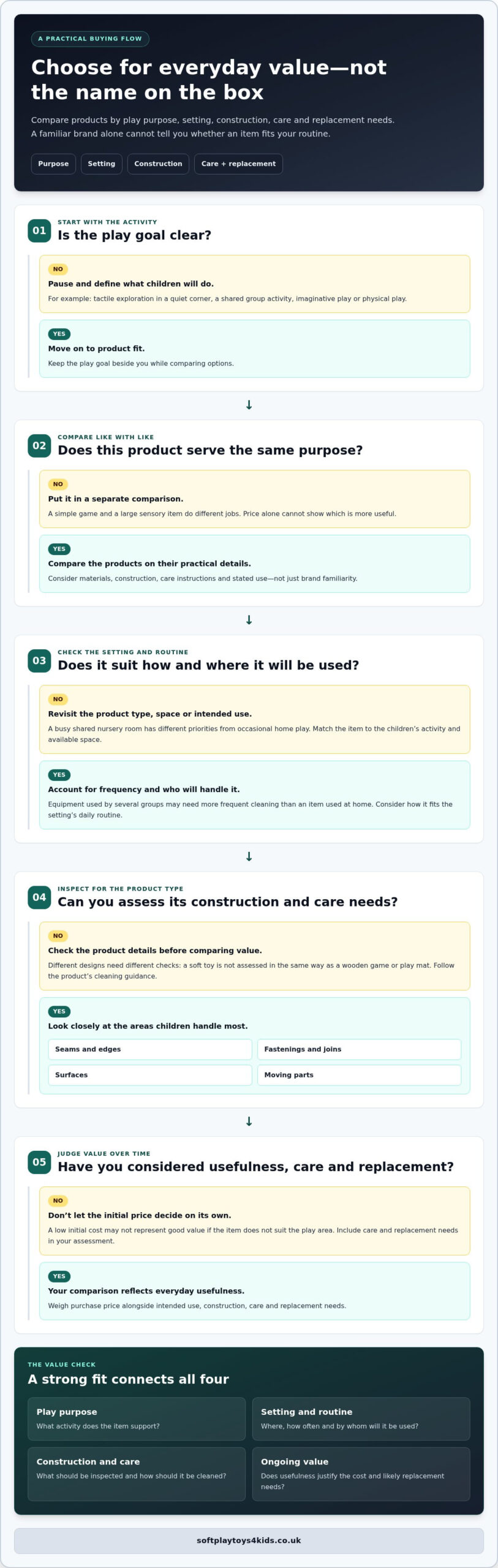
For frequent daily use, compare construction, intended play and care needs before choosing. Inspect seams, joins and surfaces, and follow the product’s cleaning guidance. Consider how each item fits your setting’s routine.
Assessing durability for daily use
Durability describes how well a toy withstands repeated handling and play. It matters because nursery or play-centre equipment may be used more often than a household toy. Inspect the areas children handle most, such as seams, edges, fastenings and moving parts. Check each product according to its design: a soft toy needs different checks from a wooden game or play mat.
Compare shortlisted products by material, construction, care instructions and stated use. Then consider your setting’s daily routine: an item handled by several groups may need more frequent cleaning than one used at home. For a commercial grade alternative to Chad Valley toys, value begins with suitability, not a broad durability label.
Evaluating purchase value
Purchase value balances usefulness, care and replacement needs. A low initial cost may not offer good value if the item doesn’t suit the play area. Compare like with like: a simple game and a large sensory item serve different purposes, so price alone can’t determine their usefulness.
Chad Valley’s history offers context, not a current price comparison. Johnson Brothers began making children’s games in Birmingham in 1860, while the Chad Valley name first appeared on toys around 1920. Those dates show a long toy-making heritage, but buyers still need to assess each item against today’s use.
Before comparing products, write down the play goal. A quiet corner might call for tactile exploration, while a shared activity area may benefit from equipment children can use together. Then compare the construction and care needs of products serving the same purpose. This keeps the decision focused on everyday usefulness.
- Match each item to the children’s activity and the space available.
- Compare similar materials and construction, rather than unrelated toy types.
- Consider how cleaning and routine handling fit your setting.
- Include replacement needs when judging long-term value.
Keep the comparison specific. A nursery choosing a toy for a busy shared room has different priorities from a family selecting a game for occasional home play. In either case, good value comes from a clear fit between purpose, construction and routine, not brand familiarity alone.
A historical price example can provide context, but it isn’t a current quote or a direct comparison between products with different purposes. Check what a price refers to, and don’t assume an old figure reflects value today.
When weighing options, consider how often the item will be used, whether it suits the intended play and what care it needs. Comparing similar products makes it easier to assess usefulness alongside cost, rather than letting one price decide the purchase.
What brands make commercial-grade toys for nurseries, schools and play centres in the UK?
Chad Valley is a familiar toy name, but the brand alone doesn’t show whether a particular item suits frequent use in a nursery or other organisation. Compare the product, its intended setting and the type of play. A table game has different demands from equipment for a shared play area.
Chad Valley’s history begins with Johnson Brothers, which started making children’s games in Birmingham in 1860. The Chad Valley name first appeared on toys around 1920. These names provide useful historical context, but they don’t establish how a current product will perform in a school or play centre.
Separate general toy ranges from specialist play equipment when comparing brands. A commercial buyer might need products for imaginative play, sensory exploration, group activities or physical play. These categories describe purpose, not guaranteed suitability for commercial use. Small games may suit classroom activities, while a shared play area may need a different format.
Chad Valley expanded its range over time. It bought Peacock and Company in 1931, adding tinplate toy cars and clockwork train sets after the acquisition. That history illustrates how a single brand can cover distinct kinds of play. Buyers should compare like with like: a toy car should be assessed against similar toys, not against equipment designed for another setting.
For a UK shortlist, note each maker beside the exact product type and intended use. Then compare construction, care instructions and suitability for the children who will use it. A brand may offer a suitable tabletop toy without offering the equipment needed for a sensory corner. The product category matters as much as the label.
- General toy brands: compare individual games, dolls or vehicles for their intended activity.
- Specialist play-equipment makers: compare equipment by play function and setting.
- Sensory-focused ranges: consider the tactile or exploratory activity each item supports.
This distinction helps avoid treating “commercial-grade” as a brand name. Check whether each product is designed for the activity your setting needs. A nursery planning an active shared area will assess products differently from a school choosing resources for quiet group play.
As a final step, compare product details rather than relying on brand recognition. Match the item to the activity, the available space and the everyday routine. If your setting is planning protective equipment around exposed posts, commercial play-area equipment can be part of that comparison.
Chad Valley is the only toy brand named here, but its name alone doesn’t establish that a product suits commercial use. The key distinction is between general toys and specialist play equipment, including sensory-focused products.
When finalising the layout for the play area, treat protective equipment as a separate purchasing decision. Woolworths revived the Chad Valley brand in 1987 and bought it in 1988. Woolworths developed the brand for twenty-one years before its demise in 2008.
Which UK suppliers offer durable commercial-grade toys similar to Chad Valley?
Start by separating supplier types, because “similar” can mean different things. Chad Valley is associated with familiar toys, while nurseries and play centres may need products for repeated group use. A UK buyer can compare general toy retailers, specialist educational suppliers and commercial play-equipment manufacturers. Each route serves a different purchasing need.
General toy retailers suit buyers seeking familiar play formats such as dolls, games or toy vehicles. Compare the particular item rather than assuming every product from one brand has the same construction or intended use. A tabletop game for supervised classroom play, for example, has different demands from equipment in an active play area.
Educational suppliers are another option for schools and nurseries. Their ranges may be organised around learning activities, including imaginative play, group tasks or sensory exploration. Check the product description for its intended age group, activity and setting. Compare those details with your daily routine, available storage and how staff will manage shared resources.
Commercial play-equipment manufacturers are more relevant when the requirement involves a dedicated play area. Their products may serve a different purpose from Chad Valley’s conventional toys, so compare by function rather than brand. A soft play item, for instance, isn’t a direct substitute for a toy car. It may, however, better match a brief centred on active or sensory play. For organisations exploring bespoke equipment or durable plastic parts, custom manufacturers such as centplasticmfg.com provide specialized injection molding services.
- General toy retailers: compare familiar toys by type and intended activity.
- Educational suppliers: look for resources supporting classroom or nursery play.
- Commercial equipment makers: compare products designed for shared play spaces.
Build your shortlist around the exact play need. If a school wants group games, compare games with games. If a play centre needs equipment for an active zone, compare products with the same function. This makes construction, care instructions and suitability easier to assess without relying on a broad “commercial-grade” label.
Next, review each UK supplier’s product information. Note the item type, intended use, materials, cleaning guidance and any stated usage limits. Apply the same checks to every option. A consistent comparison can distinguish a familiar household toy from equipment designed for a shared setting, while keeping the focus on children’s play.
No single supplier route suits every nursery, school or play centre. Your shortlist depends on whether you need a recognisable toy, a learning resource or equipment for a dedicated play area. Match the supplier’s product category to your purpose first, then compare individual products for fit and practical care.
The supplier types to compare are general toy retailers, specialist educational suppliers and commercial play-equipment manufacturers. Assess their products by play function, intended setting, construction and care guidance rather than assuming they’re interchangeable with Chad Valley toys.
How do commercial-grade toys compare with Chad Valley toys in durability and safety?
Compare the specific product, not just the brand label. Chad Valley offers familiar toy types, while commercial-grade products may be designed for shared settings. A classroom board game and a soft play item differ in construction and use. Neither category is automatically more durable or safer. The useful question is how well each item suits its intended activity.
To assess durability, inspect the parts that face regular handling. Check seams on fabric toys, joins on wooden resources and moving parts on toy vehicles. Read the cleaning, storage and use instructions. A classroom game kept in a box wears differently from toys children carry between play areas, so match your checks to the product’s design.
Safety depends on the product and how it’s used. Read its age guidance, warnings and care instructions. Check for small components in games intended for younger children and loose fastenings on frequently handled toys. In shared play settings, consider whether staff can inspect items easily. A regular check helps identify visible damage before an item is used again.
- Construction: inspect seams, joins, edges and moving parts.
- Use: match the product’s intended activity to the setting.
- Care: follow the product’s cleaning and storage guidance.
- Condition: remove damaged items from play and assess them.
“Commercial-grade” shouldn’t be taken as a promise of greater safety or a longer life. It describes a market category, not the performance of every product. A Chad Valley toy may suit a particular supervised activity, while specialist equipment may better fit a shared play area. Compare stated use and construction side by side for a fairer assessment of durability.
For a playroom with exposed posts or hard edges, assess the surrounding environment too. Padding can help protect against contact with those surfaces, but it doesn’t replace suitable toys or supervision. Consider the layout, children’s activities and areas needing protection. This is a different safety decision from comparing a toy’s materials or construction.
Before choosing a commercial grade alternative to Chad Valley toys, write down the activity and who will use the item. Then compare shortlisted products on intended use, construction, care guidance and visible condition. For example, compare two toys designed for imaginative play rather than a toy car with protective padding. This keeps assessments of durability and safety specific and useful.
What safety standards and certifications should commercial-grade toys meet in the UK
There isn’t one standard for every play product. A soft play item, wooden puzzle and electronic toy have different designs and risks. For a UK purchase, match the safety information to the product category, intended age group and activity. Don’t treat “commercial-grade” as a safety certification.
Start with the product’s instructions, warnings and supporting documents. Look for any named standard or certification, then check which product it covers. Documentation for one toy doesn’t automatically apply to every item in a range. For example, a certificate for a wooden activity board shouldn’t be assumed to cover a separate fabric toy.
Read the age guidance alongside the product’s design. Small pieces, cords, accessible seams and moving parts can matter differently from one product to another. A toy for supervised tabletop play is used differently from equipment in a shared play zone. Check that the information matches the children and activity in your setting.
Review three things separately: the product’s stated standard, the evidence for that claim, and how the item will be used. A label alone may not explain its scope. Instructions and technical documents can clarify which model they cover, its intended use and any limits stated by the maker.
- Product identity: match documents to the exact item or model.
- Scope: check the named standard relates to that product category.
- Intended use: compare age guidance and warnings with your activity.
- Care: follow instructions for cleaning, storage and inspection.
For a nursery choosing sensory resources, check whether the documentation covers the materials and activity. For a school selecting a game, consider small components and the stated supervision needs. For a play centre, review equipment documents alongside how the space will be used. One general claim of safety can’t replace product-specific information.
Keep a record of the item name, its instructions and the documents you reviewed. If the product changes, review the information again. During routine checks, look for wear that could affect safe use, such as loose parts or damaged surfaces. Follow the maker’s care guidance and remove damaged items from play.
Safety also involves the surrounding space. Exposed posts or hard edges present different considerations from toy construction. Explore safety pads for play areas as one way to consider those surfaces alongside product-specific safety information.
No single standard applies to every toy. Check that any stated standard or certification fits the product category, intended age group and use. Match supporting documents to the exact item or model, and review its instructions, warnings and stated limits.
SoftplayToys4kids: Soft Play Ball Pits
SoftplayToys4kids can help you create a play space focused on sensory discovery rather than conventional toys alone. Its Sensory Toys suit settings looking to add tactile play, while Lamp Post Protectors address exposed posts in play areas. These options serve different needs: choose sensory resources for exploration, or protective padding when the layout includes posts.
For nurseries, schools and play centres, consider how each item fits the room, the activity and children’s routines. This specialist equipment can complement familiar toys, not replace every game or learning resource. Explore SoftplayToys4kids when planning a sensory area or considering protection around posts.
Visit softplaytoys4kids.co.uk to learn more.
Shape a Play Space Around the Way Children Learn
Your next step is to define what the play area should invite children to do. Is the priority active play, a softer floor space, or sensory exploration? A clear purpose helps you choose equipment that complements existing toys and fits the setting’s everyday routine. A commercial grade alternative to Chad Valley toys may be most useful when it answers a specific need, rather than simply adding more products to the room.
SoftplayToys4kids offers Soft Play Ball Pits, Soft Play Mats and Sensory Toys for play spaces with different needs. Consider which category best supports the children’s activities and the atmosphere you want to create. A thoughtful choice can make the space feel more engaging and purposeful.
Ready to explore options for your setting? Contact SoftplayToys4kids today and take the next step towards a play area children can enjoy.
Leave a Reply