
Padded Floor Mats for Nurseries and Children’s Play Areas

The best padded floor mats for nurseries depend on how the space will be used: 13 mm EVA foam mats suit light indoor play, while 20 mm mats provide extra cushioning for more active indoor play. Their puzzle-style edges connect to form a play surface and can be fitted without specialist tools. Choosing the right thickness is only part of the decision.
A nursery floor, a busy school play corner and a sensory room each have different needs. Choose padded floor mats for nurseries that fit the available space, suit planned activities and are practical to clean. Colour and pack size matter too, especially when covering a larger area or defining a play zone.
This guide explains how to choose between interlocking EVA foam tiles and nursery-style mats, estimate the coverage you need and select colours for your setting. You’ll also find practical fitting and cleaning tips to help you plan a comfortable indoor play area.
Key Takeaways
- Match the mat style to the play area’s use and layout before deciding how much surface to cover.
- Plan the fit by measuring the space and considering edges, doorways and any areas that need to stay clear.
- Choose colours with the room’s purpose in mind, from a calm sensory space to a clearly defined play zone.
- Use practical cleaning and assembly steps to keep the surface ready for everyday play.
- Learn what to look for when assessing mat safety and suitability for a nursery, school or sensory room.
Interlocking EVA foam play mats for children’s play areas
For indoor play, compare tile thickness, coverage, surface layout and cleaning needs. The available examples include 13 mm foam mats for light play and 20 mm mats for extra cushioning during more active play.
EVA Foam and Padded Construction
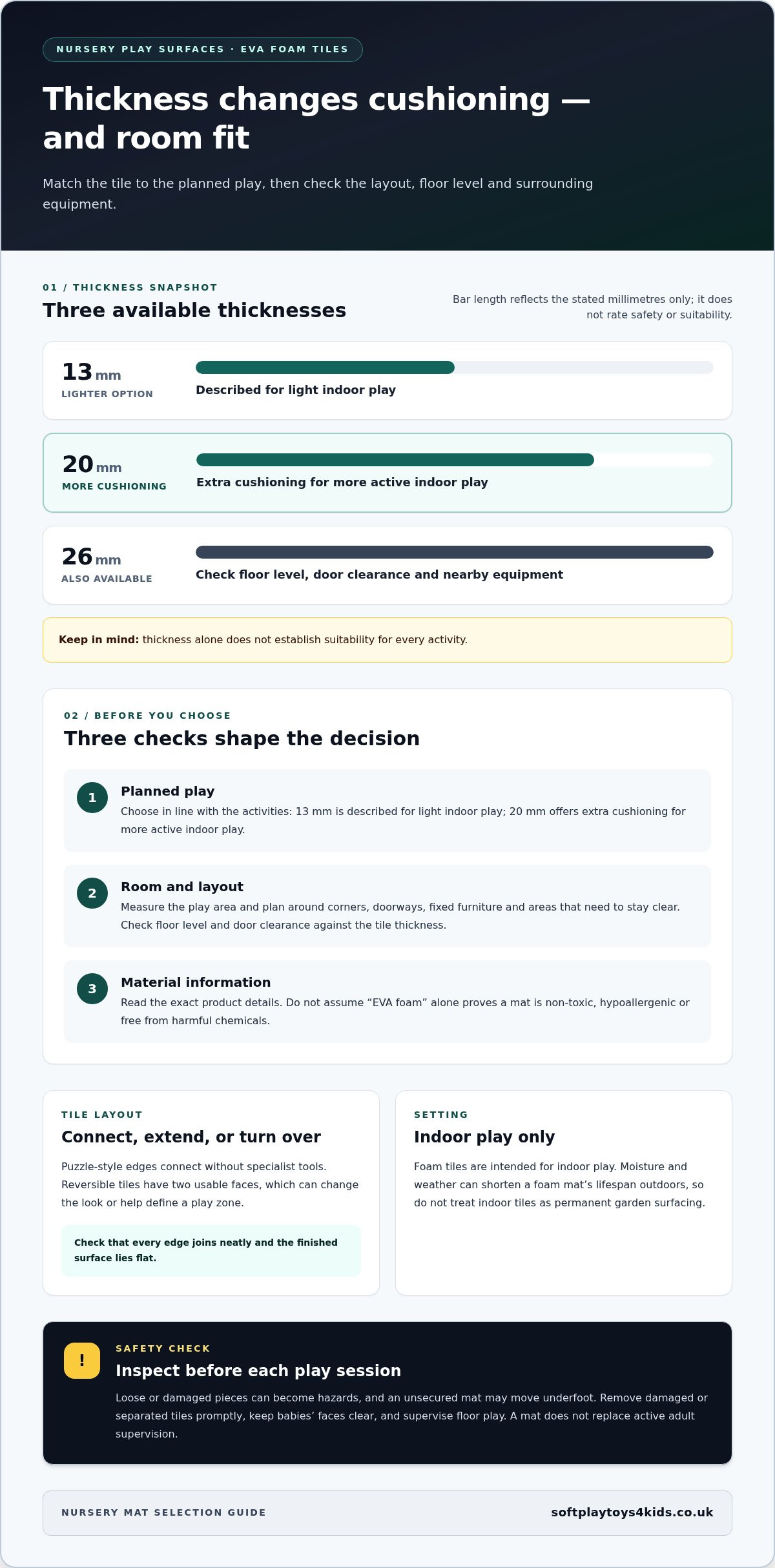
EVA foam forms the cushioned core of these interlocking play tiles. Compare thickness with the activities planned: 13 mm mats are described for light indoor play, while 20 mm mats offer extra cushioning for more active indoor play.
Some EVA foam mats are also available in 26 mm thickness. Check the stated thickness against floor level, door clearance and the equipment around the play zone. A padded surface can make floor play more comfortable, but thickness alone doesn’t establish suitability for every activity.
Reversible Interlocking Tiles
Puzzle-style edges connect individual foam tiles, letting you cover a defined area or extend the layout later. They can be fitted without specialist tools. Before assembly, clear the floor and arrange the pieces to see how the edges meet around corners and obstacles.
Reversible tiles offer two usable faces, which can help vary the appearance of a play space. Use contrasting sides to mark a play zone, for example, then turn the tiles over to change its look. Keep the layout consistent and check that every edge joins neatly.
Indoor Use for Babies and Toddlers
For babies practising tummy time and toddlers exploring the floor, choose a flat indoor area and fit tiles edge to edge. A compact play zone beside a clear wall can make supervision easier. Arrange toys and furniture so children have room to move.
Foam tiles are intended for indoor play. Moisture and weather can shorten a foam mat’s lifespan outdoors, so don’t treat indoor tiles as permanent garden surfacing. For babies, inspect the mat before each play session and remove any tile that is damaged or separated.
Chemical and Physical Safety Considerations
Are nursery floor mats non-toxic, hypoallergenic and free from harmful chemicals? Those claims depend on the specific mat’s material declarations, so don’t infer them from “EVA foam” alone. Read the product information for the exact tile before choosing it for a nursery.
Can padded floor mats create choking, slipping or suffocation risks for babies? Yes. Damaged or loose pieces can become hazards, and an unsecured mat may move underfoot. Keep babies’ faces clear, supervise floor play and promptly remove damaged tiles. A mat doesn’t replace active adult supervision.
Cleaning, assembly and fitting FAQs
A simple routine helps keep a nursery play surface ready for daily use. Separate fitting, cleaning and drying into clear steps, and follow the care guidance for the specific mat material.
How should I prepare the floor before fitting?
Start by moving toys, chairs and storage baskets from the play area. Sweep or vacuum the floor, then check for grit, crumbs and small objects that could end up beneath the tiles. Make sure the floor is dry before assembly.
Next, lay out the pieces loosely to plan the shape. Account for corners, doorways and fixed furniture rather than forcing tiles into a tight gap. Join the edges gradually, working across the space and checking seams as you go. If a tile doesn’t sit flush, lift it and realign the connection instead of pushing hard against neighbouring pieces.
Keep the finished surface clear of trailing cords and movable equipment. In a room with exposed columns, plan the mat layout around them and consider suitable column padding for play areas.
What is the practical way to clean play mats?
For everyday marks, remove loose debris first, then wipe the surface with a clean, damp cloth. Nursery mats described as wipe-clean high-tenacity PVC can be wiped as part of routine care. Dry the surface before children return to play, and don’t leave pooled water between tiles.
For a larger clean, take apart only the area that needs attention. Clean each piece separately, including its edges, then let the pieces and floor dry before refitting. Check the product’s care instructions before using a cleaning product. Strong solvents or abrasive pads may affect some finishes, so don’t assume every cleaner suits every material.
Can I lift and refit tiles for cleaning?
Yes, interlocking sections can be separated by easing apart the joined edges. Start at an outside edge rather than pulling from the centre, which can strain connected pieces. Keep removed tiles together in their original layout so you can replace them in the same positions.
After cleaning, reconnect the edges fully and inspect the joins across the whole area. Replace any piece that no longer lies flat or connects properly. This is especially useful after moving a play zone to clean beneath it or rearranging a small room.
How often should I inspect the fitted surface?
Make a quick visual check before each play session. Look for lifted corners, separated joins, visible dirt and damage. After a spill, clean the affected area promptly and let it dry before use. Set a cleaning schedule based on how often the room is used and the activities that take place there.
For example, a nursery activity area used throughout the day may need more frequent surface checks than a quiet home play corner. Keep a cloth and the mat’s care instructions accessible to staff. Consistent cleaning and refitting help keep the play area organised and ready for its next session.
Which materials are best for padded nursery mats: foam, rubber or fabric?
For indoor nursery play, options include EVA foam tiles and soft-foam nursery mats with wipe-clean PVC. Fabric padding is also used in the MiniDream Jumbo Baby Play Mat. Rubber mats are recommended for outdoor play, while foam is recommended indoors. Choose according to the setting and planned activities.
How much do padded nursery floor mats cost in the UK?
Prices for padded floor mats for nurseries vary depending on the size, thickness and material quality, ranging from affordable interlocking foam tile packs for home use to bespoke, high-tenacity PVC options for commercial settings.
Which UK retailers sell padded nursery floor mats, and what are their delivery and return policies?
SoftplayToys4kids sells padded nursery floor mats, including the made-to-order Soft Play Bee Nursery Floor Mat, with an expected delivery time of 10 working days.
Mat pack sizes and colour choices
Choose a pack by calculating the floor area you want to cover, then comparing it with each pack’s stated coverage. Measure the usable length and width, multiply them and record the result. For an L-shaped play zone, divide the floor into rectangles, calculate each area, then add them together.
Measure around fixed furniture rather than including space that tiles cannot cover. Sketch the nursery corner, for example, marking the doorway, storage unit and clear central area. Mark the intended mat boundary on the sketch. This makes pack comparisons more useful than relying on the room’s full floor dimensions.
How to compare pack coverage
Pack sizes depend on tile dimensions and the number of pieces included. Compare stated coverage, not just pack count, because differently sized tiles cover different areas. Check whether the pack includes edge pieces, and plan how the outer sides will finish beside walls or furniture.
Plan a layout that follows the room’s shape. A narrow strip beside a play area may need a different arrangement from a square central zone. Before ordering, draw the tiles onto your floor sketch and note where full tiles meet doorways, corners and fixed equipment.
A separate nursery mat provides another size reference: the Soft Play Bee Nursery Floor Mat measures 145 cm by 145 cm. It is a single mat, not a tile-pack coverage guide. Compare its footprint with your planned play zone to judge whether a defined standalone surface suits the room.
Choose colours for the room’s purpose
Plan colours around how children and staff will use the space. A single-colour layout can create a calm, visually simple floor. Two colours can outline a play zone or distinguish one activity area from another. For example, use contrasting colours to mark a clear boundary around a reading corner.
Reversible tiles can change the visible colour arrangement without replacing the floor covering. Sketch both sides of the tiles before fitting, then decide where each colour should appear. Keep the finished pattern consistent around corners so the design looks intentional rather than scattered.
Make a practical buying plan
Before selecting a pack, write down the measured area, each pack’s stated tile coverage and your colour layout. Then compare those details with the room’s furniture and door clearance. This checklist helps avoid buying a pack that leaves an awkward uncovered strip.
- Measure: record the clear floor area and any irregular corners.
- Compare: use stated pack coverage, not piece count alone.
- Plan: mark colour blocks and boundaries on a room sketch.
- Review: check the layout against doorways and fixed furniture.
A nursery with an open rectangular corner may suit a straightforward tile grid, for example. A sensory room with separate activity areas may benefit from planned colour zones. Let the room’s shape and intended use guide your pack and colour choice.
Mats for nurseries, schools and sensory rooms
Start with the room’s activities, floor plan and cleaning routine. A nursery baby area, an active school play corner and a sensory room need different layouts. Match the mat’s format and thickness to its intended use, then plan clear boundaries around furniture and equipment.
Nursery spaces for babies and toddlers
For a defined nursery play zone, compare interlocking EVA foam tiles with a single nursery-style mat. The Soft Play Bee Nursery Floor Mat measures 145 cm by 145 cm by 2.5 cm. Its square footprint can suit a dedicated floor-play area, while tiles can be arranged around a room’s shape.
The Bee Nursery Floor Mat uses soft foam and durable, wipe-clean PVC. This surface can be convenient for routine cleaning in a busy room. Consider how staff will reach the mat, clean around its edges and keep nearby furniture from obstructing the play area.
School play areas with varied activity
A school play corner may host quieter floor activities and more active indoor play. The available thickness examples include 20 mm foam mats for extra cushioning during more active indoor play, plus EVA foam mats in 26 mm thickness. Compare these options with the planned activities and room layout.
Map the space before selecting tiles. Mark doorways, storage and fixed equipment, then estimate the area children will use. A play corner beside shelving needs a different mat boundary from an open classroom floor, for example. Keep the route between the play zone and room entrance unobstructed.
Sensory rooms and defined zones
A sensory room can use a clear floor boundary to distinguish one activity area from another. Choose a layout that leaves space for equipment and movement. In a small room, a single square mat may define a compact zone; a larger open area may suit connected tiles.
Colour planning can also make zones easier to recognise. Sketch the room and mark each activity area before arranging tiles. Keep transitions simple, especially where children move between a mat and uncovered flooring. Check that the planned arrangement fits around the room’s furnishings.
Compare material and care needs
Foam thickness is one comparison point, not the only one. The Bee Nursery Floor Mat is 2.5 cm thick and uses wipe-clean PVC, while EVA tile options include 20 mm and 26 mm thicknesses. Match the product format to the room’s footprint and cleaning routine.
In indoor settings, plan cleaning access before placing furniture around a mat. Leave enough room to inspect edges and reach the floor underneath. A nursery, school or sensory room benefits from a layout staff can maintain without shifting the entire space.
What safety standards apply to nursery floor mats in the UK?
There isn’t a thickness figure that proves a mat suits every nursery. Assess the product’s intended use, material information, construction and fit within your room. An indoor play mat and outdoor impact surfacing serve different purposes, for example. Choose according to the activity and setting, not thickness alone.
Review product information carefully
Start with the manufacturer’s product description and technical documents. Check the stated materials, dimensions, intended setting and cleaning instructions. If a listing makes claims about chemical content or hypoallergenic properties, look for supporting product information rather than assuming those claims apply to every foam mat.
Keep product details with your nursery’s equipment records. This makes it easier for staff to identify the exact mat, follow its care instructions and spot changes as the surface wears. A product description that clearly identifies indoor use, for example, helps distinguish it from surfacing designed for outdoor play.
Assess fit, joins and surface condition
Installation affects day-to-day use. Fit interlocking tiles closely, check that edges sit flat and avoid placing loose pieces across walking routes. A gap beside a doorway or a raised edge can catch feet. Recheck joins after moving furniture or cleaning beneath the mat.
Inspect the surface before children use it. Look for torn foam, loose sections, exposed edges or a slippery spill. Remove a damaged tile from the play area, clean spills promptly and let the floor dry. These practical checks complement product information, but they don’t establish a certification.
Match cushioning to the activity
Thickness helps describe a mat, but it doesn’t show how much impact protection a particular installation provides. The examples in this guide include 13 mm foam for light indoor play and 20 mm foam for more active indoor play. Select according to the stated use, then consider the floor beneath and the activities planned.
For climbing, jumping or equipment use, assess the whole setup rather than relying on a soft surface alone. Consider equipment height, movement space and nearby walls or columns. A mat is not a substitute for suitable supervision or an activity-specific risk assessment.
Use a simple nursery review
- Before fitting: read material, use and care details.
- After fitting: check seams, edges and doorways.
- During use: inspect for damage, movement and spills.
- After cleaning: let the surface dry before play resumes.
Where exposed columns create a separate impact concern, consider column and room safety padding as part of the wider room assessment.
SoftplayToys4kids: Soft Play Ball Pits
SoftplayToys4kids can help you build on your floor plan with soft play equipment for children’s spaces. If your nursery or sensory room needs more than a padded surface, sensory toys can complement a designated play area and add another activity option. Choose them to suit the room’s purpose and the children who use it.
For outdoor settings, Lamp Post Protectors address a different need from indoor floor mats. Keep these requirements separate and plan each area around its use, rather than expecting one product to solve every problem.
If you’re planning a play space, you’re welcome to visit SoftplayToys4kids online to explore its children’s soft play equipment.
Shape a play space that grows with its purpose
Your next step is to turn the room’s needs into a practical plan. Consider who will use the area, which activities belong there and how the space may change over time. A nursery corner might later become a shared play zone, while a sensory room may need a distinct area for focused activities. Choosing padded floor mats for nurseries is one part of creating a purposeful space that works for everyday routines.
SoftplayToys4kids offers Soft Play Mats to help create a dedicated floor-play area, alongside Soft Play Ball Pits and Sensory Toys for children’s spaces. Think about which elements support your room’s purpose, rather than adding equipment without a clear role.
Ready to explore suitable options for your setting? Contact SoftplayToys4kids to discuss your play space and take the next step towards planning it with confidence.
Frequently Asked Questions
Which Play Mat Is Best for Your Space?
The best choice depends on the room shape, play activity and storage needs. For a fixed play area with unusual corners, interlocking tiles let you plan coverage around furniture. A single mat can suit a clearly defined spot, such as beside a reading corner. In a sensory room, consider how the mat’s colour and footprint work with other activity zones, leaving clear routes between them.
How thick and large should padded mats be for a nursery?
Choose thickness according to the intended indoor activity, then size the mat to the usable floor area. The examples include 13 mm foam for light play and 20 mm foam for more active indoor play. Measure the clear space, excluding furniture and door swings. If the nursery layout changes, interlocking pieces can make it easier to adjust the covered area without replacing one large mat.
What are the best padded floor mats for babies learning to crawl?
For a crawling baby, look for a stable, smooth indoor surface that stays flat during movement. Padded floor mats for nurseries can define a dedicated floor-play area, but suitability depends on the specific product’s materials and use guidance. Keep small objects, loose pieces and toys with detachable parts away from the baby. Stay close during play, especially as crawling leads to pulling up and exploring nearby furniture.
How do you clean and maintain padded nursery floor mats?
Follow the care instructions for the mat’s specific material, since cleaning methods can differ. After everyday play, remove crumbs and inspect seams, corners and the floor beneath. For a spill, clean the affected area and let it dry fully before use. Keep a simple room-care note for staff, including the product’s cleaning guidance and any visible damage, so maintenance stays consistent across shifts.
How do interlocking foam mats compare with foldable and one-piece nursery mats?
Interlocking tiles work well when you need to shape coverage around a room or replace individual sections. A one-piece mat creates a single defined surface, while a foldable mat can be moved or stored as needed. Compare the available floor area, storage space and how often the play zone changes. Check that the format fits the routine, rather than choosing by appearance alone.
What features should you look for when choosing a padded floor mat for a nursery?
Prioritise clear product information: material, dimensions, thickness, intended use and cleaning guidance. Then consider whether the edges fit your layout, whether the surface stays suitably positioned and whether staff can inspect it easily. A nursery with frequent room changes may favour separate pieces, while a permanent corner may suit one mat. Treat claims about chemical properties as product-specific, not universal.
Leave a Reply