
Softplay Solutions vs Soft Brick Company

For a venue, the better choice is the provider whose bespoke soft play design suits the available layout and whose completed projects show what the result can look like. A Softplay Solutions vs Soft Brick Company comparison is most useful when it goes beyond names to assess design approach, project examples and customer feedback.
Choosing soft play for a commercial space means balancing the room’s shape and size with the experience you want children and families to enjoy. You need confidence that the proposed design will work in your venue, not just look appealing in a brochure.
This article explains how bespoke designs can suit different venue layouts and what to look for in project examples and testimonials. Use the practical framework to compare the two companies, assess the evidence behind their completed work and decide which details matter most for your space.
Key Takeaways
- Compare safety information by looking for clear product documentation and details relevant to the intended setting.
- Assess delivery and installation plans against your venue’s access, layout and practical requirements.
- Understand what warranty, maintenance and after-sales support cover before choosing a solution.
- Use completed-project examples and customer testimonials to see how designs work in real venues.
- Explore soft play ball pits, mats, sensory toys and lamp post protectors when these products suit your needs.
What safety standards and certifications do their soft play products meet in the UK?
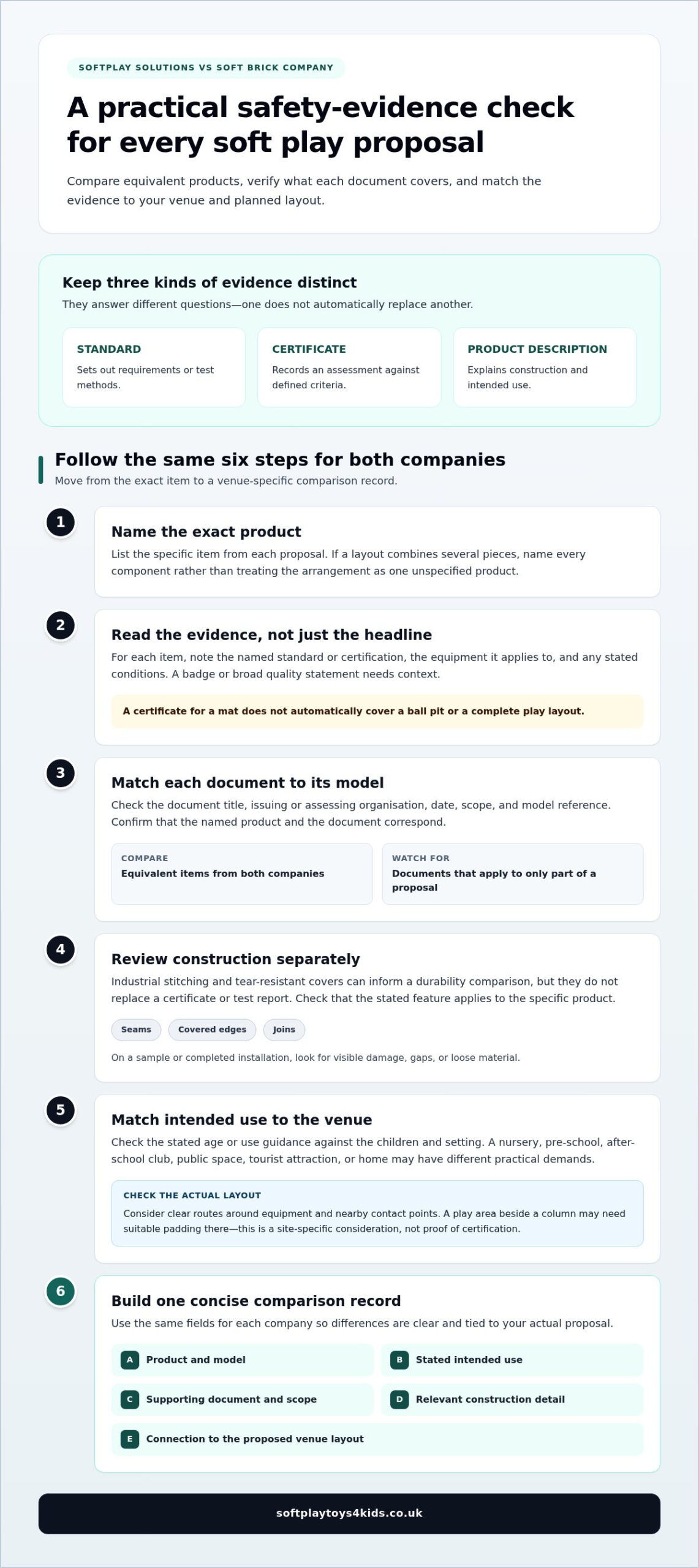
When comparing Softplay Solutions and Soft Brick Company, assess safety evidence product by product, rather than relying on broad claims about either business. A certificate is useful only when its title, scope and connection to the equipment are clear. A general quality statement does not identify which item was assessed or what the assessment covered. Treat documentation as part of the product specification, alongside dimensions, materials and intended use.
Separate three kinds of evidence. A standard sets out requirements or test methods; a certificate records an assessment against defined criteria; and a product description explains construction and intended use. These terms are not interchangeable. For example, saying that a soft play item has a covered surface describes a feature, but does not establish certification. Soft play equipment generally has soft surfaces covered in child-friendly materials, but that does not prove anything about a particular model.
Use the same comparison method for both companies. Start with the exact product names, then match each safety document to the product being considered. Check the document title, issuing or assessing organisation, date, scope and model reference. A certificate for one piece of equipment is not evidence for every item in a range. If a proposal combines several pieces, compare the documents with each named component.
Read the evidence, not just the headline
Product pages and brochures can make safety information easy to find, but a badge or phrase needs context. For each item from Softplay Solutions or Soft Brick Company, note the named certification or standard, which equipment it applies to and any stated conditions. Then compare equivalent items. A certificate for a mat, for example, does not automatically cover a ball pit or a complete play layout.
Construction details offer a separate, practical basis for comparison. Soft play items may have industrial stitching and tear-resistant covers. These features relate to durability, but do not replace a certificate or test report. Check whether the stated construction applies to the specific product. On a sample or completed installation, inspect seams, covered edges and joins for visible damage, gaps or loose material.
Match the equipment to its setting
A nursery, pre-school, after-school club, public space, tourist attraction or home can have different practical demands. The equipment’s intended users and use should match the setting described in its documentation. Compare the stated age or use guidance for each product instead of assuming that two similar-looking pieces suit the same children or environment. A soft surface matters, but it does not settle every safety question.
Room layout matters, too. Consider whether the planned arrangement leaves clear routes around the equipment and whether nearby structures create contact points. For example, a play area beside a column may need suitable padding there. This is a site-specific consideration, not evidence of a manufacturer’s certification. Record the layout alongside product references, so the safety evidence relates to the actual proposal.
Before deciding between Softplay Solutions and Soft Brick Company, create a concise comparison record. List each product, its stated use, the supporting document and any relevant construction detail. Note when a document applies to only part of a proposed arrangement. This makes differences clear without treating marketing language as independent verification, and helps you judge whether the evidence matches your venue and the children who will use it.
Keep product quality and safety evidence distinct. Durable stitching or tear-resistant covers can inform a material comparison, while certificates and test documents address specific assessment criteria. Neither should stand in for the other. Reviewing model-specific documentation, intended use and the planned layout gives you a more reliable comparison than relying on a general claim of compliance.
What are the delivery times, installation times and delivery areas for each company?
Compare delivery and installation only when both proposals cover the same scope. A delivery estimate for packaged equipment is not directly comparable with a schedule that includes on-site assembly. For Softplay Solutions and Soft Brick Company, assess the stated lead time, delivery arrangements and installation scope together. Compare the same requirements for your venue rather than assuming either company follows a particular timetable.
Start with the order itself. A ready-to-ship item and a bespoke layout can involve different preparation, production and dispatch steps. Venue measurements, chosen components and design revisions can also affect the sequence. For example, a proposal based on a clear floor plan may progress differently from one that needs changes to fit around a column or entrance. Treat any lead time as applying to the order described, not to every product a company sells.
Separate the main milestones in each company’s schedule. Record when the order is accepted, when production or preparation is expected to finish, when dispatch is planned and whether installation is included. These stages show what a quoted delivery window covers. If a schedule gives only an overall estimate, planning staff, room access and the play area’s opening can be more difficult.
Compare delivery and installation as separate services
Delivery means transporting equipment to the venue; installation means work at the destination. With delivery only, the venue is responsible for handling and assembly. Installation may require a prepared room and agreed access. Read each company’s proposal to understand the actual scope, including whether placing equipment, joining components or removing packaging is part of the work.
Site conditions can affect the practical schedule. A ground-floor room with direct access differs from an upstairs venue with narrow stairs, restricted parking or limited delivery hours. A fitted play area may also require a clear room before work begins. Compare how Softplay Solutions and Soft Brick Company describe access, preparation and installation responsibilities for your specific address. Do not treat a general delivery estimate as a promise for a complex site.
Compare geographic coverage precisely, too. A company may describe delivery by region, while a quote may apply to a particular postcode or venue. Check whether the stated area includes your destination, and distinguish transport coverage from installation coverage, as they may differ. For a venue outside a company’s usual delivery area, the arrangement stated in the proposal is more relevant than a broad national claim.
Build a like-for-like planning record
Use the same checklist for both proposals to make practical differences easy to spot:
- Order scope: Record the equipment, bespoke elements and final layout shown in each proposal.
- Timing: Note the stated lead time and which order milestone starts it.
- Delivery: Capture the destination, delivery method and any access conditions.
- Installation: Identify whether assembly is included and what room preparation is expected.
- Schedule changes: Read how revisions, site access and delivery coordination affect the agreed plan.
Then test the schedules against your own opening plan. A nursery preparing a room during a holiday closure may value a defined installation window. A community venue with shared rooms may need delivery and assembly coordinated around other activities. These examples don’t establish either company’s actual service; they show why a venue-specific schedule matters more than an unqualified estimate.
Keep the final comparison in writing, including the delivery address and installation scope. This makes it easier to see whether the proposed timing covers the full journey from order preparation to a ready-to-use room. For an additional reference while planning a venue layout, explore soft play layout options.
The Chilton Academy soft play project has two separate play areas and two slide features, details to check against a venue’s access and installation plan. Soft play there is open Monday to Sunday from 9 am – 6 pm, though opening times may change during term time and holidays. Parents and guardians must remain in Kensington Leisure Centre’s soft-play area and supervise their children at all times. These venue details do not establish either supplier’s delivery coverage or schedule.
What warranties, maintenance and after-sales support do they provide?
For Softplay Solutions and Soft Brick Company, compare the written warranty terms for the exact equipment in each proposal. A warranty’s value depends on what it covers, how claims are handled and which conditions apply. A general quality statement is not a substitute for product-specific terms. Record each company’s stated coverage alongside the product name to keep the comparison clear.
Start with the scope. Does the warranty cover the whole item, its cover, stitching, filling or a particular component? If a proposal includes several pieces, check whether the same terms apply to each. For example, terms for a soft play mat may differ from those for a ball pit or bespoke structure. Compare equivalent items before drawing conclusions.
Next, note the warranty period exactly as each company states it. Identify the start point, such as delivery or installation, if the terms specify one. Check what evidence the company requires when a problem occurs and what remedy the written terms describe. A repair, replacement or assessment process can affect how quickly a venue resolves an issue. Keep the wording with your notes instead of relying on memory.
Separate warranty cover from routine care
A warranty and a maintenance plan serve different purposes. Warranty terms describe the company’s stated cover for certain problems. Maintenance is the venue’s ongoing work to keep equipment clean, orderly and suitable for its setting. In a nursery, for example, that could mean following product care instructions and including inspections in the room’s usual checks. Do not assume maintenance is included just because a warranty exists.
Look for product-specific cleaning instructions, including suitable methods and materials to avoid. Check how the guidance applies to covers, seams and joins. If instructions differ by product, keep each set with the relevant item. For example, written care instructions for a mat should stay with that mat, rather than being treated as guidance for every product in the play area.
Keep a simple maintenance record for the venue. Note the item, the date of each check, visible wear, cleaning completed and any action taken. Pay particular attention to seams, cover damage and joins between pieces. A consistent record helps staff spot changes, describe them clearly if they contact Softplay Solutions or Soft Brick Company, and hand over information between team members.
Compare after-sales support by its practical steps
After-sales support is easier to compare when you map the process, not just the promise. For each company, record the stated contact route, what information to provide, how the issue is assessed and what happens next. A useful report identifies the product, describes the problem and includes a clear photograph where appropriate. These details help distinguish a damaged cover from a loose connection or a cleaning concern.
Before choosing, put the terms side by side. Compare warranty scope and duration, conditions, maintenance instructions and the stated route for reporting a problem. Note whether the guidance covers individual products or a complete installation. This matters for venues with several components, where one issue may affect use of the surrounding play area.
For a practical comparison, keep the product documentation and maintenance notes together from delivery onward. If your venue also needs protective padding around a column, explore column padding options as part of planning a safer, more considered space.
Compare after-sales support as carefully as written cover. Ask how to report a concern, what information to provide and how the company will keep you informed while it is assessed. Record the contact route and any stated response or remedy in the proposal; do not assume a service promise that is not written down. A clear handover process matters when staff change, so keep instructions and correspondence with the equipment and maintenance record.
The setting also shapes practical questions. Soft play equipment can be used in nurseries, pre-schools, after-school clubs, public spaces, tourist attractions and homes. Soft play provides stimulation covering all five senses. Check how the proposed equipment’s care guidance and support apply to your setting rather than assuming one arrangement suits every venue. Kensington Leisure Centre does not set a maximum number of children a visitor can bring to soft play, provided supervision requirements are followed. Check the relevant venue’s own supervision expectations before planning use.
SoftplayToys4kids: Soft Play Ball Pits
SoftplayToys4kids offers soft play ball pits for venues looking to add a dedicated play feature for children. If your layout needs a softer floor area, soft play mats can complement the space, while sensory toys add tactile and visual play opportunities. Lamp post protectors are another practical option where exposed posts need padding.
Choose products to suit the room’s available footprint and how children will use the area. A ball pit can create a clear play destination, mats can define a softer zone, and sensory toys can add variety. If fixed features shape the layout, consider how protective padding fits into the wider plan.
To discuss your soft play requirements, contact SoftplayToys4kids or visit softplaytoys4kids.co.uk.
Turn Your Venue Plans Into a Playful Space
Use your Softplay Solutions vs Soft Brick Company comparison as a starting point, then picture how children will move through your venue. A successful play area should feel inviting and work naturally with the room’s shape, circulation and purpose. Consider the experience you want to create, from a lively feature that draws children in to a calmer space for sensory exploration.
SoftplayToys4kids offers Soft Play Ball Pits, Soft Play Mats and Sensory Toys to help shape that experience. Consider which elements suit your space and the children who will use it, then bring those priorities into your next conversation. A clear idea of your venue’s needs can make the path from inspiration to a considered choice feel much simpler.
Contact SoftplayToys4kids about your venue and take the next step towards a welcoming space for little ones.
Frequently Asked Questions
What should UK buyers check before choosing a soft play supplier?
Check that the proposed equipment suits your venue, users and planned layout, then compare each supplier’s written proposal. Make sure the product list, dimensions and bespoke elements match what you intend to buy. Review the safety documents and care instructions, and clarify who handles delivery, setup and any future issue. For example, a nursery should consider how the proposed play zone fits its room and daily routines, not just how it looks.
Leave a Reply