
Safety Padding for Indoor Play Areas and Soft Play Equipment

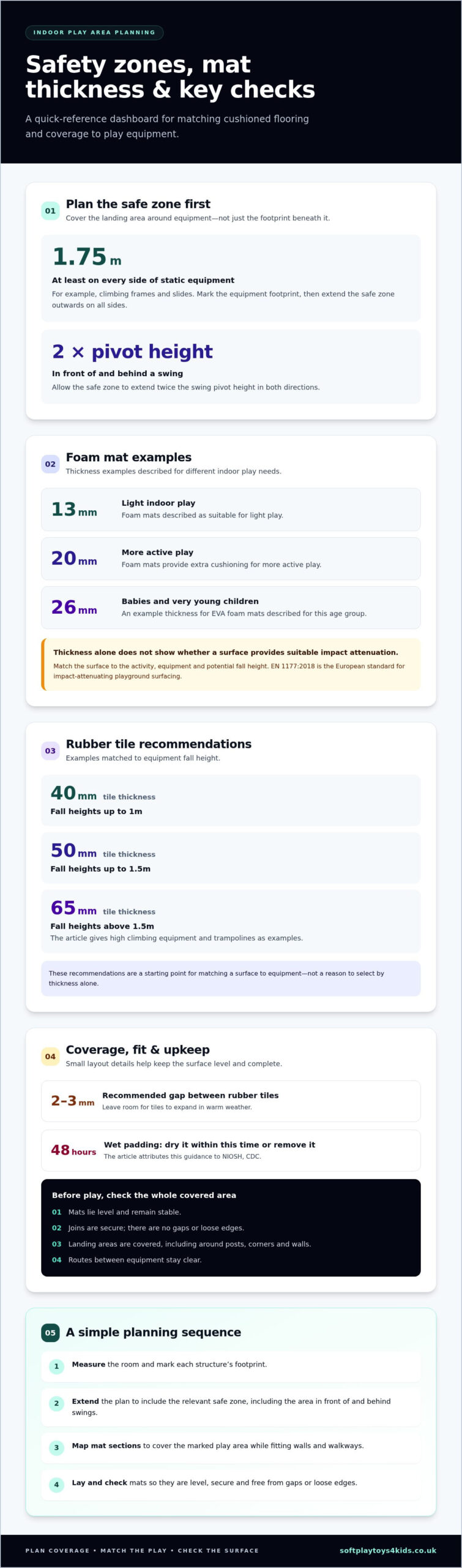
For static equipment such as climbing frames and slides, the safe zone should extend at least 1.75m on all sides. For swings, allow a safe zone extending twice the swing pivot height in front and behind. This gives you a practical starting point when planning safety padding for indoor play areas, while the layout should also account for how children move between equipment.
A cushioned floor can soften the impact of everyday tumbles, but matting needs to work with the play equipment, not simply sit beneath it. Gaps, loose edges and uncovered posts or corners can create hazards instead of making the space more comfortable.
Learn how to plan the matting zone, how cushioned flooring absorbs impact and where pads can help reduce bumps and falls. We’ll also cover how to pair mats with soft play equipment so the whole area supports active, confident play.
Key Takeaways
- Plan a safe zone extending at least 1.75m around static equipment such as climbing frames and slides; for swings, allow twice the pivot height in front and behind.
- Choose cushioning with the play activity and layout in mind, then make sure the surface stays stable and covers the areas where children may land.
- Think beyond the floor: padding on posts, walls, corners and equipment edges can help soften bumps in busy play spaces.
- Pair mats with soft play shapes and activity equipment to create a more comfortable space for crawling, climbing and balancing.
- Keep the area tidy and hygienic by addressing gaps or loose edges and following a regular cleaning routine.
How far should playground matting extend beyond play equipment?
For static equipment such as climbing frames and slides, extend the safe zone at least 1.75m on all sides. For swings, extend it twice the swing pivot height in front and behind. These measurements help map the landing area around each structure, rather than covering only the footprint directly beneath it.
For indoor play, 13mm foam mats are described as suitable for light play, while 20mm foam mats provide extra cushioning for more active play. Thickness alone doesn’t tell you how well a surface absorbs impact. EN 1177:2018 is the European standard for impact-attenuating playground surfacing, so consider whether the surface’s impact performance suits the equipment’s fall height.
Equipment height affects the thickness recommendation for rubber playground tiles: 40mm tiles are recommended for fall heights up to 1m, and 50mm tiles for fall heights up to 1.5m. For high climbing equipment and trampolines with fall heights above 1.5m, the recommendation is 65mm tiles. These recommendations provide a starting point for matching a surface to equipment, not a reason to select by thickness alone.
Measure the full play and landing area before choosing mat sizes. A clear plan helps you compare the available space with the equipment’s safe zone and avoid narrow uncovered strips. For example, map a climbing frame’s footprint, then mark the required 1.75m safe zone on every side. Keep routes between equipment clear, and include nearby posts, corners and walls in the layout.
- Measure the room and mark each structure’s footprint on a plan of the ground.
- Add the relevant safe zone around each structure, including the swing area in front and behind.
- Work out how the mat sections will cover the marked area, allowing the layout to fit walls and walkways.
- Lay the mats level and secure, with no gaps or loose edges that could catch a foot.
Durability matters in a busy playground. Choose material suited to regular traffic and cleaning, and consider how seams, joins and edges will hold up with repeated use. A temporary mat layout may suit changing play spaces, but it still needs stable edges and complete coverage while in use. Leave room for rubber tiles to expand in warm weather, as the recommended gap between tiles is 2-3mm.
Wet padding needs prompt attention. Dry wet padding materials within 48 hours of getting wet or remove them, according to the National Institute for Occupational Safety and Health (NIOSH), CDC. Check the whole covered area after cleaning or a spill, including joins and corners. If padding shifts, separates or stays damp, restore a level, dry surface before children return to play.
Cushioned flooring and impact absorption
Foam and other cushioned surfaces help absorb impact during children’s play. Their performance depends on factors such as material, thickness, floor condition and activity, so assess the whole space rather than choosing by softness alone. Well-planned safety padding for indoor play areas should suit both the play and the room’s daily use.
Impact Cushioning for Injury Prevention
A cushioned surface can soften impact when a child crawls, rolls or tumbles, but it can’t prevent every injury. Match the surface to the play activity and equipment, and consider the potential fall height. EN 1177:2018 is the European standard for impact-attenuating playground surfacing. A mat’s thickness alone doesn’t show whether it provides suitable impact attenuation.
Different foam thicknesses can suit different indoor play needs. Foam mats described as 13mm thick are intended for light indoor play, while 20mm foam mats provide extra cushioning for more active play. EVA foam mats described for babies and very young children are 26mm thick. These examples illustrate product differences, not a universal rating scale: a thicker mat doesn’t automatically mean better protection for every activity.
Crawling and floor-based sensory play, for example, place different demands on flooring than jumping from foam shapes. Consider how children move, the equipment’s height and likely landing areas. Where equipment has a defined fall height, choose impact performance suited to it rather than relying on a general description such as “soft”. This makes safety padding for indoor play areas a considered choice, not simply a soft surface.
Balancing Cushioning and Grip
Cushioning and grip need to work together: the surface should soften landings while staying stable under moving feet and hands. A very yielding or shifting mat can make crawling, standing and active play harder to control. Check that the flooring lies flat, joins stay together and the surface doesn’t slide across the ground during use.
Grip also depends on the room and how it is used. A dry indoor playroom differs from an outdoor space exposed to rain and changing conditions. Foam play mats are advised for indoor use, as rain, frost, UV exposure and moisture can affect their performance over time. For indoor flooring, cleanable surfaces and secure joins help keep the play area practical as well as cushioned.
- Match the surface to the activity, such as crawling, balancing or jumping.
- Check that mats remain level and stable during play.
- Review the material and impact performance alongside thickness.
For areas where children may bump against vertical surfaces, column padding can complement cushioned flooring. Explore column padding options as part of a joined-up play-space plan.
What Is Soft Safety Padding and Why Do Children Need It?
Soft safety padding combines a cushioned surface with protection for places children might bump during play. The right type depends on the setting, the activity and whether the layout needs to move or stay in place.
Padding Types and Settings
Foam-filled floor padding creates a cushioned base for crawling, rolling, climbing and active play. In a sensory room, it can provide a comfortable floor for seated or floor-based activities; in a nursery or school, it can support a dedicated play area. Choose padding to suit children’s movements and the room’s everyday use.
Temporary mats can be moved or rearranged as activities change, while semi-permanent flooring is intended to stay in place as part of the play space. Before choosing, consider storage, room access and how often the layout changes. A wood-backed pad has a firm backing beneath its cushioned layer, which may suit a fixed layout; check that it sits level and doesn’t create an uneven edge.
Colourful flooring can help define activity zones and make a play area feel welcoming. Different colours can distinguish a quiet sensory corner from a space for climbing or group play, without relying on signs alone.
Safety Standards and Material Requirements
EN 1177:2018 is the European standard for impact-attenuating playground surfacing. It’s a relevant reference when considering impact performance, but it doesn’t mean every mat or wall pad meets a particular performance level. Check the intended use and impact information for the surface being considered.
There isn’t a single fire or material requirement established here for every indoor padding product. Listed PVC material is described as non-toxic and fire retardant, but those descriptions don’t prove that all PVC padding has the same properties. For hygiene, vinyl or PVC coverings can be wiped with disinfectants, and regular cleaning helps maintain the play space.
Comparing Foam Wall Padding and Impact Mats
Foam wall padding covers vertical surfaces, such as walls or posts, where children might collide. Padded flooring covers the ground across a play area, while impact mats provide cushioning in a particular location or beneath an activity. Identify where contact or falls are most likely, then position the padding to address that need.
For example, floor mats can cushion a crawling zone, while column padding protects a post beside a route through the room. Keep joins flat and inspect the surface for damage, movement or exposed backing. Clean wipeable coverings as part of the room’s regular routine, and remove or repair padding that no longer lies securely.
UK manufacturers and suppliers offer options for indoor play spaces, including foam-filled pads, mats and wall padding. Costs depend on the area covered, material, thickness, backing and whether the layout is temporary or permanent. Compare these factors rather than assuming one price fits every room.
Reducing the risk of bumps and falls
Poorly fitted or damaged padding can create trip and entrapment hazards, especially where edges lift or gaps open. Worn or displaced sections may expose hard surfaces, leaving children without cushioning where contact is likely. Well-fitted safety padding for indoor play areas helps soften contact at floor and wall level, provided it stays secure and intact.
Plan protection around likely contact points, not just the floor. Padding can cover walls, posts, corners, flooring and equipment edges. A post beside a climbing route, for example, may need padding, while the floor beneath active play needs stable, continuous coverage. The aim is to cushion contact without creating new obstacles.
Installation matters as much as material choice. Play structures and padding should be securely fixed, level and free of hazards. A loose mat near a slide exit can shift underfoot; an uneven join across a route can catch a child’s shoe. Check edges, seams and corners after fitting, then repeat checks as the area is used.
Use this practical inspection sequence before children enter the play area:
- Walk the full floor and press along joins to find movement, raised edges or gaps.
- Look over wall pads, posts and corners for tears, exposed hard backing or loose fixings.
- Check that each mat lies flat and equipment remains level and securely fixed.
- Remove damaged or displaced padding from use until the hazard is corrected.
Pay close attention to gaps. A space between floor pads can catch a foot, while a loose section may shift as children crawl, jump or change direction. Inspect the perimeter too: edges against walls and equipment can lift even when the middle of a mat looks flat. Keep routes between play features clear and unobstructed.
Comfort should never come at the expense of a stable surface. A soft mat that slides or buckles can make balancing harder and turn a cushioned area into a trip risk. After cleaning or moving equipment, check that the padding is back in position and that joins still meet evenly. These checks help keep safety padding for indoor play areas functional during everyday play.
Build checks into the room’s routine. Before opening, scan flooring and padded contact points; after busy play, look again for movement or visible damage. If a spill wets padding, dry it within 48 hours or remove it, according to the National Institute for Occupational Safety and Health (NIOSH), CDC. This keeps damp material from remaining in use.
Children move unpredictably, so no padding can prevent every bump or fall. A careful layout, secure installation and repeated checks can address avoidable hazards. In a room with a padded post beside a busy route, inspect both the post fixing and the floor around its base. This helps safety padding for indoor play areas cushion contact without creating a footing hazard.
Pairing mats with soft play equipment
Soft play works best when equipment and flooring function together as one planned activity zone. Match mats to the movement each piece encourages, then check that children have a stable, cushioned route between activities.
Foam shapes, climbing blocks and balance beams each create different landing and movement patterns. A child stepping from a low foam shape needs a clear, cushioned area nearby, while a balance beam needs enough floor space for stepping off safely. Group related equipment together, but leave routes between play features unobstructed.
Start with the activity, not the colour or shape of a mat. Crawling and rolling call for a smooth, continuous surface; climbing and balancing need flooring that stays firm and level underfoot. Soft play equipment and foam mats can support coordination, balance, confidence and social skills through active play. In a play centre, place a balance beam beside open matting rather than in a busy walkway.
Plan for the room’s users and daily routine. A school may need an open floor area for group movement, while a play centre may combine climbing blocks with quieter floor activities. Mark each equipment footprint on a room plan, then show mat coverage and walking routes. This makes it easier to spot narrow gaps, awkward joins or places where children may cross between activities.
Use this sequence to check a proposed equipment-and-mat layout:
- Place each play feature where children can approach and leave without crossing another activity.
- Extend cushioning around likely landing points, not only beneath the equipment itself.
- Check that mat edges meet evenly and don’t create raised transitions.
- Test the layout by walking the routes and moving the equipment as children would.
Cleaning also affects how equipment and mats work together. Foam mats designed to be wiped clean can help maintain a hygienic play space, especially around frequently handled equipment. Keep the surface accessible so staff can clean beneath and between movable shapes. After cleaning, return each piece to its planned position and check that the mats remain flat.
Flooring isn’t the only surface to consider. A climbing route beside a column, for example, can bring children close to a hard vertical edge. Padding on posts can complement floor mats by addressing that separate contact point. Keep padding secure and check its edges alongside the floor joins during routine room inspections.
The clearest takeaway: pair each play activity with suitable cushioning, stable transitions and enough open space to move. Explore column padding for play areas when planning protection around posts near soft play equipment.
The same principle applies across equipment types: soft play equipment such as climbing blocks, balance beams, foam shapes and activity sets works best on a cushioned surface.
SoftplayToys4kids: Soft Play Ball Pits
SoftplayToys4kids offers Soft Play Ball Pits for families and organisations creating dedicated spaces for children’s play. A ball pit can add an inviting activity zone, while the surrounding layout still needs suitable floor coverage and clear routes for moving in and out.
For a broader play setup, Soft Play Mats provide a cushioned surface, while Sensory Toys add options for exploratory play. Lamp Post Protectors can help pad posts in relevant settings. Choose each item to suit the room, the activity and the surfaces children may come into contact with.
If you’re planning a new play area or refreshing an existing one, explore SoftplayToys4kids’ soft play range and consider how each piece fits your layout. Contact SoftplayToys4kids or visit softplaytoys4kids.co.uk to discuss your play-space needs.
Make your next play-space decision with confidence
A well-planned play space starts with understanding how children use it. Before choosing safety padding for indoor play areas, think about the experience you want to create: a lively place for shared play, a calmer corner for sensory exploration or a flexible mix that changes throughout the day. That vision can guide your choices while keeping comfort and practical upkeep in view.
SoftplayToys4kids offers Soft Play Ball Pits, Soft Play Mats and Sensory Toys to help shape different kinds of play. These options can support a room designed for movement, discovery or both. Consider which activities matter most in your setting, then choose the pieces that fit the available space and the way children will use it.
Ready to plan your play area’s next step? Contact SoftplayToys4kids about safety padding and explore options for your space. A thoughtful setup can make room for joyful play and new discoveries.
Frequently Asked Questions
What is the safest flooring for a kids’ play area?
The safest choice is cushioned flooring suited to the children’s activities and the equipment’s fall height, with a stable, level surface. For a home play corner used for crawling and rolling, soft play mats can provide cushioning underfoot. For climbing or jumping equipment, consider impact performance as well as thickness. Keep the floor clear of loose objects and choose a covering that can be cleaned as part of regular room care.
How much does indoor play area safety padding cost in the UK?
The cost of safety padding for indoor play areas varies depending on the materials used, the thickness required, and the total square footage of the space. Custom designs and specialized impact-absorbing finishes generally require a tailored quote based on your specific venue layout and safety requirements.
Which UK suppliers provide safety padding for indoor play areas?
Softplay Solutions and SoftplayToys4kids are named in the supplied material.
Which UK and European safety standards apply to indoor play area padding, such as BS EN 1177?
EN 1177:2018 is the European standard for impact-attenuating playground surfacing. The material also states that quality playground rubber tiles sold in the UK should meet EN 71 toy safety standards for harmful substances.
Leave a Reply