
Replacement pads for climbing frames and play equipment

Replacement pads for climbing frames should be replaced when they’re visibly worn, damaged, loose or no longer stay securely in place. Inspect the frame regularly, and replace worn or damaged parts promptly to help reduce the risk of accidents. Pads help cushion impact, but they don’t make a damaged or unstable frame safe to use.
It’s easy to focus on the fun of climbing, swinging and playing, but small signs of wear need attention too. This guide explains what bumper pads do, how to spot when one needs replacing and how to find a suitable replacement for your frame. You’ll also learn how impact-absorbing surfaces relate to fall height, what to check after fitting a part and how to identify the right spare for your model.
Key Takeaways
- Inspect the frame regularly and look for wear, damage, looseness or missing protective caps before children play.
- Understand how impact-absorbing surfaces relate to fall height; a pad alone doesn’t make an unstable frame safe.
- Choose replacement parts that suit the frame and follow the manufacturer’s fitting instructions.
- Before searching for a spare, note the part’s size, material and model details to narrow down the right match.
- For indoor play areas, SoftplayToys4kids offers Soft Play Mats and Soft Play Ball Pits as separate soft-play options.
Critical fall height and impact absorption
Critical fall height helps determine how much cushioning a play area needs beneath climbing equipment. When choosing replacement pads, consider the frame’s fall height, the landing area and the material’s tested impact performance together.
Impact Absorption
Impact-absorbing materials deform or compress on landing, helping reduce the force transmitted to a person. The protection they provide depends on the material, its depth and the fall height it is intended to cushion. A pad around a frame component protects that contact point; it does not replace suitable surfacing beneath the play equipment.
Assess the whole landing area, not just a padded post or edge. For example, rubber mulch can cushion the ground below a frame when installed at a depth appropriate for the fall height. It should also stay in place and cover the area where a child could land.
Applicable Safety Standards
What UK safety standards apply to climbing frame replacement pads? EN 1177 is a relevant standard for impact-absorbing playground surfacing, while ASTM F1292 is another example of a standard concerning impact absorption. These names help identify the kind of performance being considered; they don’t establish that every pad or garden frame must meet both.
Look for information about the impact performance of the complete surfacing system, including its material and installation depth. A pad fitted around a frame component and the ground surface beneath the frame have different roles. Don’t treat a product description or standard reference as proof that the entire play area is suitable for a particular fall height.
Pad Materials and Thicknesses
What materials and thicknesses suit climbing frame replacement pads? The material and depth need to suit the part being covered and the impact risk at that location. Rubber mulch is one example of an impact-absorbing ground material, but its depth is not a specification for a frame-mounted pad.
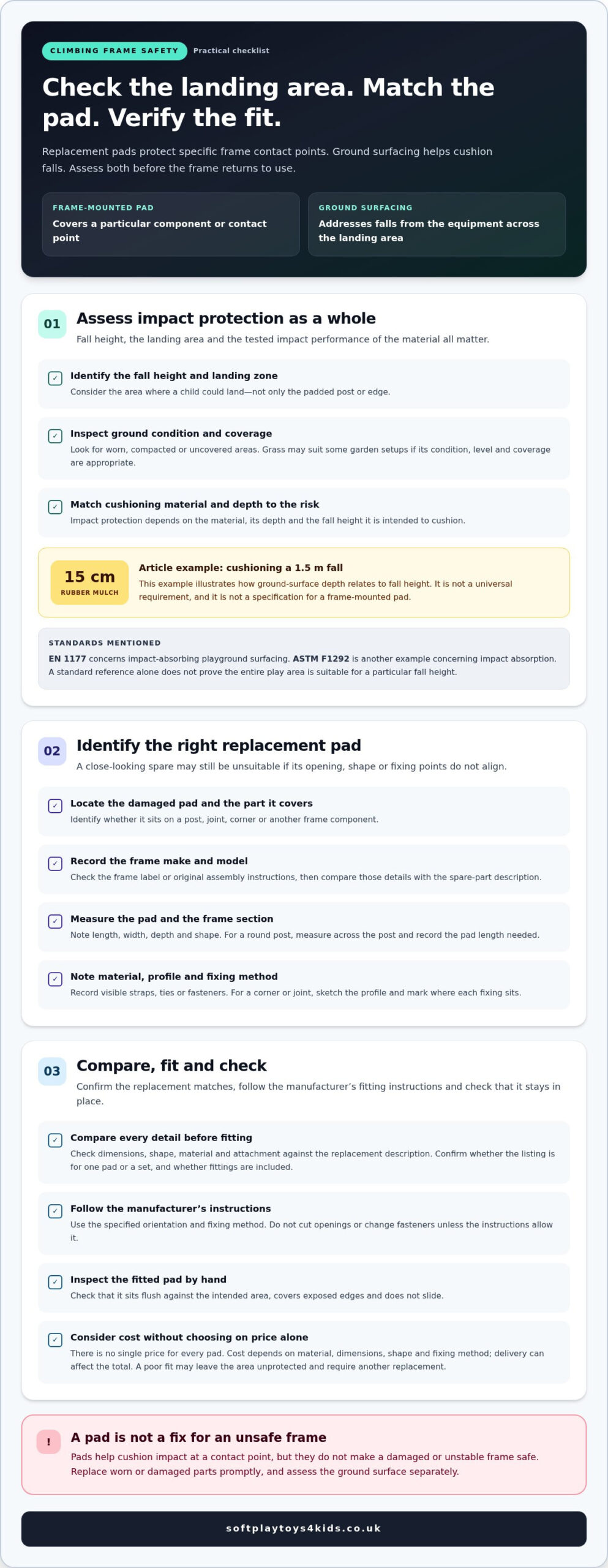
As an example, 15 cm of rubber mulch is given for cushioning a 1.5 m fall from a climbing frame. Use that example only for understanding how depth relates to fall height, not as a universal requirement for every frame. Pad thickness must match the component and manufacturer’s fitting instructions.
Many garden climbing frames fall below the critical height threshold for specialist surfacing, and well-maintained grass can suit some garden setups. However, not every grass area is appropriate: check its condition, level and coverage beneath the frame. If the ground is worn or compacted, assess the landing surface separately from any replacement pad. For commercial play areas, record the chosen surface, material depth and fall-height assessment so these criteria can be revisited during maintenance checks.
Use this practical sequence when assessing impact protection:
- Identify the frame’s fall height and the area where a child could land.
- Inspect the ground surface for worn, compacted or uncovered areas.
- Match any cushioning material and depth to the relevant impact performance.
- Check that replacement pads fit their intended components and follow the manufacturer’s instructions.
Impact absorption depends on the whole setup. A well-fitted pad can protect a specific contact point, while suitable ground surfacing addresses falls from the equipment. Check both before returning the frame to use.
Replacement bumper pads for climbing frames
A bumper pad should fit its intended frame component, stay securely in place and suit the equipment’s design. Before ordering, identify the damaged pad and gather the details needed to match its size, material and fixing method.
Replacement Pad Costs
How much do replacement pads for climbing frames cost in the UK? There’s no single price for every replacement, as the cost depends on the pad’s material, dimensions, shape and fixing method. A small cover for a frame joint differs from a shaped pad designed to wrap around a post.
Compare like with like: check whether the listing is for one pad or a set, and whether fittings are included. Delivery can also affect the total cost. Don’t choose on price alone: a pad that doesn’t fit may leave the area unprotected and need replacing again.
Matching Pads to a Frame Model
How do I measure a climbing frame to order replacement pads? First identify the exact part, then record its length, width, depth and shape. For a round post, measure across the post and note the pad’s required length. For a corner or joint, sketch the profile and mark where each fixing sits.
Record the frame make and model from its label or instructions, then compare the measurements with the spare-part description. Note the material and attachment type, such as straps, ties or fasteners, if visible. A pad that looks similar may still be unsuitable if its opening or fixing points don’t align.
Use this checklist before placing an order:
- Locate the damaged pad and identify the frame component it covers.
- Check the model name, label or original assembly instructions.
- Measure the pad and the section of frame it must cover.
- Note the material, profile and existing fixing arrangement.
- Compare each detail with the replacement description before fitting.
Outdoor parts need materials suited to regular use and exposure to the elements. Replacement parts should be high-quality and made from durable materials, such as metal or heavy-duty plastic where appropriate for the component. For a bumper pad, check that the covering is intact and its attachment can hold it securely in place.
Follow the manufacturer’s instructions when replacing a part. They explain how to install it correctly, including its orientation and fixing method. Don’t adapt a pad by cutting openings or changing its fasteners unless the instructions allow it. An altered fit can leave gaps or loosen during play.
After fitting, inspect the pad by hand. Check that it sits flush against the intended area, covers exposed edges and doesn’t slide when gently moved. Then check nearby bolts, caps and frame joints for visible movement or damage. If the pad shifts, has gaps or cannot be secured as instructed, keep the equipment out of use until the fit is corrected.
Keep the measurements and model details with the frame instructions. This record makes future replacements easier to match, especially if an old pad is too damaged to measure accurately. A clear photograph of the part in place can also help distinguish a post cover from a joint or edge pad.
Signs that a climbing frame part needs replacing
Climbing frames change with use and exposure to the British weather. A split pad, loose fixing or frayed rope can signal that a part needs attention. Inspect the whole structure regularly, not just the areas children use most. Check connections, moving parts and surfaces that protect against contact or falls.
How often should climbing frame pads be replaced, and what signs indicate wear? There’s no fixed replacement interval in the available guidance. Inspect pads regularly and replace them as soon as you notice damage, wear or movement that affects their fit.
Check bumper pads and bolt caps closely. A pad that has split, shifted or come loose may no longer cover the intended area. Worn bolt caps can expose the fixing beneath, while missing or damaged caps at the ends of metal tubes or poles can leave a contact hazard. Leaving worn caps and pads in place may also affect frame stability.
Other parts show different signs of wear. Outdoor swing seats can deteriorate through frequent use or exposure to the elements. Ropes and chains may fray or weaken; climbing holds can wear down or become loose. Bolts and screws may loosen or become damaged, while safety mats can develop worn or damaged areas. Inspect each affected part closely, including its connection to the frame.
- Pads and caps: Look for splits, loose edges, movement, missing covers or exposed tube ends.
- Swing seats: Check for damage and wear on the seat and where it attaches.
- Ropes and chains: Look for fraying, weakened sections or damaged connections.
- Climbing holds: Check for wear, looseness or movement against the frame.
- Bolts and screws: Look for loose, missing or damaged fixings.
- Safety mats: Inspect the surface for worn or damaged areas.
When you find a problem, assess nearby parts too. A loose bolt beside a shifting pad, for example, may mean the connection also needs attention. Don’t treat tightening as a fix for damaged hardware: replace worn or damaged parts promptly. Follow the manufacturer’s instructions for replacements, then check that each part sits securely and works as intended.
Keep children away from any section with a visibly damaged or loose part until the issue is addressed. After a repair or replacement, test the part: check that a pad stays in place, a hold doesn’t move and a swing seat is securely attached and supports weight. Regular inspections help catch small changes before they become more serious problems.
Spare parts availability
Finding a suitable spare starts with the frame’s make, model and the exact part that needs replacing. A pad for a vertical post, for example, may differ from one designed for a joint or exposed edge.
Can replacement pads be made to measure for non-standard climbing frames? A non-standard frame may need a pad shaped to fit its dimensions and fixing points. The measurements, material and attachment method determine what the replacement needs to match.
Are universal replacement pads compatible with different climbing frame brands? Not automatically. A universal label doesn’t prove a pad’s dimensions, opening or fixings will suit every brand, so compare its specifications with your frame before fitting it.
Start by checking the frame’s original instructions, product label or parts diagram. These can identify the model and show where the original pad was positioned. If the label has faded, use the frame’s shape and component layout to distinguish a post cover from a connector pad. Keep a photograph of the whole frame and a close-up of the part for reference.
- Record the frame make and model from its label or assembly instructions.
- Name the part and the component it protects, such as a post or joint.
- Measure its length, width, depth and opening where relevant.
- Note the material and how the existing pad attaches.
- Compare these details with the replacement’s stated specifications.
Measurements matter: a pad that’s too short can leave part of a post exposed. A loose opening or mismatched fixing can also let the pad move during play. Check the fit against the frame itself, rather than relying on a similar-looking product image or brand name alone.
For outdoor frames, replacement parts should be high-quality and made from durable materials, such as metal or heavy-duty plastic where appropriate. The pad’s material still needs to suit its purpose and fixing method. Follow the frame manufacturer’s instructions, especially if they specify a particular attachment arrangement.
If the original part is difficult to identify, use the measurements and model details to narrow your search. A sketch can show a curved edge or unusual cut-out that measurements alone might miss. Keep the old pad until you’ve matched the replacement, if it can be removed safely and doesn’t present an immediate hazard.
After fitting a spare, check that it sits securely and works as intended. Make sure the pad doesn’t shift and its fasteners hold it in place. For a swing seat, inspect the attachment and test that it supports weight before children use it. Matching the part carefully, installing it correctly and testing it afterwards help return the equipment to play safely.
How do I identify the correct replacement pad for my climbing frame model?
Start with the frame itself, not a product photo that looks similar. Find the make and model on its label or in the assembly instructions, then identify the damaged pad’s exact position. A cover around a vertical post needs different dimensions from padding fitted over a corner joint.
Next, record the part’s specifications. Measure its length, width and depth, and note its shape, material and fixing method. For a curved pad, sketch the profile and mark the opening or cut-out. These details help distinguish a close visual match from a part that will actually fit.
If the original pad is still attached, use it to understand how it sits against the frame. Note where its edges meet, how far it extends and where straps or fasteners hold it. If it has already been removed, compare the exposed frame section with the instructions or parts diagram. A photo of the frame and a close-up can help you keep each part identified.
Build a simple record before looking for a spare:
- Frame identity: Write down the make and model shown on the label or instructions.
- Part location: Describe whether the pad covers a post, edge, corner or connection.
- Measurements: Record length, width, depth and any opening needed for the frame.
- Shape and material: Note curved edges, cut-outs and the material of the existing pad.
- Attachment: Describe the straps, fasteners or other fixing points visible on the frame.
Compare every detail with the replacement description instead of relying on the brand alone. A pad made for another model may have different fixing points, even if both frames share a similar colour or shape. A universal label doesn’t guarantee a fit either. Check the dimensions and attachment arrangement against your recorded details.
Prioritise the manufacturer’s instructions if they specify a part or fitting method. Follow them during installation, including the pad’s orientation and how its fasteners sit. Don’t cut a replacement or reposition its fixings to force a fit. An altered shape can leave a gap or prevent the pad from staying secure.
Once installed, compare the pad with the exposed area you recorded. Check that it covers the intended section, faces the right way and doesn’t slide when gently moved. Inspect the fasteners and nearby frame connection too. If the pad shifts or leaves an exposed edge, stop and reassess the fit before children use the equipment.
Keep your notes, sketch and frame instructions together. If another pad wears out later, these records make it easier to identify the part without relying on a damaged sample. For an unusual frame shape, the measurements and profile sketch are especially useful when searching for a suitable replacement.
SoftplayToys4kids: Soft Play Ball Pits
SoftplayToys4kids offers Lamp Post Protectors for settings where exposed posts need a protective covering. They’re a separate option from climbing-frame pads, but may suit a play area with posts that need protection from contact. Choose protection according to the post and its location, and keep inspecting climbing equipment and its parts as described above.
If you’re also creating a play space for younger children, sensory toys can complement suitable play equipment. Choose items according to the needs of the play area and how children use it. They have a different purpose from a correctly fitted climbing-frame part and should not be treated as a substitute.
Visit SoftplayToys4kids online to explore its play equipment and protective products.
Make the next step a confident one
A well-kept play space depends on thoughtful choices as equipment changes. Keep the frame’s details and measurements together so you’re ready to identify a suitable part when a pad needs attention. When choosing replacement pads for climbing frames, start with the fit and the frame manufacturer’s instructions.
SoftplayToys4kids also offers Soft Play Ball Pits, Soft Play Mats and Sensory Toys for children’s play spaces. These are separate additions, not substitutes for a correctly fitted climbing-frame pad. Choose what suits your setting and the way children play there.
For a next step, share your needs with SoftplayToys4kids and explore the available options. Contact SoftplayToys4kids about replacement pads, and keep building a play area that’s ready for happy, active days.
Frequently Asked Questions
When is a climbing frame spare part needed?
Repair or replace a part when damage affects its fit, movement or protective function. For example, a pad that shifts during use, a visibly frayed chain or a bolt that won’t stay tight needs attention. Inspect the equipment after severe weather or unusually heavy use too, as these conditions can reveal fresh damage. Keep children off affected equipment until the problem is addressed and the repaired part has been checked.
Are climbing frame accessories easy to attach?
Some accessories are straightforward to fit, while others need tools or careful alignment. The part’s design and the frame’s fixing method determine the work involved. A replacement cap may fit differently from a pad secured around a post. Depending on the part, you may need a wrench, screwdriver or pliers. Follow the frame manufacturer’s instructions, and don’t improvise with fixings that alter how the accessory attaches.
What types of replacement pads are available for climbing frames?
Common protective options include bumper pads for contact points, covers for posts or columns, and safety mats for the play area. These have different purposes: a post cover protects a frame component, while a mat provides a surface beneath equipment. Choose according to the area needing protection and the frame’s design. Don’t assume a mat replaces a fitted pad or that one pad type suits every location.
Where can I buy replacement climbing frame pads in the UK?
For a model-specific spare in the UK, use the frame’s parts information and match the part to its make, model and dimensions. SoftplayToys4kids sells safety pads and column padding for play environments, which may suit wider protection needs. These offerings shouldn’t be confused with a guaranteed match for every climbing frame. Compare the product’s intended use and fit with the equipment before choosing.
How do I fit and secure replacement pads safely?
Use the manufacturer’s fitting instructions and the correct fixings for the pad and frame. Carefully remove damaged parts, then position the replacement as directed without cutting or altering it to force a fit. Secure its attachments and check for gaps, slipping or exposed edges. Test the fitted part before children return to play. If you’ve also replaced a swing seat, check its attachment and that it supports weight.
Leave a Reply