
Fire Retardant Foam for Soft Play: A Parent and Provider’s Safety Guide

Did you know that a single piece of non-compliant foam can ignite and fill a room with toxic smoke in less than 60 seconds? It’s a terrifying thought for any parent or nursery provider, especially when the UK market is increasingly flooded with cheap, untested imports. You want your children to enjoy “new wild fun” in a secure space, and choosing the correct fire retardant foam for soft play is the most vital decision you’ll make for their safety. We understand the confusion caused by complex safety labels and the genuine fear of accidentally buying a hazardous product for your little ones.
You deserve to feel confident that every giggle and jump happens on equipment that meets the highest British standards. This guide will help you master the BS 5852 requirements and finally understand the life-saving difference between “fire resistant” and “fire retardant” materials. We’ll show you exactly how to spot premium, UK-made equipment from our West Yorkshire factory so you can provide a fun environment with total peace of mind. Check the facts with us before you checkout your next play set.
Key Takeaways
- Learn why BS 5852 ‘Crib 5’ testing is the essential benchmark for safety and how to identify genuine CMHR foam for your play area.
- Understand the life-saving differences between standard upholstery materials and specialised fire retardant foam for soft play to protect against the dangers of toxic smoke.
- Discover how to spot high-risk, non-compliant imports from unregulated markets that could compromise your facility’s safety and insurance.
- See why a fire-safe environment depends on a certified 610gsm non-toxic PVC cover and foam working together as a complete, compliant system.
- Find out why choosing equipment lovingly handmade in West Yorkshire ensures your products meet the highest UK standards before you checkout.
What is Fire Retardant Foam for Soft Play and Why Does it Matter?
Are you planning a new play area for your nursery or a fun zone in your home? Ask any parent what they want most for their child and the answer is always the same. They want them to be happy, have fun learning, and play in a safe environment. This is where fire retardant foam for soft play becomes the most important part of your equipment list. It isn’t just a technical spec; it’s the invisible shield that protects your “bundle of joy” during their wildest adventures.
In the soft play industry, we use Combustion Modified High Resilience (CMHR) foam. This is a world away from the standard upholstery foam you might find in a cheap sofa or an imported toy. Standard foam acts like solid fuel in a fire, but CMHR foam is engineered to behave differently. To understand the science, you should look at what flame retardants are and how they function. These chemical additives are mixed into the foam during the manufacturing process to interfere with the combustion cycle. This ensures that if a heat source touches the material, it doesn’t immediately erupt into an uncontrollable blaze.
Why is this the number one priority for schools and nurseries? In a 2023 safety review, it was highlighted that children’s play areas often contain high volumes of synthetic materials. If those materials aren’t compliant, a small accidental spark can lead to a flashover in under 180 seconds. Our UK safety culture is among the strictest in the world for a reason. We don’t take risks with children’s lives. Every product lovingly handmade in our West Yorkshire factory meets these rigorous demands because safety and quality are our core promises.
Fire Retardant vs. Fire Resistant: Clearing the Confusion
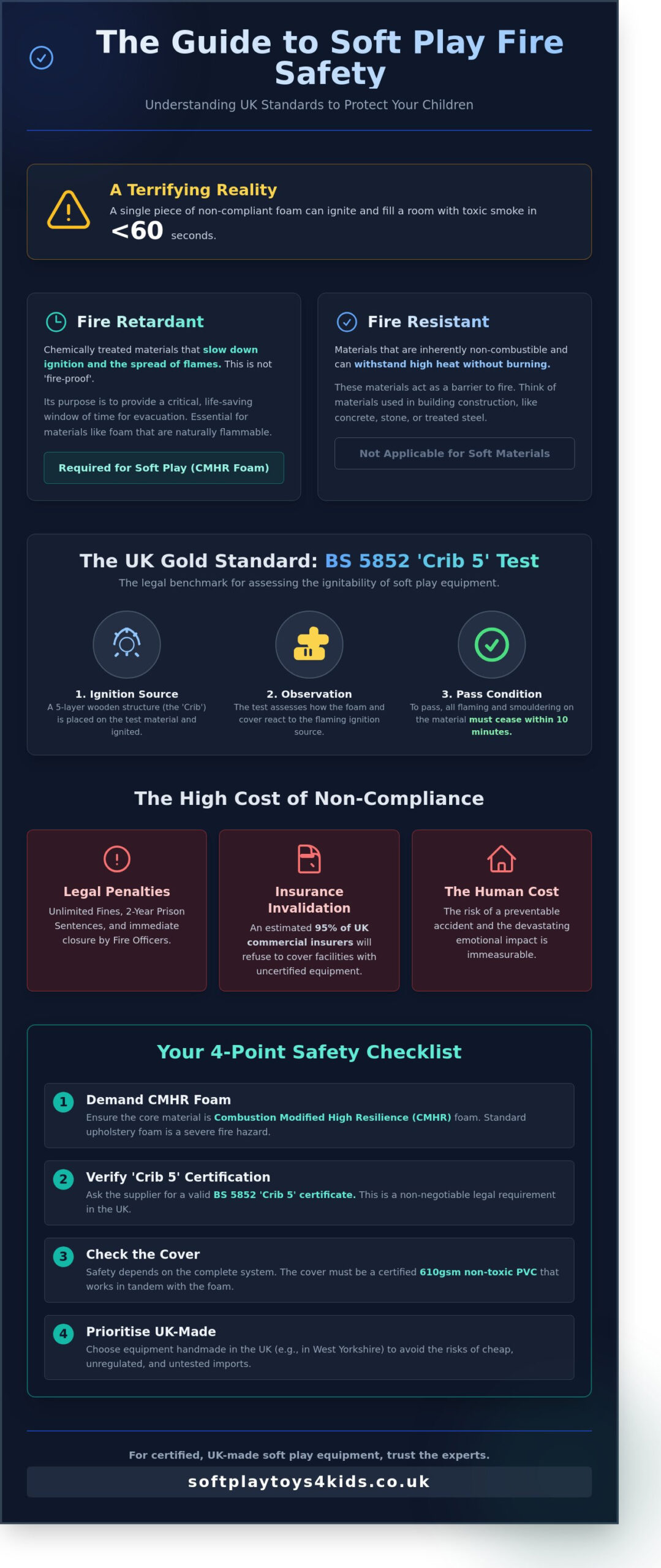
Do you know the difference between these two terms? Many people use them interchangeably, but they mean very different things in a safety context. Fire resistant materials, like stone or treated steel, are naturally designed to withstand heat without burning. However, soft play needs to be, well, soft! Since foam is an organic polymer, it can’t be 100% fireproof. Instead, we make it fire retardant. Fire retardancy is the time-delay factor in ignition that provides a life-saving window for evacuation. By slowing the spread of flame, these materials give caregivers the vital minutes needed to get every child to safety.
The Legal Requirement for Soft Play in the UK
In the United Kingdom, we follow the Furniture and Furnishings (Fire Safety) Regulations 1988. These laws aren’t just suggestions; they’re strict requirements for any upholstered items, including ball pools, climbing wedges, and sensory mats. Whether you’re buying for a commercial centre or a domestic playroom, the foam must pass the “Crib 5” flaming ignition source test. Check Us Out Before You Checkout to ensure your supplier provides this certification.
The consequences of using non-compliant foam are severe. For a commercial play centre, using uncertified materials can lead to immediate closure by the Fire Officer, unlimited fines, or even a 2-year prison sentence for the business owner. Beyond the legalities, the emotional cost of a preventable accident is immeasurable. We proudly offer high-quality, compliant equipment that gives you total peace of mind. When you choose fire retardant foam for soft play that meets UK standards, you’re investing in a “price-beater guarantee” for your children’s safety.
Understanding British Standards: The BS 5852 Benchmark
When you’re building a play area, you aren’t just buying blocks and mats. You’re buying peace of mind. In the UK, the law is crystal clear. The British fire safety standards established in 1988 dictate exactly how furniture and soft play components must behave under heat. The BS 5852 standard is the primary benchmark for assessing the ignitability of upholstered items by using different ignition sources, known as ‘Cribs’.
A ‘Crib 5’ test involves a wooden structure made of five layers of sticks, which is placed on the foam and ignited with propan-2-ol. For the foam to pass, all flaming must cease within 10 minutes. In higher-risk environments, ‘Crib 7’ is used. This involves a much larger 126-gram wooden stack that burns more intensely. Choosing the right fire retardant foam for soft play is a legal obligation; 95% of UK commercial insurers will refuse to provide public liability cover if your equipment lacks these specific certifications. We take this seriously because your children’s safety is non-negotiable.
Manufacturers also test for ‘Source 0’ (smouldering cigarettes) and ‘Source 1’ (match flames) to ensure the entire assembly is resilient. High-density foam plays a massive role here. It prevents ‘pool fires’, which occur when low-quality foam melts into a liquid puddle of fuel. High-quality foam chars instead of melting, keeping the fire contained and giving staff those vital extra seconds to evacuate the building safely.
What is CMHR Foam?
CMHR stands for Combustion Modified High Resilience foam. It’s the gold standard for safety. During the manufacturing process, minerals like graphite or hydrated alumina are added to the chemical mix. These minerals act as a built-in fire extinguisher. When heat hits the foam, these additives release water vapour or create a carbonaceous char that blocks oxygen. Our West Yorkshire factory only uses premium fire retardant foam for soft play to ensure every giggle happens in a safe environment. The ‘High Resilience’ part is just as vital. It ensures your ball pits and mats don’t sag or lose shape after six months of heavy use. Cheaper, unregulated alternatives often crumble or ‘bottom out’, creating trip hazards and failing fire tests simultaneously.
How to Read a Safety Certificate
Don’t just take a salesman’s word for it. Always ask for a formal specification sheet. You need to look for a UKAS-accredited laboratory stamp. This proves an independent body tested the material. A common mistake is relying solely on a ‘CE’ or ‘UKCA’ mark. While these are important for general toy safety, they don’t specifically guarantee that the foam meets the stringent BS 5852 Crib 5 requirements for commercial use. Look for the specific mention of ‘BS 5852:2006’ and the ‘Crib 5’ designation on the report. If a supplier cannot produce a certificate dated within the last 3 years, it’s time to check us out before you checkout to ensure you’re getting the latest, safest materials. Safety isn’t just a tick-box exercise; it’s the foundation of your business.
The Risks of Non-Compliant Foam and How to Spot It
Are you tempted by that bargain price tag on a third-party marketplace? Think twice. Buying cheap soft play equipment from unregulated international markets might seem like a win for your budget, but it’s a massive gamble with your child’s safety. These products often bypass the strict UK safety regulations that keep families safe. When you opt for uncertified materials, you’re inviting a “Trojan Horse” of fire hazards into your home or business. Standard polyurethane foam is essentially solid fuel; it’s made from petroleum products. Without the correct fire retardant foam for soft play, a small spark can turn a playroom into a furnace in under 180 seconds.
The heat isn’t the only killer. Toxic smoke is the primary cause of death in domestic fires involving foam furniture. According to UK Home Office fire statistics for 2023, smoke inhalation is responsible for over 50% of fire-related fatalities. Non-compliant foam releases hydrogen cyanide and carbon monoxide when it burns. Research into the potential toxic effects of exposure to certain cheap flame retardants and non-regulated chemicals shows that the risks start long before a fire even breaks out. These chemicals can off-gas, filling your nursery or play centre with invisible hazards. Why take that risk with your bundle of joy?
Second-hand equipment is another safety gamble that rarely pays off. While the low price is tempting, foam degrades over time. Items manufactured before the 1988 Furniture and Furnishings (Fire Safety) Regulations, or those that have lost their original labelling, might no longer meet current safety standards. You can’t see the chemical composition of the internal core just by looking at the cover. If the foam has become crumbly or “dusty” when pressed, it’s a sign the internal structure is failing, which makes it even more flammable and dangerous.
Red Flags When Buying Soft Play Equipment
Is the price too good to be true? If a full ball pool set is retailing for under £80, it’s unlikely to contain genuine fire retardant foam for soft play. High-quality FR materials cost significantly more to manufacture; there’s no way around that reality. Always look for a permanent label stating compliance with BS 5852. If the product arrives with a pungent, “sweet” industrial smell, it’s a major red flag. This often indicates the use of volatile organic compounds (VOCs) that haven’t been properly treated or aired out at a UK-based factory like ours in West Yorkshire.
The True Cost of ‘Saving’ on Safety
For business owners, the financial fallout of using non-compliant gear is devastating. If a fire occurs and your equipment doesn’t meet British Standards, your insurance provider will likely invalidate your claim, leaving you with 100% of the liability and potential criminal charges. But the emotional cost is what really matters. No parent wants to imagine the unthinkable. We always tell our customers: “Check Us Out Before You Checkout” elsewhere. We proudly offer high-quality, lovingly handmade equipment because your peace of mind is worth more than a few saved pounds. On average, the price difference between a dangerous, non-compliant foam block and a safe, British-made version is only about £12 per unit. Isn’t your child’s safety worth twelve quid?
Beyond the Foam: PVC Covers and Chemical Safety
Safety doesn’t stop at the core. Your fire retardant foam for soft play needs a partner to provide total protection. That partner is the outer cover. In our West Yorkshire factory, we use 610gsm PVC as the industry standard. It’s tough. This specific weight provides the ideal balance between flexibility for tumbling and the durability required to resist punctures. If a cover tears, the internal foam loses its first line of defence against heat and ignition.
Think about the way the pieces are joined. Welded seams offer a massive safety advantage over traditional stitching. While stitching is common, it creates thousands of tiny needle holes. These holes let in air. In the event of a fire, air acts as fuel. Our heat-welded seams create a continuous, airtight barrier. This keeps the internal foam protected from external heat sources for much longer. It’s a small manufacturing detail that makes a huge difference in a real-world emergency.
We believe the skin of your equipment should be just as safe as the inside. When you invest in fire retardant foam for soft play, the outer skin acts as a critical heat shield. Using high-quality, 610gsm non-toxic PVC ensures that the equipment remains flame-resistant while standing up to the daily rigours of a busy commercial play centre.
Non-Toxic and Fire Retardant: Can You Have Both?
Parents often worry that “fire retardant” means a product is coated in nasty, harsh chemicals. That’s a myth we love to debunk. Modern UK manufacturing has moved away from those old, smelly treatments. We use aqueous-based coatings that provide incredible flame resistance without the toxic off-gassing. Our PVC is also 100% phthalate-free. This is vital because toddlers spend a lot of time with their faces pressed against these mats. You can choose our vibrant, primary colours knowing they’re safe for teething babies who explore everything with their mouths.
Maintaining Your Soft Play for Long-Term Safety
Keeping your equipment clean shouldn’t come at the cost of its safety properties. Harsh industrial bleaches or solvent-based cleaners can actually strip away the fire-retardant layers on PVC over time. We recommend using mild, pH-neutral soapy water to keep things hygienic. It’s also essential to check for foam degradation during your weekly inspections. If you notice “crumbs” or yellow dust leaking from seams, it’s time for a replacement. Old, brittle foam loses its structure and can become more flammable because of the increased surface area of the debris.
- Inspect all seams weekly for signs of wear or accidental damage.
- Avoid abrasive sponges that scratch the protective 610gsm PVC coating.
- Keep play areas well-ventilated to prevent moisture from getting trapped inside the foam.
- Replace any unit immediately if the PVC cover is breached or torn.
We take pride in every piece that leaves our floor, ensuring it meets the strictest UK safety regulations. Don’t settle for cheap imports that cut corners on material weight or chemical safety. Check Us Out Before You Checkout and see why our UK-made soft play equipment is the trusted choice for safety-conscious parents and play providers.
Why SoftplayToys4kids is the UK’s Trusted Choice for Safe Play
Ask any parent what they want most for their child, and the answer is always the same. They want them to be happy, to have fun learning, and to play in an environment that is 100% safe. At SoftplayToys4kids, we don’t just sell toys; we manufacture peace of mind. We’ve spent over 12 years perfecting our manufacturing process to ensure that every giggle is backed by the highest British safety standards. Our commitment starts with our materials. We use 100% UK-sourced, fire retardant foam for soft play that meets the strict Furniture and Furnishings (Fire Safety) Regulations 1988. This isn’t a “luxury” feature for us; it’s a non-negotiable standard for every ball pit, wedge, and step we produce.
Buying direct from our West Yorkshire factory gives you a massive advantage. You aren’t paying for middleman markups or expensive international shipping. You’re paying for quality British craftsmanship. We’re so confident in our value that we offer a Price-Beater Guarantee. If you find a comparable UK-manufactured product for less, we won’t just match it; we’ll beat it. Safety shouldn’t be a luxury that only big commercial centres can afford. We make sure it’s accessible for home playrooms, local nurseries, and community groups alike.
- 100% UK-sourced CMHR (Combustion Modified High Resilience) foam.
- Direct-from-factory pricing with no hidden retail margins.
- Rigorous quality control on every “lovingly handmade” item.
- Fast UK delivery across our entire range of soft play essentials.
Handmade in West Yorkshire
Our Dewsbury-based factory is the heart of everything we do. We’re proud to support local British industry, employing skilled machinists who treat every order as if it were for their own children. This transparency in our manufacturing process means we know exactly what goes into your order. When we create custom designs or bespoke play areas, we never cut corners on safety. Every piece of fire retardant foam for soft play is hand-cut and fitted into our premium, wipe-clean PVC covers. This hands-on approach allows us to maintain a “lovingly handmade” standard that mass-produced imports simply can’t match.
Our Safety Promise to Parents and Providers
We prioritise durability alongside fire retardancy because a safe toy must also be a long-lasting one. Our high-density foam is designed to retain its shape for over 5,000 hours of active play, preventing the “bottoming out” that can lead to injuries on hard floors. We select our materials based on their ability to self-extinguish and their resistance to sagging. Before any product leaves our floor, it undergoes a final 10-point inspection to check seams, zips, and foam density. You can trust that our equipment is built to survive the “new wild fun” of a busy playroom while keeping your bundle of joy protected. Check out our range of safe, handmade soft play sets here!
Don’t settle for “good enough” when it comes to your child’s safety. Check us out before you checkout elsewhere. We’ve built our reputation on being a helpful, reassuring partner for parents across the UK. Whether you’re looking for a single sensory mat or a full commercial setup, our West Yorkshire team is ready to deliver quality you can see and safety you can trust. Join the thousands of UK families who have chosen the SoftplayToys4kids standard for their homes.
Give Your Little Ones the Safest Start Possible
Your child’s safety isn’t something to leave to chance. By choosing equipment that strictly follows the BS 5852 benchmark, you’re investing in peace of mind and long-lasting fun. We understand that parents and providers need absolute certainty. That’s why every piece we create uses premium fire retardant foam for soft play that meets rigorous UK safety standards. Our CMHR foam is specifically designed to resist ignition; meanwhile, our heavy-duty 610gsm PVC covers provide a non-toxic, durable barrier that stands up to years of giggles and games.
We don’t just sell toys; we lovingly handcraft them right here in our West Yorkshire factory. You get high-quality, British-made equipment backed by our famous Price-Beater Guarantee. Check us out before you checkout to see why thousands of UK families trust us for their “new wild fun”. Whether you’re setting up a home nursery or a commercial play centre, our gear is built to last.
Secure your child’s safety today with our UK-made, fire-retardant soft play equipment!
It’s time to build a play area where the only thing you’ve got to worry about is who’s winning the game.
Frequently Asked Questions
Is all soft play foam in the UK fire retardant by law?
Yes, all soft play equipment sold within the United Kingdom must comply with the Furniture and Furnishings (Fire Safety) Regulations 1988. These strict laws mandate that both the internal foam and the external covers pass specific ignition tests to ensure child safety. We manufacture every single item in our West Yorkshire factory to meet these exact legal requirements. You should always look for a permanent label that confirms compliance with these 1988 safety standards before you make a purchase.
How can I tell if my old soft play mats are still fire-safe?
You can identify fire-safe equipment by locating a permanent fire safety label stitched into the seam, which has been a legal requirement for all UK-manufactured soft play since 1988. If the label is missing, torn, or illegible, you cannot guarantee the product’s safety. Foam typically has a functional lifespan of 10 to 15 years before it starts to degrade and lose its structural integrity. If your mats are over a decade old or the internal material feels crumbly, it is time to upgrade to new fire retardant foam for soft play to keep your little ones protected.
Does fire retardant foam smell or contain harmful chemicals?
High-quality modern foam does not have a strong chemical odour and is completely safe for children to climb on and enjoy. We use foam that meets REACH standards and is free from harmful levels of formaldehyde or heavy metals. While some brand-new foam might have a slight “new car” scent for the first 48 hours, this quickly vanishes in a ventilated room. Our UK-made products prioritise health just as much as fire safety, so your bundle of joy can play without any worries about toxic emissions.
What is the difference between Crib 5 and standard fire retardancy?
Crib 5, also known as Source 5, is a more rigorous fire test required for commercial environments like hotels and nurseries under BS 5852 standards. While standard domestic foam passes a simple match and cigarette test, Crib 5 materials must withstand a much more intense flame from a wooden “crib” structure. If you’re running a commercial soft play centre, you must ensure your equipment meets these higher Crib 5 requirements to comply with UK insurance and safety laws. We proudly offer high-quality options that meet these demanding commercial specifications.
Can I buy fire retardant foam inserts separately for DIY projects?
You can certainly purchase fire retardant foam for soft play inserts separately for your own bespoke DIY builds. However, you must remember that the foam is only one part of the safety puzzle. For a project to be truly fire-safe, your outer fabric must also be fire retardant to BS 7176 standards. We offer custom-cut foam blocks directly from our factory, ensuring you get the same premium quality we use in our own professional ball pools and play sets. Check us out before you checkout elsewhere for your DIY supplies.
Why is fire retardant foam more expensive than regular foam?
The higher price reflects the cost of the specialised fire-retardant additives and the rigorous laboratory testing required to meet British Safety Standards. Standard upholstery foam lacks these life-saving chemicals, making it dangerous in a fire even if it feels similar to the touch. On average, fire-rated foam costs 15% to 25% more than non-treated alternatives found in discount shops. We believe this small extra investment is a tiny price to pay for the peace of mind that your children are playing in a safe environment.
What happens to fire retardant foam if it gets wet or damp?
Getting the foam wet won’t wash away its fire-retardant properties because the chemicals are permanently bonded into the material during the manufacturing process. However, damp foam can become a breeding ground for mould and bacteria within 24 to 48 hours if left untreated. This is why we use wipe-clean, waterproof PVC covers on our soft play items to keep the core dry. If water does manage to get inside, you should remove the cover and allow the foam to air dry completely in a warm, well-ventilated room.
Do home playrooms need the same fire standards as commercial nurseries?
Every piece of soft play equipment sold for domestic use in the UK must still meet the 1988 Fire Safety Regulations. While commercial nurseries often require the stricter Crib 5 certification for their specific insurance policies, your home playroom deserves the same level of protection against fire risks. We don’t cut corners on safety just because a product is intended for home use. Every mat and block we hand-make in our UK factory offers the same high-quality fire resistance to keep your family safe and happy.
Leave a Reply