
What Age Is Soft Play Suitable For?
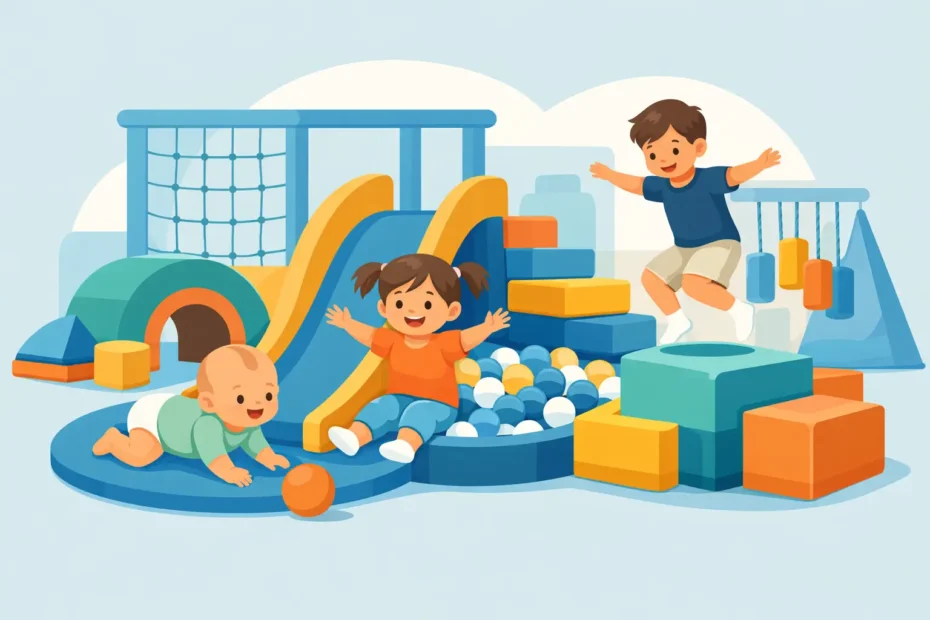
A six-month-old and a four-year-old can both enjoy soft play, but they should not be using the same setup in the same way. That is the real answer to what age is soft play suitable for. It is not about one fixed age bracket. It is about matching the equipment to the child’s stage, confidence, movement and supervision needs.
For parents buying for the home, and for nurseries or playgroups fitting out a room, getting that match right matters. Choose well and soft play becomes safe, active, confidence-building fun. Choose badly and you can end up with equipment that is too advanced, too basic or simply not used properly.
What age is soft play suitable for at each stage?
Soft play can be suitable from infancy right through the early primary years, provided the equipment is age-appropriate. Babies benefit from soft, low-level pieces that support tummy time, crawling and early climbing. Toddlers usually get the most out of soft play because they are constantly testing balance, coordination and movement. Preschool children still love it, but they often need more challenge and more varied layouts to stay engaged.
That means there is no single start-and-stop answer. In practical terms, most soft play use falls into three broad stages: babies from around 6 months, toddlers from 1 to 3 years, and older children from 3 to 5 years and beyond. Each stage needs different shapes, different heights and a different level of adult oversight.
Soft play for babies
For babies, soft play is less about adventure and more about safe sensory movement. At this stage, the best options are play mats, low foam wedges, simple crawl shapes and soft blocks that encourage rolling, sitting, crawling and pulling up. Ball pits can also work well for babies, but only when they are designed for younger children and used under close supervision.
The key point is scale. Babies do not need tall slides or complex climbing sets. They need soft, stable, easy-to-clean equipment with gentle edges and enough room to move safely. If you are buying for home use, a compact setup often works better than a larger one because it keeps everything controlled and easier to supervise.
Soft play for toddlers
This is the age where soft play really comes into its own. From around 12 months to 3 years, children are learning to climb, step, crawl through spaces, balance and judge distances. A good soft play setup gives them a safe way to practise all of that without hard surfaces and sharp corners.
Step-and-slide units, small balance beams, soft play shapes, corner climbers and toddler ball pits are usually ideal at this stage. Toddlers need enough challenge to stay interested, but not so much height or complexity that play turns into constant rescue missions for adults. The best equipment builds confidence one movement at a time.
For nurseries and commercial settings, this is often the busiest age group for soft play because the developmental benefits are obvious. Children can burn energy, improve coordination and learn to share space with others, all while playing on equipment built for active use.
Soft play for preschool and early years children
From around 3 to 5 years, children are often more adventurous and physically capable. They still enjoy soft play, but they may outgrow very basic baby shapes quite quickly. At this stage, modular layouts, larger activity sets, more varied beam sections and obstacle-style arrangements can keep them interested for longer.
This is also where buying quality matters. Older children are heavier, faster and more confident, so equipment needs to be durable as well as child-safe. For schools, preschools and indoor play businesses, it makes sense to invest in commercial-grade pieces that can handle repeated daily use without losing shape or support.
When is soft play not suitable?
Soft play is not automatically suitable just because a child falls into a broad age range. Some pieces are too advanced for babies. Some are too small or too limited for older children. Mixed-age play can also be tricky, especially if larger children are moving quickly near younger toddlers or infants.
You also need to consider individual development. One 18-month-old may be walking steadily and climbing confidently, while another is still cautious on uneven surfaces. Age is a useful guide, but it should never be the only deciding factor.
If a setup encourages risky falls, leaves babies sharing space with much bigger children, or uses unstable pieces on unsuitable flooring, then it is not the right choice. Safety starts with age suitability, but it also depends on layout, supervision and product quality.
How to choose the right soft play by age
The smartest way to buy is to start with the child, then work backwards to the equipment. Too many buyers do the opposite. They see a large bundle or a colourful setup and assume more pieces always means better value. In reality, the best value comes from equipment that gets used properly and lasts.
For babies, focus on floor-level movement and sensory play. For toddlers, look for climbing, stepping and sliding options with low heights and stable surfaces. For older children, choose sets that offer more challenge without compromising safety.
Space matters too. A home play corner needs a very different approach from a nursery room or soft play centre. In smaller domestic spaces, compact units, foldable mats and multi-use foam shapes are often the practical answer. In commercial or educational settings, larger custom-built arrangements can make better use of available space while keeping age groups more clearly separated.
Home soft play setups
Parents often ask whether soft play is worth it at home, especially for younger children. In many cases, yes – if you choose pieces that fit both the child and the room. Home soft play works best when it solves a real need, such as safe indoor activity on rainy days, active play in limited space or a softer environment for early movers.
There is no benefit in overfilling a lounge or playroom with equipment that dominates the space and is awkward to clean. A few well-chosen pieces usually outperform a cluttered setup. Play mats, wedges, small slides and soft shapes can go a long way when they are built well and easy to rearrange.
Nursery and commercial soft play setups
For professional settings, age suitability becomes even more important because more children are using the equipment every day. Nurseries need pieces that support early years development and are simple to clean between sessions. Soft play centres and larger venues need layouts that guide different ages into suitable zones.
That is why bespoke options are often the stronger investment. Instead of forcing a standard set into a room, custom sizing and colour choices allow buyers to build around the space, the age group and the expected level of use. It is a practical way to improve both safety and long-term value.
What features matter most for age-appropriate soft play?
The first is height. Younger children need low-level equipment that reduces fall risk and supports confidence. The second is surface stability. Foam shapes should hold their form properly and sit securely on the floor. The third is hygiene. Whether you are buying for home or trade, wipe-clean covers and durable finishes make everyday use easier.
Beyond that, think about progression. The best soft play equipment does not just entertain for a week. It gives children room to develop new movements and new confidence over time. A good setup should feel accessible at first, then stay useful as skills improve.
This is where quality manufacturing makes a difference. Poorly made soft play can flatten too quickly, split at the seams or become less supportive with regular use. Better-made pieces keep their structure, clean up well and provide more dependable value, especially in busy family homes and commercial environments.
So, what age is soft play suitable for really?
If you want the simple version, soft play is generally suitable from around 6 months up to 5 years and often beyond, depending on the design. The more accurate version is that soft play is suitable whenever the equipment matches the child’s developmental stage, size and confidence.
That is why buying on age label alone is not enough. You need to look at the type of movement the child is ready for, how much space you have, and whether the equipment is built for domestic or commercial use. Parents need practical products that are safe, affordable and easy to manage. Nurseries and play businesses need durable sets that can handle regular use while still supporting child development.
Softplay Toys4Kids understands that balance because one size never fits every child or every setting. From baby mats and first-climb shapes to larger modular setups for nurseries and soft play venues, the right choice is always the one that matches the age, the space and the level of use.
If you are deciding what to buy, think less about the broad age printed on a label and more about how a child will actually move, play and grow with the equipment. That is where soft play proves its value.
Leave a Reply