
Soft Play Equipment Safety Standards UK: The 2026 Compliance Guide

Did you know that properly installed safety surfacing can lower the risk of serious head injuries by up to 79%? For any play provider, ensuring that every ball pit and play mat meets the latest soft play equipment safety standards uk is about more than just avoiding a fine. It’s about protecting those precious moments of childhood joy while securing your business against liability. You want to see kids laughing and exploring, not worry about the hidden dangers of cheap imports or the complex jargon of BS EN 1176.
We know you care deeply about providing a secure environment, but the technical requirements can feel like a maze. This guide simplifies the 2026 compliance landscape, giving you the clarity to choose premium UK manufactured gear with total confidence. You’ll learn exactly what BS EN 1176-10:2023 means for your equipment, how to handle fire safety requirements, and get a practical daily inspection checklist to keep your area secure. Let’s make your play space the superior choice for safety and fun.
Key Takeaways
- Learn the critical differences between BS EN 1176 and BS EN 1177 to ensure both your equipment and safety surfacing meet the highest benchmarks for public use.
- Discover how to navigate soft play equipment safety standards uk by identifying non-toxic, REACH-compliant materials and “Crib 5” fire-retardant foam.
- Understand why investing in commercial-grade durability for your home or business is the smartest way to ensure long-term security and child happiness.
- Master our step-by-step safety checklist, from conducting site surveys to verifying UKCA certifications, to keep your play area compliant and secure.
- Find out why sourcing from a proud UK manufacturer in West Yorkshire guarantees 100% material traceability and protects you from the risks of unbranded imports.
Understanding the Core UK Soft Play Safety Standards: BS EN 1176 and 1177
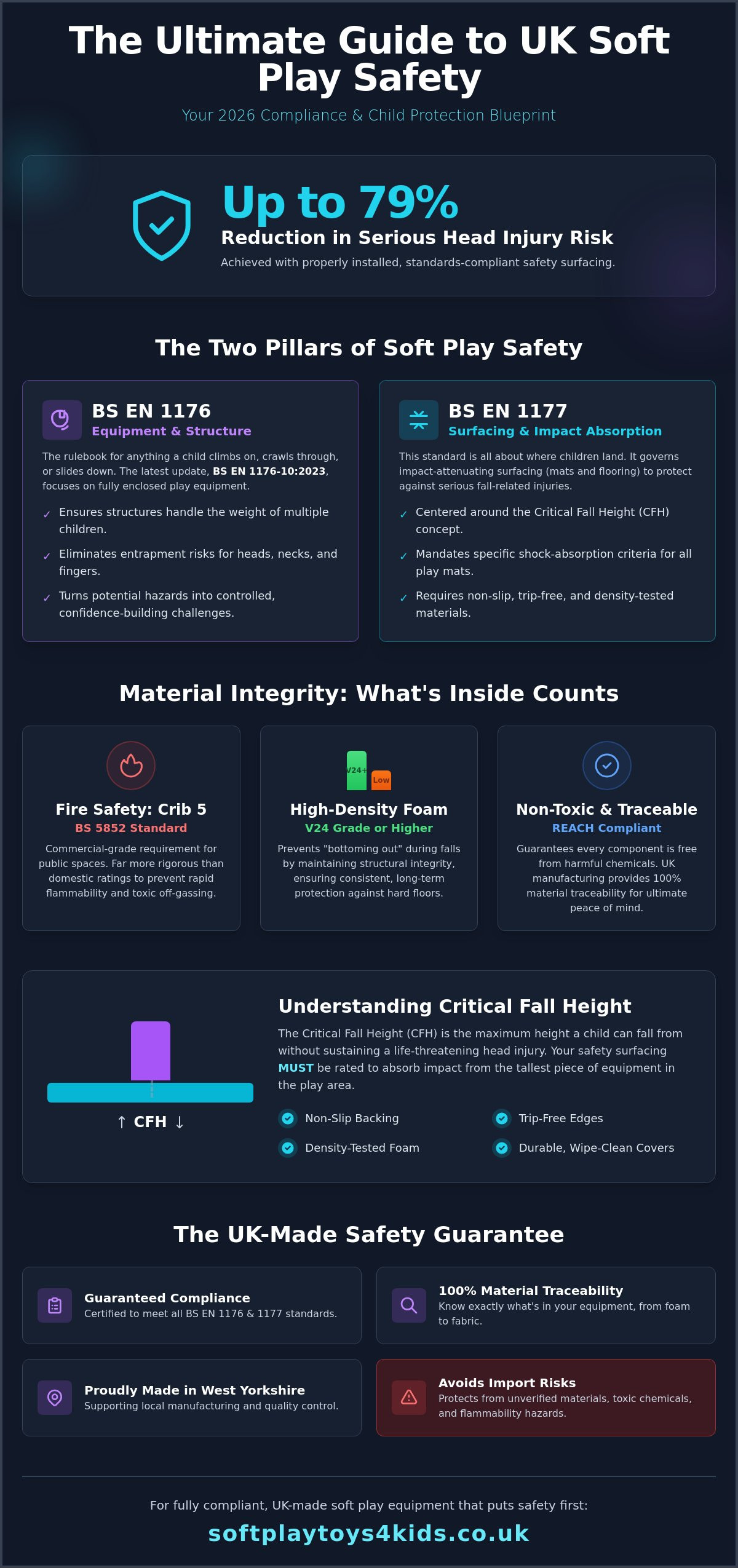
Safety isn’t just a box to tick; it’s the foundation of every giggle and leap in your play area. The British Standards Institution (BSI) sets the bar high to ensure children can push their limits without facing “bad risks” that lead to injury. For anyone running a commercial space or a busy home playroom in 2026, the soft play equipment safety standards uk are your ultimate roadmap to peace of mind. These benchmarks, specifically the European Standards EN 1176 and EN 1177, are updated regularly to reflect the latest research into child development and injury prevention. They provide a clear framework for due diligence, helping you prove that you’ve met your duty of care under UK law.
BS EN 1176: Equipment Structure and Design
This standard is the primary rulebook for anything a child climbs on, crawls through, or slides down. The most recent update, BS EN 1176-10:2023, focuses specifically on fully enclosed play equipment, which is vital for modern soft play centers and ball pits. It ensures that every structure is built to handle the weight of multiple energetic kids at once without buckling or failing. We take this seriously in our West Yorkshire factory. We design our products to eliminate entrapment risks, checking every gap to ensure heads, necks, and tiny fingers can’t get stuck. Whether you’re installing a ball pool or a complex climbing frame, these rules exist to turn potential hazards into controlled, healthy challenges that build a child’s confidence.
BS EN 1177: Impact and Flooring Safety
While 1176 covers the equipment itself, BS EN 1177 is all about where the children land. This standard governs impact-attenuating surfacing, which is a fancy way of saying “mats that actually protect.” It’s centered around the concept of Critical Fall Height (CFH). This technical term measures the maximum height a child can fall from without sustaining a life-threatening head injury. For younger children, choosing the right baby play mats is essential because they must meet specific shock-absorption criteria to be effective. High-quality safety pads and play mats aren’t just pieces of foam; they’re engineered safety systems. To meet the soft play equipment safety standards uk, your flooring must include:
- Non-slip backing to prevent the mat from sliding during high-speed chases.
- Trip-free edge designs that keep the floor level and easily accessible.
- Density-tested foam that provides consistent protection and doesn’t “bottom out” over time.
Investing in equipment that meets these rigorous standards shows you’re serious about quality. It’s the difference between a “cheap fix” and a premium play space that’s built to last and designed to keep every child smiling.
Material Safety: Fire Retardancy and Non-Toxic Requirements
What’s actually inside those colorful play blocks? While many people focus on the shape and size, the chemical makeup of the materials is where true safety begins. To meet the soft play equipment safety standards uk, every component must be as safe as it is fun. We use high-density foam (V24 or higher) because it’s a vital safety feature. This premium foam maintains its structural integrity under pressure, preventing children from “bottoming out” against hard floors during a tumble. It’s about more than just a soft seat; it’s about consistent, long-term protection that cheaper, low-density alternatives simply can’t provide.
Fire safety is another non-negotiable area. We strictly adhere to BS 5852, known in the industry as the “Crib 5” standard. This benchmark is far more rigorous than standard domestic ratings. It’s the level required for contract furniture used in public spaces like schools and play centers. Many cheap international imports bypass these rules, leading to the dangerous “off-gassing” of toxic chemicals or, worse, rapid flammability. Our West Yorkshire factory ensures every batch of fabric and foam is tested to meet these life-saving requirements, giving you total peace of mind.
Fire Safety Standards for Indoor Play
All our soft play covers are flame retardant to UK nursery standards. There’s a massive difference between a toy meant for a private living room and equipment designed for a high-traffic commercial setting. We treat our products with the same care as professional nursery furniture. By following the guidance of the Association of Play Industries (API), we ensure our manufacturing process is transparent and fully compliant with national expectations. We don’t just guess; we verify every material before it ever reaches your play area.
Hygienic and Non-Toxic Surfaces
Kids explore with their hands and, quite often, their mouths. This is why premium PVC is essential for any soft play equipment safety standards uk compliance. The soft play equipment we manufacture uses antimicrobial, REACH-compliant PVC. This ensures every surface is free from harmful phthalates and heavy metals. We use lead-free inks and non-toxic dyes for all our sensory play items, ensuring they’re safe for even the smallest adventurers. Easy-clean surfaces are a health and safety requirement, helping you maintain a hygienic environment that stands up to daily use. Take a look at our range of UK-made safety pads to see how we blend these high standards with vibrant, engaging designs.
Commercial vs. Residential Safety: What Do You Really Need?
Is there really a difference between the gear used in a massive play centre and the set you buy for your lounge? While parents aren’t legally bound by the same Health and Safety at Work Act as business owners, the physical risks to a child remain identical. Choosing products built to soft play equipment safety standards uk for your home means you’re investing in commercial-grade durability. This equipment is designed to survive the high-energy play of hundreds of children, so it’ll easily handle your energetic toddler for years without losing its shape or protective qualities.
For UK businesses, compliance is a survival trait rather than a choice. If you’re a childminder, nursery owner, or play centre manager, using non-compliant equipment can instantly void your liability insurance. Insurers require proof that you’ve followed best practices to protect your clients and your livelihood. We’ve seen a massive rise in “professional-grade” home playrooms lately, where parents choose the same high-standard mats and padding used in schools to ensure their children have the safest possible environment to explore.
Standards for Schools, Nurseries, and Play Centres
Public-facing equipment carries a heavy weight of responsibility. If you’re managing a commercial space, annual RoSPA inspections are essential to verify that your setup remains secure. Every piece of indoor playground equipment you install should be backed by professional logs that track maintenance and cleaning. It’s not just about the gear; your staff need clear training on supervision ratios and emergency evacuation protocols. Safety is a team effort that starts with premium manufacturing and continues with diligent daily management.
Home Soft Play Safety for Parents
Creating a safe haven at home doesn’t have to be complicated. When you’re picking out a ball pit, look for high-walled designs that prevent toddlers from tumbling out onto hard surfaces. The CE and UKCA marks are absolutely non-negotiable; they’re your guarantee that the toy has passed essential safety tests. Always position your play area away from windows, radiators, and sharp furniture corners. By following the same soft play equipment safety standards uk that professionals use, you’re giving your child a world-class play experience right in your living room. We take pride in making that professional quality accessible to every family across the country.
The Ultimate Safety Checklist for Installation and Maintenance
Building a world-class play area is an exciting journey, but the real magic happens in the details of the setup. To stay fully aligned with soft play equipment safety standards uk, you need a systematic approach that starts before the first mat is laid. Begin with a thorough pre-installation site survey. Are the floors perfectly level? Are the wall fixings strong enough to support heavy-duty column padding? Once your site is ready, verify every piece of gear. You must check for UKCA or CE certifications and keep the material data sheets provided by the manufacturer on file. This isn’t just paperwork; it’s your proof of quality and your shield against liability.
Next, perform the “entrapment test.” This is a critical part of the structural requirements we discussed earlier. You need to ensure no gaps exist where a child’s head, neck, or fingers could become caught. Even a small oversight here can lead to serious accidents. Finally, establish a tiered maintenance schedule and document every check in a dedicated safety logbook. If an insurance claim ever arises, this logbook is your best friend. It proves you’ve exercised due diligence and maintained a secure environment for every little visitor. We take immense pride in our West Yorkshire manufacturing process, ensuring every seam is double-stitched for maximum durability.
Daily and Weekly Maintenance Checks
Daily checks are your first line of defense. Walk through the area every morning to look for split seams or exposed foam. These aren’t just unsightly; they can become choking hazards for curious toddlers. Make sure all Velcro joins between your play mats are flush and secure to prevent tripping. Cleanliness is also a safety standard, not just an aesthetic one. Regular sanitization prevents the spread of germs and keeps the PVC surfaces in peak condition. Want to ensure your area stays top-notch? Explore our range of durable safety pads and mats designed for easy maintenance and long-term performance.
Long-term Integrity and Professional Inspections
Over time, even the best foam can lose its bounce. High-traffic areas are prone to “bottoming out,” where the foam no longer provides adequate shock absorption. If a mat feels thin or doesn’t spring back when stepped on, it’s time to retire that piece. For commercial operators, hiring an independent RPII (Register of Play Inspectors International) inspector for an annual review is a brilliant way to ensure ongoing compliance. Understanding what soft play is and how it wears helps you make informed decisions about when to upgrade. We’re proud to manufacture premium replacements in our local factory that meet the most recent 2026 soft play equipment safety standards uk, helping you stay ahead of the curve.
Why UK-Made Matters: The SoftplayToys4kids Safety Guarantee
Why choose mystery when you can have total mastery over your play area’s security? When you opt for unbranded international imports, you’re often unknowingly introducing “mystery materials” into your home or business. These products frequently bypass the rigorous testing required by soft play equipment safety standards uk, leaving you with foam that might be flammable or PVC that contains harmful chemicals. We believe that safety is a manufacturing philosophy, not just a sticker on a box. By keeping our production right here in our West Yorkshire factory, we ensure 100% traceability for every roll of fabric and block of foam we use. You’ll know exactly where your equipment came from and exactly what’s inside it.
Our handmade quality is a direct response to the common playground injuries seen with mass-produced gear. We use double-stitched seams on all our products, from our vibrant ball pits to our heavy-duty play mats. This isn’t just about aesthetics; it’s a critical safety feature. Weak seams are the first thing to fail under the pressure of energetic play, creating dangerous trip hazards or exposing foam that can become a choking risk. When you buy direct from us, you’re getting more than a product. You’re getting direct access to the craftsmen who understand the technical nuances of the 2026 regulations. If you’re struggling with a tricky layout, we can provide expert advice and bespoke solutions to keep your space secure.
Traceability and Quality Control
Every single piece of equipment we produce is batch-tested for both structural and chemical safety. We don’t leave anything to chance. Because we ship direct from our factory, your order doesn’t suffer the “hidden damage” that often occurs during long-haul international transit. Containers can get damp or crushed, compromising the integrity of the foam before it even arrives. We also specialize in custom safety solutions. If your play area has awkward columns or lamp posts, we can manufacture bespoke column padding and lamp post protectors that fit like a glove, ensuring every hard surface is properly cushioned.
Our Commitment to British Standards
We don’t just meet the current soft play equipment safety standards uk; we strive to exceed them in every build we undertake. Our team stays ahead of the curve, ensuring that every ball pool and sensory toy we create is ready for the demands of 2026 and beyond. This dedication is why schools, nurseries, and professional play centres across the country trust us to kit out their spaces. They know that UK-compliant gear is the only way to protect their reputation and their little visitors. Don’t gamble with unverified imports. Browse our range of UK-certified soft play equipment today!
Secure Your Play Area for 2026 and Beyond
Mastering the soft play equipment safety standards uk is about more than just legal compliance; it’s about the peace of mind that comes from knowing every tumble is protected. You now have the tools to navigate BS EN standards, identify non-toxic materials, and maintain a rigorous safety logbook. Why settle for unverified imports when you can choose gear that’s built to last and designed to protect? We’re proud to support your journey with products that are handmade in our West Yorkshire factory, ensuring strict BS EN 1176 and 1177 compliance for every ball pit and play mat we create.
Our equipment is trusted by UK schools and nurseries because we never compromise on quality or craftsmanship. Ready to transform your space into a premier destination for safe, joyful play? It’s time to choose the superior choice for your children. Shop our 100% UK-Compliant Soft Play Range today and see the difference that local, expert manufacturing makes. Let’s create a world where every child can explore, learn, and grow with total confidence!
Frequently Asked Questions
Do I legally need RoSPA inspections for my home soft play?
No, there’s no legal requirement for annual RoSPA inspections for equipment used strictly in a private residence. However, we always recommend that parents follow the same soft play equipment safety standards uk used by professionals to ensure their children are playing on the most durable and secure surfaces available. For anyone running a business or childminding service, these inspections are a vital part of proving you’ve met your duty of care.
What is the difference between CE and UKCA markings for play equipment?
The UKCA (UK Conformity Assessed) mark is the specific product marking used for goods being placed on the market in Great Britain. The CE mark is the European equivalent that was used previously. Both markings serve as a manufacturer’s declaration that the product complies with all relevant safety and environmental regulations, making them a non-negotiable feature for any ball pit or play mat you buy.
How often should I replace the foam in my soft play area?
You should replace the foam as soon as it begins to “bottom out” or fails to spring back after being compressed. In busy commercial play centres, high-traffic areas might need attention every few years, whereas home equipment often remains supportive for much longer. Regular density checks are essential because compressed foam loses its ability to absorb impact, which is a key requirement of the BS EN 1177 standard.
Does soft play equipment need to be fire-rated in the UK?
Are ball pits considered safe under BS EN 1176 standards?
Ball pits are perfectly safe when they’re designed and maintained according to BS EN 1176-10:2023. This specific part of the soft play equipment safety standards uk focuses on fully enclosed equipment, ensuring there are no entrapment hazards and that the walls are strong enough to contain energetic play. Keeping the ball depth consistent and the area clean are also vital for ongoing safety.
What is the maximum fall height allowed for soft play mats?
The allowed fall height is determined by the Critical Fall Height (CFH) of the mat itself. This technical rating measures how well the mat absorbs impact to prevent head injuries. For equipment where children might fall from a height, the mats must be thick enough and have the correct density to meet the shock-absorption criteria set out in BS EN 1177.
Can I install commercial soft play equipment myself?
You can certainly install individual items like ball pools, play mats, and sensory toys yourself by following the manufacturer’s instructions. For complex, multi-level structures, professional installation is usually necessary to ensure every fixing and join is structurally sound. Always remember to record your installation steps in a safety logbook to show you’ve followed best practices for your insurance provider.
What should I do if I find a split seam in a play mat?
You must take the mat out of use immediately to prevent any accidents. Split seams are a major tripping hazard and can expose the internal foam, which might become a choking risk for smaller children. We use double-stitched seams in our UK factory to provide superior durability, but regular daily checks are still the best way to catch wear and tear before it becomes a problem.
Leave a Reply