
What Softplay Fire Ratings Mean for UK Buyers
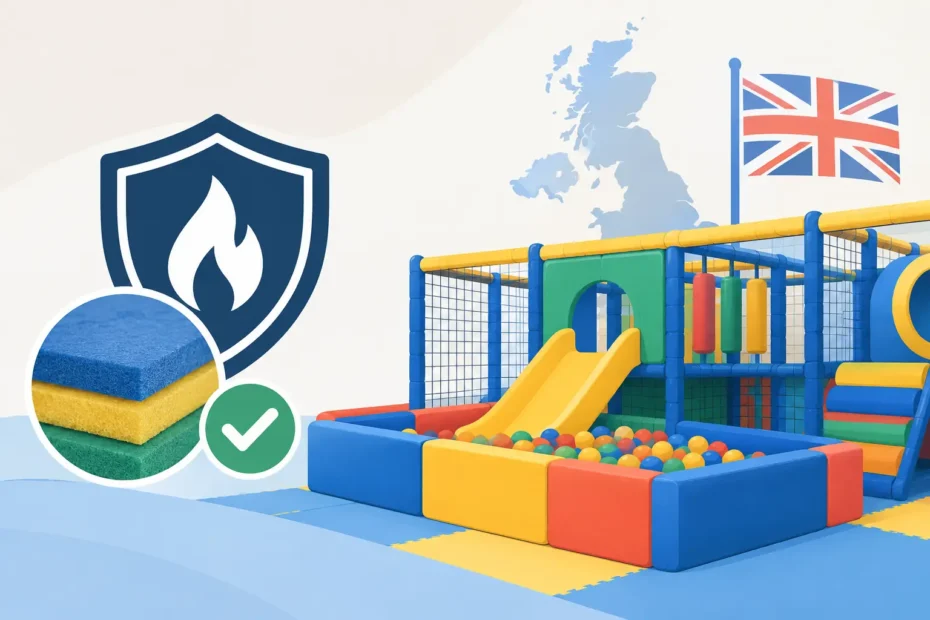
A soft play set can look fantastic, fit the room perfectly and keep children busy for hours – but softplay fire ratings should be checked before colour choices, shapes or price. For parents, nurseries and commercial venues, the right question is not simply, “Is it fireproof?” It is whether the equipment has been made and tested appropriately for where and how it will be used.
No soft play equipment is genuinely fireproof. What matters is how materials react if exposed to an ignition source, how quickly flame may spread and whether the supplier can provide clear evidence for the product you are buying. That distinction protects children, supports sensible purchasing and prevents expensive mistakes when equipping a nursery room or play centre.
What do softplay fire ratings actually mean?
“Fire rated” and “fire retardant” are often used as broad sales terms. They can be useful, but neither phrase tells the full story on its own. Soft play products are made from several components, commonly including foam, PVC or vinyl covers, stitching, bases, hook-and-loop fastenings and sometimes internal boards or supports. A claim about one material does not automatically apply to the finished item.
A meaningful fire-performance claim should identify the relevant test or standard, the product configuration tested and the intended use. For example, a cover material may have passed an ignition-resistance test, while the foam inside has different performance characteristics. A certificate for a sample fabric is not necessarily proof that an entire ball pit, climbing block or bespoke wall pad meets the same requirement.
For domestic buyers, the priority is choosing well-made equipment from a supplier that can explain its materials honestly. For nurseries, schools and commercial operators, documentation becomes even more important because the equipment sits within wider premises safety responsibilities, insurance requirements and fire risk assessments.
Why the setting changes the requirement
The right level of specification depends on where the soft play will live. A few lightweight shapes used under supervision in a family home are not assessed in the same way as a large installed play frame used all day by multiple groups of children.
Home soft play
At home, parents should focus on safe construction, cleanable covers, good-quality foam and sensible positioning. Keep equipment away from heaters, fireplaces, candles, radiators, cooking areas and charging equipment. Never place soft play beneath smoke alarms where it could obstruct them, and make sure children cannot drag shapes towards a heat source.
A domestic setup does not need to resemble a commercial venue to be enjoyable or safe. In fact, choosing only the pieces that fit the available floor space often gives children more room to crawl, climb, balance and move freely. Ask the supplier what the cover and foam are made from, how it should be cleaned and whether any test information is available for that specific product range.
Nurseries, schools and playgroups
Busy settings need equipment that can cope with repeat use, routine cleaning and more demanding supervision. Managers may be asked by insurers, local authorities or internal compliance teams for product specifications and fire-related information. Buying the cheapest unverified set can soon become poor value if paperwork is missing when it is needed.
Consider where the equipment is stored as well as where it is used. A pile of soft shapes left in a corridor, beside an exit or in front of electrical cupboards creates a separate fire-safety concern, regardless of its material rating. Storage must not narrow escape routes or prevent staff and children leaving quickly.
Commercial soft play centres
Commercial operators should treat fire performance as one part of a full safety plan, not a box to tick on a purchase order. Larger equipment, wall protection, safety pads, seating and themed features may be supplied by different manufacturers. Each item needs appropriate records, while the whole area must work with the building’s fire strategy, escape routes, alarm system, occupancy level and maintenance programme.
The Regulatory Reform (Fire Safety) Order 2005 places duties on responsible persons in England and Wales, with corresponding fire-safety legislation elsewhere in the UK. A competent fire risk assessment will consider ignition sources, evacuation, staff training and the materials within the premises. Your equipment supplier can provide product information, but cannot replace a proper assessment of your building.
Tests and certificates: what to ask for
There is no single universal certificate that makes every type of soft play suitable for every UK location. Different tests may apply to upholstery, contract furniture, fabrics or particular materials. You may see references to ignition tests such as BS EN 1021, or broader contract-furniture standards such as BS 7176. The appropriate benchmark depends on the item and its intended environment.
Do not assume that a higher-sounding number automatically means a better or legally required choice for your project. A wall pad, a modular foam shape and an upholstered bench are different products. Their specification should be discussed individually.
Before ordering a substantial quantity of equipment or a bespoke installation, ask for four things:
- the exact product specification, including cover and foam materials;
- the test standard being quoted and the date of the report;
- confirmation that the report relates to the finished product or clearly states what it covers; and
- care and cleaning guidance, plus advice on replacement covers or damaged sections.
These questions are not awkward. A dependable supplier should welcome them. Clear paperwork saves time for nursery managers, procurement teams and venue operators who need to show that buying decisions were considered properly.
Do not confuse fire ratings with general toy safety
Fire performance is only one part of a safe soft play purchase. Standards relating to toy safety, physical hazards and chemical safety may be relevant depending on the product, its age range and how it is sold. They do not replace evidence relating to ignition resistance, just as a fire test does not prove that a product is suitable for unsupervised use by a particular age group.
Look at the full picture: secure stitching, no exposed zip heads, firm but cushioned foam, stable construction, wipe-clean surfaces and age-appropriate sizes all matter. For commercial projects, correct installation and suitable anchoring are equally important. A well-specified piece that is poorly fitted or badly maintained can still become a risk.
Fire-retardant materials need proper care
Even correctly specified soft play needs looking after. Covers can split, seams can open and foam can be exposed after heavy use. Strong cleaning chemicals may also affect some finishes or treatments, so always follow the manufacturer’s cleaning instructions rather than using whatever product is nearest to hand.
Inspect high-use equipment regularly. Remove damaged items from use until they are repaired or replaced, particularly if foam is visible, covers have become loose or fastening points no longer hold securely. In a commercial setting, keep a straightforward inspection record. It helps staff act quickly and provides evidence of sensible maintenance.
Be cautious about altering equipment yourself. Re-covering a block, adding decorative fabric, fixing extra padding or combining products in a new layout can change how the item performs and may invalidate the relevance of previous test information. Bespoke designs are brilliant for making the most of an awkward room, but the specification needs to be agreed before manufacture, not improvised afterwards.
Choosing value without taking a shortcut
Price matters, especially when fitting out a nursery, setting up a home play corner or refreshing a commercial venue. But compare like for like. One quote may include UK-made foam, durable covers, tailored dimensions and supporting paperwork, while another may only show a photograph and a broad material claim.
Ask how the equipment is made, where it is made and what happens if you need support after delivery. British-made bespoke soft play can be especially useful where standard imported sets leave gaps, block exits or waste valuable floor space. The best value is equipment that fits properly, lasts well and comes with straightforward answers when you need them.
At Softplay Toys4Kids, we believe buyers should never have to choose between affordable soft play and clear product information. Whether you need a few shapes for home or a tailored commercial area, start with the intended setting, request the right specification and keep safety documents with your purchase records. That gives you a stronger foundation for play that is energetic, practical and ready for the real world.
Leave a Reply