
How to Write a Business Case for Play Equipment Costs

A strong business case presents play equipment as a practical investment, not just a purchase. To understand how to write a business case for new play equipment, define the need, compare realistic options, and weigh their costs, benefits and risks. Then recommend the option that best supports your organisation’s goals.
It’s natural to focus on the cost first, especially when budgets are tight. But a clear case also considers what happens if you do nothing, how the equipment could improve children’s and families’ experience, and whether that value supports your organisation’s objectives. This guide explains how to assess risks, compare purchasing options and identify investment triggers. You’ll also learn how to present the figures and practical benefits so decision-makers can assess the proposal.
Key Takeaways
- Define the problem clearly and show what may happen if you leave it unresolved.
- Compare risks and practical alternatives, including improving existing resources before investing.
- Use signs such as equipment nearing capacity to identify when a stronger case for action may be needed.
- Explain how play equipment could support customer experience and commercial value, not just add a cost.
Assessing risks and mitigation strategies
Build risk controls into the proposal from the start. Use these steps to assess safety, approvals, demand and financial resilience.
-
Identify Applicable Safety Requirements
Map UK safety requirements and relevant playground equipment standards to the proposed equipment, setting and users. Assess product safety, installation, impact-absorbing surfaces, inspection, maintenance and supervision as separate risk areas. Supplier product information is not a substitute for a site safety assessment. Record who will manage each control, what evidence they need and how ongoing checks will be organised.
-
Check Planning and Local Approvals
Make planning permission and local-authority approval explicit decision gates in your business case. Requirements depend on the site and proposed work, so record the location, whether equipment is fixed, and any changes to the land or existing use. Identify the relevant planning authority and establish which approvals apply before setting a delivery timetable. Add approval requirements to the risk register, with a mitigation such as delaying commitment until the necessary decisions are in place.
- Test demand with evidence. Assess demand for new playground equipment using customer feedback, existing usage records and operational observations. Compare busy and quiet periods, note where children’s play needs aren’t being met, and review recurring comments from families or staff. Distinguish evidence of unmet demand from assumptions about future visits. Explain how the equipment addresses the identified gap and what you’ll monitor after installation, such as feedback or usage patterns.
- Model financial and operational risks. List each risk, its likely effect, its owner and a practical mitigation. Test how a 10% increase in energy costs would affect projected savings, then show the assumptions behind your calculation. Include disruption during installation, maintenance needs and the consequence of delaying action. If existing equipment is underused, consider whether better processes could address the problem first. This gives decision-makers a clear view of the downside, not only the expected benefits.
Common business-case pitfalls and investment triggers
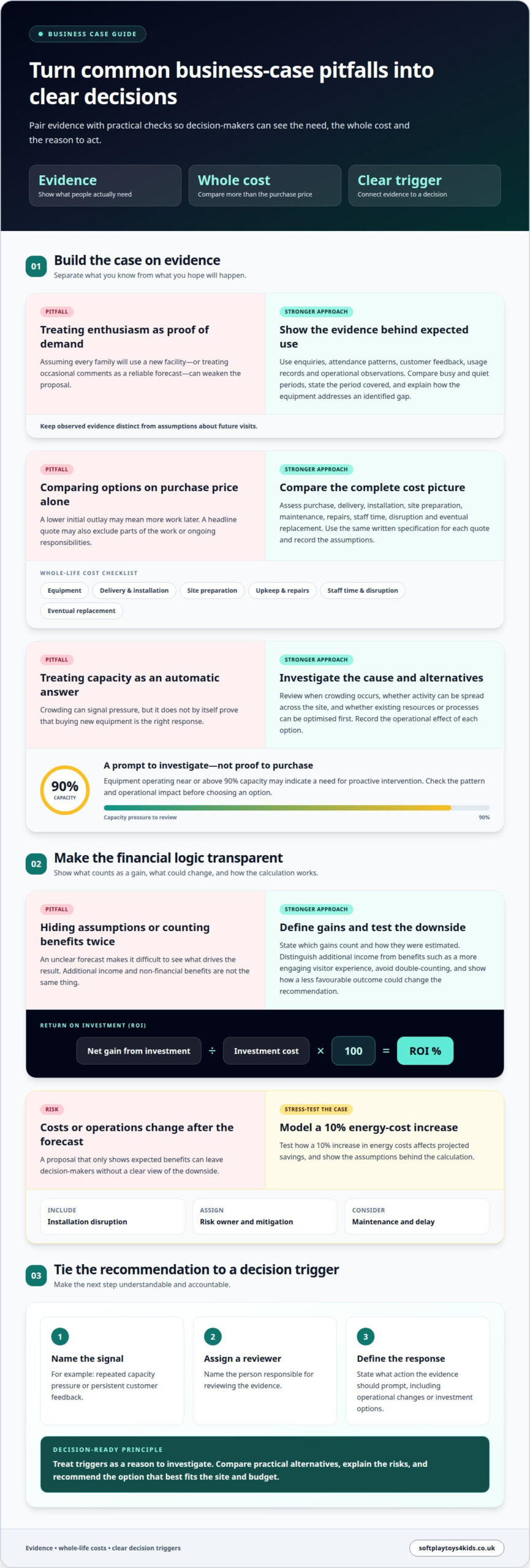
- Separate evidence from enthusiasm. A proposal loses credibility if it assumes every family will use the new facility. Base forecasts on actual enquiries, attendance patterns or customer feedback. For example, distinguish regular requests for more play space from occasional comments. State the period covered by your evidence and explain how it supports expected use. Don’t present an optimistic estimate as a certainty.
- Include the full cost picture. Don’t compare options on purchase cost alone. Include installation, upkeep, staff time, disruption and eventual replacement in the same assessment. A lower initial outlay may mean more work later, while a more expensive option may better suit operational needs. Show each assumption clearly so decision-makers can see what drives the total and which costs could change.
- Check whether existing capacity is the trigger. Equipment operating near or above 90% capacity may indicate a need for proactive intervention. Treat this as a prompt to investigate, not automatic proof that buying is the answer. Review when crowding occurs, whether activity can be spread across the site, and whether existing resources can be optimised first. Record the operational effect of each option.
- Make the financial logic transparent. Calculate return on investment as net gain from investment divided by investment cost, multiplied by 100. Define which gains count and how you estimated them. For example, distinguish additional income from non-financial benefits such as a more engaging visitor experience. Avoid counting the same benefit twice, and show how a less favourable outcome changes the recommendation.
- Set a clear decision trigger. Link the recommendation to a measurable condition, such as repeated capacity pressure or persistent customer feedback. Then name the person responsible for reviewing that evidence and the action it should prompt. If wear around a play area creates a separate concern, include physical protection in the options assessment, alongside operational changes and investment.
Comparing leasing, retrofitting and purchasing
Compare every option against the same needs, time horizon and whole-life costs. The strongest choice is the one that suits your site and budget, not necessarily the one with the lowest initial quote.
- Define the comparison criteria. Record the play experience you want to provide, site constraints, expected use and maintenance responsibilities. Then assess leasing, retrofitting and purchasing against those needs. A site with usable equipment, for example, may benefit from upgrading selected areas, while a full replacement may suit a layout that no longer meets operational needs.
- Estimate the complete cost. Include equipment, delivery, installation, site preparation, maintenance, repairs and eventual replacement. Ask for costs to be itemised, then compare like with like across quotes. In the UK, the total depends on the equipment design, site conditions, installation scope and upkeep plan. Record these assumptions so decision-makers can see what could change the estimate.
- Compare suppliers and quotes consistently. Use the same written specification for every quote, including materials, dimensions, installation scope, maintenance expectations and exclusions. Check whether the quoted work covers site preparation and after-installation responsibilities. A lower figure may cover less work, so compare the full scope of work, not just headline totals.
- Choose a funding route alongside the purchase option. Consider an approved capital budget, organisational reserves, a suitable grant programme, borrowing or leasing. Review repayment commitments and restrictions before choosing a route. A grant may have eligibility conditions, for example, while leasing can spread payments but creates ongoing obligations. Match the funding plan to cash flow and decision-making authority.
- Make the recommendation evidence-led. There’s no single typical UK price for commercial playground equipment: scope, site preparation, installation and maintenance needs all affect the total. Present a comparison table showing initial outlay, ongoing costs, responsibilities and operational fit. Explain why the preferred option offers better value over the period your organisation plans to use it, and state the assumptions behind your conclusion.
Play equipment as a commercial asset
- Connect the investment to a business outcome. Identify how the play area could support visitor satisfaction, repeat visits, dwell time or additional income. Choose outcomes that suit your organisation. A family venue might track return visits, for example, while commercial recreation spaces catering to older guests might evaluate features like American Heritage Billiards pool tables to extend dwell time and hospitality spend. When considering how to write a business case for new play equipment, explain how these outcomes support your organisation’s purpose.
- Set a baseline before forecasting change. Record attendance, customer feedback, usage patterns and relevant income before installation. Compare the same measures afterwards across comparable operating periods. If visitors mention limited play choices, track whether feedback changes after improvements. This helps distinguish the equipment’s contribution from seasonal demand or other changes, giving your evaluation a useful comparison point.
- Calculate returns with transparent assumptions. Apply the ROI approach outlined earlier, using estimated net gain and the full investment cost. For example, connect additional visits to attributable revenue, then deduct associated operating costs. Don’t count every visitor as new income or assign a cash value to every wellbeing benefit. Show the evidence behind each estimate and explain where assumptions affect the result.
- Plan delivery and ongoing care. Set out each stage, from approval and ordering to site preparation, installation and opening. Assign an owner to every task and identify dependencies, such as completing site work before delivery. Document inspection routines, maintenance responsibilities, repair reporting and record-keeping. Clear ownership helps keep equipment in good condition and gives staff a practical way to raise operational issues.
- Review performance after opening. Compare actual use, feedback, income and upkeep against the forecast. If results differ, investigate causes such as opening hours, layout or visitor awareness before judging the investment. Knowing how to write a business case for new play equipment also means using those findings to improve operations and inform future decisions. To explore options for your play space, discuss your project.
SoftplayToys4kids: Soft Play Ball Pits
SoftplayToys4kids can help turn an approved play-space plan into a practical choice of equipment. If your business case identifies a need for varied play experiences, consider its Sensory Toys as one option for supporting exploration and engagement. Where the assessment highlights exposed posts or columns, Lamp Post Protectors can address that specific site requirement.
Match each product choice to the needs, intended use and risks set out in your proposal. This keeps the decision grounded in your site’s priorities, rather than adding equipment without a clear purpose. SoftplayToys4kids is a natural next step when you’re ready to explore relevant soft play options for your project.
Visit SoftplayToys4kids to discuss your play equipment plans.
Turn your proposal into a play-space plan
A business case is useful when it guides a real decision, not just approval. Turn your chosen option into a practical brief: describe the experience you want children and families to have, the space available and your organisation’s priorities. This gives the next conversation a clear starting point.
If you’re deciding how to write a business case for new play equipment, connect your commercial goals with the play experience you want to create. SoftplayToys4kids offers Soft Play Ball Pits, Soft Play Mats and Sensory Toys, giving you relevant options to consider as you shape your plan.
Bring your requirements together and take the next step with a focused discussion. Contact SoftplayToys4kids about your project to explore equipment options for your play space. A thoughtful proposal can help move your idea from a paper plan towards a welcoming place where play comes to life.
Frequently Asked Questions
What’s a business case?
A business case is a decision document that explains why an organisation should approve, change or decline a proposal. For play equipment, it can show how a planned play area addresses a specific need, such as families asking for more engaging activities. It gives decision-makers a clear recommendation, explains the assumptions behind it and sets out how success will be assessed after the investment.
What should a business case for new play equipment include?
Include the need, intended users, proposed solution, alternatives, expected outcomes, costs, risks, delivery responsibilities and measures of success. Add a short scenario showing how the equipment would fit into a typical day. Explain which visitors would use it, how staff would manage the space and what evidence would show whether the project met its purpose. Keep supporting records together for review.
What are the risks of installing new playground equipment and how can they be managed?
Common risks include installation disruption, poor site fit, unexpected maintenance demands and lower-than-expected use. Reduce these risks by assigning an owner to each task, documenting site constraints, planning access around normal operations and setting a process for reporting defects or repairs. For example, agree how staff will inform families about temporary changes if installation affects part of the play area.
What safety standards and legal requirements apply to UK playground equipment?
Map UK safety requirements and relevant playground equipment standards to the equipment, site and users. Assess product safety, installation, impact-absorbing surfaces, inspection, maintenance and supervision. Establish which planning and local-authority approvals apply before setting a delivery timetable.
Leave a Reply