
What Are Soft Play Toys Made Of? A Guide to Materials, Safety, and Quality

Did you know that a July 2025 study found that over 45% of tested plastic toy samples exceeded internationally accepted safe limits for toxic phthalates? It’s a staggering figure that makes any parent pause. You want your little ones to explore and grow in a space that’s as safe as it is exciting, but worries about hidden chemicals, fire hazards, or foam that flattens after a week are completely valid. You deserve to know exactly what are soft play toys made of before they enter your home or play centre.
We agree that safety is never optional when it comes to your child’s happiness and development. This guide will show you how to identify premium materials and the British manufacturing standards that keep our soft play ball pits and mats durable for years of heavy use. We’ll explore the benefits of high-density foam, the importance of phthalate-free 610gsm industrial vinyl, and how to verify that your equipment meets the latest UK Toys (Safety) Regulations 2011. Get ready to discover how quality craftsmanship creates a play area that’s built for fun and engineered for total peace of mind.
Key Takeaways
- Learn how to distinguish between different foam densities to ensure your play equipment provides the perfect balance of impact absorption and physical support.
- Get the facts on what are soft play toys made of by exploring the benefits of phthalate-free, 610gsm industrial-grade vinyl covers.
- Identify the specific UK safety certifications, including BS EN 1176 and BS 5852 fire standards, that protect your family and your investment.
- Discover why our “Handmade in the UK” process in Bradford delivers superior durability and precision compared to standard market alternatives.
Understanding the Anatomy of Soft Play Equipment
Ever wondered why some play equipment feels like a cloud while others feel like a brick? Soft play toys are actually sophisticated, multi-layered structures. They are precision-engineered to absorb impact and prevent injury during high-energy play. The magic happens in the balance. You need enough “squish” for safety, but enough “firmness” to support a child’s physical development and provide stable surfaces for stacking. When you ask what are soft play toys made of, you’re really looking at a three-part system: the internal core, the protective cover, and the industrial-strength closures.
Selecting premium materials isn’t just about luxury. It’s about longevity. High-quality components ensure your ball pit or play mat survives years of jumping, sliding, and tumbling without losing its shape. Cheaper alternatives might look the same on a screen, but they often sag or tear within months. We believe in building products that stand the test of time, providing a safe haven for children to explore their limits.
Why Material Transparency Matters for Parents
You shouldn’t have to guess what’s inside your child’s toys. The “cheap import” market is frequently flooded with products that hide low-grade foam or even toxic chemicals behind bright colours. We advocate for total transparency because material quality is directly linked to developmental success. When you understand what is soft play, you realize that sturdy, high-density materials provide the necessary resistance for sensory processing. A firm block helps a toddler find their balance and strengthen their core, while a flimsy, low-quality alternative can actually hinder motor skill growth by failing to provide a stable base.
The Basic ‘Sandwich’ Structure
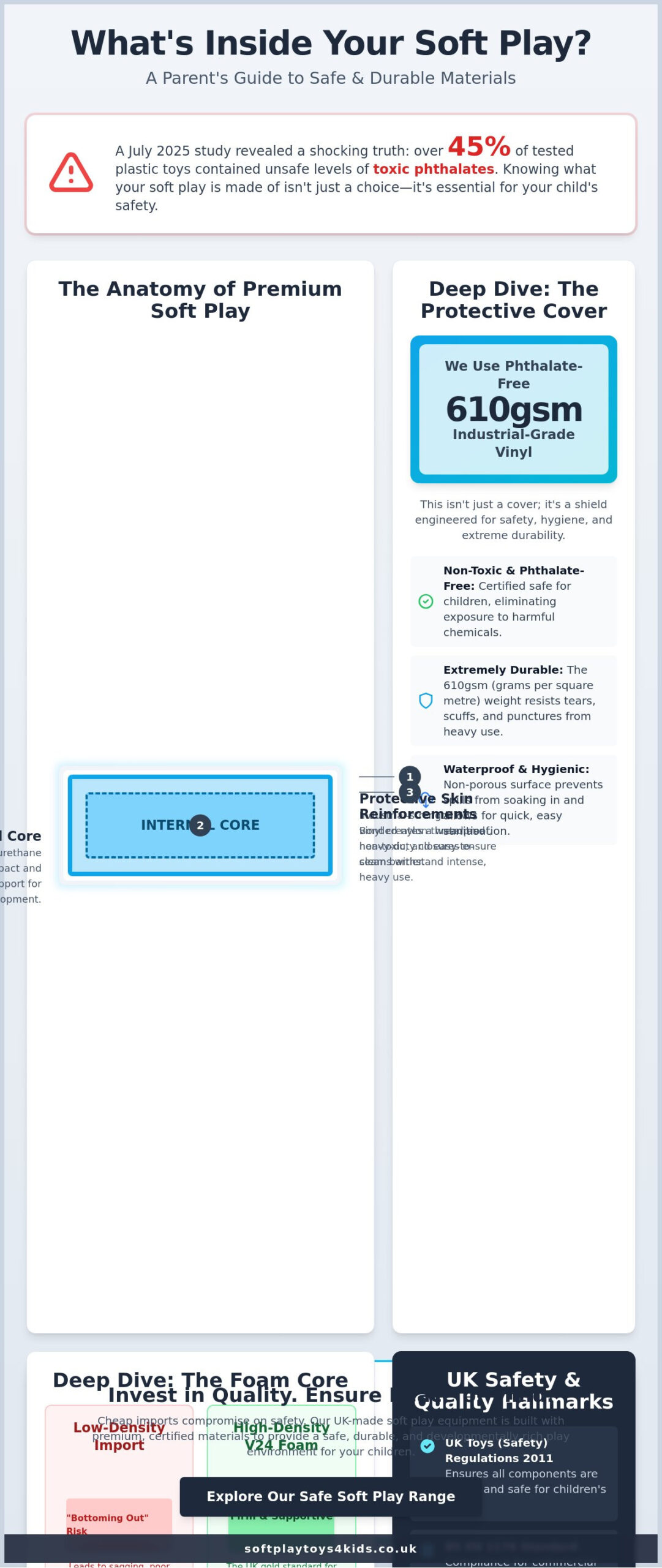
Every piece of our equipment follows a specific “sandwich” structure designed for maximum performance. At the heart is the Internal Core. High-grade polyurethane foam is the industry leader because it returns to its original shape every time, no matter how many times it’s jumped on. Much like professional playground surfacing materials, this core is designed to manage the force of impact, keeping little heads and knees safe from hard floors.
The Protective Skin is the next vital layer. We use industrial-strength, PVC-coated polyester to create a waterproof, non-toxic barrier. This shields the internal foam from spills and allows for rapid sanitisation between play sessions. Finally, the Reinforcements provide the structural integrity. We use bonded nylon thread and heavy-duty Velcro to make sure our seams stay shut even under the pressure of a busy commercial play centre. When you evaluate what are soft play toys made of, always look for these reinforced details. It’s the hallmark of British manufacturing excellence that ensures your children stay safe while having the time of their lives.
The Secret to Squish: Foam Densities and Quality Grades
Have you ever noticed how some play blocks stay firm for years while others turn into pancakes after a single afternoon? The answer lies deep inside the core. Polyurethane foam is the backbone of the industry, used in nearly 99% of all professional soft play equipment. It’s the preferred material because of its incredible ability to absorb energy and return to its original shape. When parents ask what are soft play toys made of, the density of this foam is the most critical factor for both safety and durability.
Foam density is measured in kilograms per cubic metre (kg/m³). Think of it as a measure of “substance.” The more foam material packed into every cubic centimetre, the better the “memory” and support. High-quality foam springs back instantly the moment a child steps off it. In contrast, cheap, low-density foam often found in mass-produced imports leads to a dangerous phenomenon called “bottoming out.” This happens when a child’s weight pushes right through the foam to the hard floor beneath, which is a leading cause of preventable playroom injuries.
V24 Foam vs. Commercial Grade Densities
In the UK, V24 foam is considered the gold standard for home nurseries and early years playrooms. It offers a density of 24kg per cubic metre, providing a “goldilocks” balance: it’s soft enough for a toddler’s tumble but firm enough to support a stable walking surface. For high-impact areas, such as landing zones under a slide or heavy-duty crash mats, we often move to even higher densities. Adhering to these specific foam grades ensures every product we manufacture is fully compliant with The Toys (Safety) Regulations 2011. This legal framework is what separates professional-grade equipment from basic toys, ensuring your children are protected by the highest British safety standards.
Open-Cell vs. Closed-Cell Foam
Most indoor soft play equipment uses open-cell foam. This structure features tiny, interconnected bubbles that allow air to move through the material. This breathability is why our Soft Play Mats and blocks stay fresh and bouncy over years of heavy use. It provides the superior shock absorption needed for indoor environments where children are constantly jumping and falling.
Because of this open structure, there is one vital maintenance rule you must follow: never let the internal foam core get wet. While our industrial PVC covers are completely waterproof, if moisture ever reaches the internal core through an open zip or damaged seam, it can become trapped. Keeping the core dry ensures the foam maintains its structural integrity and remains a hygienic environment for play. When you invest in quality, you’re not just buying a toy; you’re buying years of resilient, safe fun for your family.
Protective Covers: Why PVC and Vinyl are the Industry Standard
While the foam core provides the “squish,” the cover is the vital shield that protects your investment. High-quality soft play equipment relies on industrial-grade, PVC-coated polyester for its outer skin. This material isn’t just chosen for its vibrant, child-friendly colours. It’s the industry standard because it is completely waterproof, incredibly durable, and non-porous. In a busy nursery or home playroom, hygiene is paramount. These covers allow you to wipe away spills and sanitise surfaces in seconds, preventing the spread of germs and keeping the environment fresh for every child.
If you’re asking what are soft play toys made of, you have to look at the fabric weight. We use 610gsm (grams per square metre) PVC-coated vinyl. Why does this number matter? Many mass-produced toys use thin, 300gsm covers that tear under the slightest pressure. Our 610gsm material is heavy-duty and tear-resistant, designed to withstand the constant friction of sliding, jumping, and climbing. For our sensory toys and baby play mats, we often utilise a premium “faux leather” vinyl. This offers a softer, more tactile experience for younger children while maintaining the same rugged durability and easy-clean properties of our industrial-grade PVC.
Chemical Safety: Phthalates and Non-Toxic Dyes
Safety goes much deeper than just a tough surface. A major concern for parents is the presence of toxic chemicals like phthalates, which are often used to soften plastic. A July 2025 study found that over 45% of tested plastic toy samples exceeded internationally accepted safe limits for these substances. We take this risk seriously. Our covers are manufactured using phthalate-free vinyl and lead-free pigments. This ensures that even if a curious toddler decides to “taste” the corner of a block, they aren’t being exposed to harmful toxins. We also incorporate antimicrobial treatments into the fabric to provide an extra layer of built-in protection against bacteria and mould growth.
This focus on non-toxic materials is just as important for our pets as it is for our children; to find carefully selected toys and accessories for your animal companions, check out Kraina Pupila.
Reinforced Stitching and Safety Zips
The best materials in the world are useless if the seams fall apart. We use twin-needle stitching with bonded nylon thread to ensure our covers stay together under extreme pressure. Seams are usually the first place cheap toys fail, but our reinforced construction is built for commercial-level endurance. We also prioritise hidden safety zips. By tucking the zip head away in a protective pocket, we prevent scratches on delicate skin and ensure children can’t access the internal foam core. For modular soft play equipment sets, we use industrial-strength Velcro to keep pieces locked together securely. This attention to detail is what makes our Bradford-made products the superior choice for safety-conscious parents and business owners alike.
Safety Standards and Non-Toxic Certifications in the UK
When you investigate what are soft play toys made of, the legal certifications are just as important as the physical foam and vinyl. In Great Britain, the primary legislation is the Toys (Safety) Regulations 2011. This framework ensures that every ball pit and play mat is built to withstand the rigours of childhood without posing a risk. We don’t just “hope” our products are safe; we manufacture them to meet specific designated standards like EN 71-1 for mechanical properties and EN 71-2 for flammability. With over 500 toy recalls in the UK since 2021, verifying these standards isn’t just paperwork. It’s a vital shield for your children.
For larger equipment used in public spaces, we look toward BS EN 1176 and BS EN 1177. These cover the equipment itself and the impact-absorbing surfacing. While some competitors gloss over these details, we pride ourselves on transparency. It’s also essential to consider fire retardancy. Every piece of foam and every cover we produce meets the Furniture and Furnishings (Fire) (Safety) Regulations 1988, specifically the BS 5852 standard. For commercial play centres and schools, we often adhere to the “Crib 5” standard. This is a more stringent fire safety test that ensures the materials are suitable for high-occupancy public environments. Always ask a manufacturer for their compliance data before you commit to a purchase.
Testing for Physical Hazards
Safety testing goes beyond chemicals. It’s about engineering out physical risks. Soft play is designed as a single, cohesive unit to eliminate small parts that could become choking hazards. We also perform rigorous entrapment testing. This ensures that the gaps between mats or blocks are precisely calculated so they won’t trap tiny fingers, toes, or heads. This level of detail is especially critical for baby play mats, where we also utilise non-slip bases to prevent the mat from sliding during those first wobbly crawls. It’s this commitment to precision that makes our Bradford factory a trusted partner for parents across the country.
The Role of Sensory Materials
Modern play environments often integrate sensory toys into the layout to boost cognitive growth. When we add smooth, ribbed, or soft textures, these materials must pass the same migration of elements tests (EN 71-3) as our standard blocks. Whether it’s a reflective surface for visual stimulation or crinkle fabrics for auditory feedback, every addition is safety-tested for durability. We don’t believe sensory features should be a weak point in your play area. By using the same industrial-grade foundations, we ensure these developmental tools last as long as the rest of your kit.
The UK’s product safety framework is currently evolving, with a major government consultation published in March 2026. We stay at the forefront of these changes to ensure our customers always receive the safest products on the market. Ready to build a play space that meets the highest British standards? Browse our range of safety-certified Soft Play Ball Pits and play mats today and give your children the premium experience they deserve.
From Factory to Playroom: The SoftplayToys4kids Manufacturing Process
Our process begins with precision cutting. We use advanced machinery to ensure every foam block is perfectly square. This might seem like a small detail, but it’s vital for stable stacking and safe play. If the core isn’t cut accurately, the covers won’t fit tightly, leading to loose fabric that can become a trip hazard. We also maintain a strict commitment to sustainable sourcing by optimizing our cutting patterns to significantly reduce foam waste. Before any item leaves our facility, it undergoes a multi-stage quality control inspection. Our checklist includes:
- Seam tension testing to verify the durability of our twin-needle stitching.
- Zip safety checks to ensure all heads are properly tucked into protective pockets.
- Dimensional accuracy checks to guarantee blocks are perfectly balanced for stacking.
- Final surface inspection to ensure the 610gsm vinyl is flawless and playroom-ready.
The Advantage of Local Manufacturing
Choosing British-made equipment is about more than just supporting the local economy; it’s about total accountability. When you buy from us, you’re dealing directly with the people who made your child’s toys in Bradford. This proximity allows us to design and build bespoke indoor playground equipment tailored to your specific space. Buying local also reduces the carbon footprint of your purchase, making it a much greener choice than imported alternatives.
Longevity and Value for Money
We believe that premium equipment is an investment in your child’s future. While the initial cost might be higher than a cheap import, the “cost-per-play” is significantly lower because our products are engineered to last 10+ years. When you consider what are soft play toys made of, you’re paying for the peace of mind that comes with V24 foam and non-toxic covers. Explore our full range of Ball pits and mats today. Experience the difference that West Yorkshire craftsmanship makes to your home or business.
Invest in Safer, Smarter Play Today
You now have the knowledge to look past bright colours and see the precision engineering that keeps your children safe. We’ve explored how V24 foam density prevents “bottoming out” injuries and why 610gsm industrial vinyl is the premier choice for a hygienic, tear-resistant playroom. Understanding exactly what are soft play toys made of gives you the ultimate confidence to choose equipment that survives years of heavy use rather than just a few months of play.
We take immense pride in being a local manufacturer you can trust. Every ball pit, play mat, and sensory block we sell is handmade in our West Yorkshire factory to ensure full compliance with BS EN 1176 and 1177 safety standards. It’s the reason why schools, nurseries, and thousands of parents across the UK choose us for their early years environments. Don’t settle for anything less than British-made excellence for your little ones. Browse our range of high-quality, UK-made soft play equipment and discover the peace of mind that comes with professional craftsmanship. Your next great playroom adventure is just a click away.
Frequently Asked Questions
Is soft play equipment toxic for babies?
Professional soft play equipment is not toxic when manufactured using phthalate-free and lead-free materials. High-quality UK brands use medical-grade PVC and non-toxic dyes to ensure total safety for infants. This means that even if a curious baby decides to mouth a block or a mat, they aren’t being exposed to harmful chemical migration or dangerous substances.
How do I clean the PVC covers on my soft play toys?
You can clean PVC covers quickly and easily using warm soapy water and a soft microfibre cloth. For deeper sanitisation in busy nurseries or play centres, a mild, diluted disinfectant is perfectly safe to use. Always avoid abrasive scrubbers or harsh bleach-based chemicals, as these can eventually degrade the protective 610gsm vinyl coating and dull the vibrant colours.
Can soft play foam lose its shape over time?
Yes, low-density foam can sag, but high-quality V24 or commercial-grade foam is specifically designed to spring back instantly. When parents ask what are soft play toys made of, the answer usually involves high-grade polyurethane foam. This material has incredible “memory” and maintains its structural integrity for over 10 years, even in high-traffic commercial environments.
What is the difference between home and commercial soft play materials?
The primary difference lies in the foam density and the reinforcement of the seams. Home equipment typically utilises V24 foam, which is perfect for toddlers. Commercial landing zones or crash mats require much higher foam densities to manage constant, heavy impact. Commercial products also feature reinforced twin-needle stitching to ensure the covers never burst under the pressure of multiple children.
Are soft play toys fire-resistant?
Yes, all professional soft play must be fire-retardant to comply with the Furniture and Furnishings (Fire) (Safety) Regulations 1988. This applies to both the internal foam core and the external vinyl covers. In schools and large play centres, we often use materials that meet the even more stringent “Crib 5” fire safety standard to ensure maximum protection in public spaces.
What should I look for on a safety label for soft play?
You should always look for the UKCA or CE marking and specific references to BS EN 71 safety standards. These labels prove the product has passed rigorous tests for flammability, chemical toxicity, and physical hazards. A trustworthy manufacturer will also include their UK address and clear fire safety compliance data right on the product label for your peace of mind.
Why is UK-made soft play better than imported versions?
Buying UK-made ensures the product strictly follows the Toys (Safety) Regulations 2011. Imported toys often use thinner, 300gsm covers and low-density foam that can “bottom out” and cause injuries. By choosing a local Bradford-based factory, you get total accountability and a clear, honest answer regarding what are soft play toys made of before the items reach your home.
Can I use soft play equipment outdoors?
You can certainly use soft play equipment outdoors on dry days, provided it is placed on a flat, debris-free surface. While our industrial PVC covers are waterproof, you shouldn’t leave them outside permanently. Moisture can eventually seep through zips or seams if left in the rain. Always store your mats and ball pits in a dry, indoor environment after the sun goes down.
Leave a Reply