
Soft Play for Nurseries: Stepping Stones & Active Play
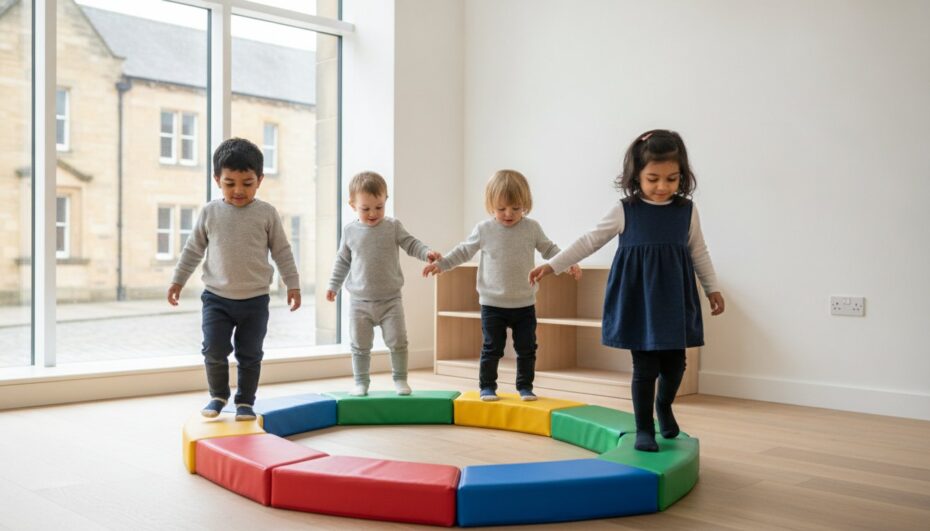
Is your current soft play area a source of pride for your nursery, or is it a collection of sagging foam and cracked vinyl that you’re dreading showing to an Ofsted inspector? It’s a common headache for providers who find that imported, low-cost options simply can’t handle the daily enthusiasm of twenty toddlers. You need soft play equipment for nurseries that doesn’t just look great on day one, but remains firm, hygienic, and safe after years of active use. We know you want to invest in tools that foster a child’s happiness and physical milestones without compromising on commercial durability or safety.
You’re about to learn exactly how to choose commercial-grade, UK-made equipment that justifies your budget by lasting years, not months. We’ll show you how to identify the features that boost coordination and confidence in your little ones while ensuring your setting stays fully compliant with BS EN 1176 and 1177 standards. From the hygiene benefits of medical-grade vinyl to the developmental impact of stepping stones, this guide provides everything you need to create a safe, vibrant, and professional play space that parents will trust and children will adore.
Key Takeaways
- Master the difference between domestic toys and commercial soft play equipment for nurseries to ensure your setting meets strict BS EN 1176 and 1177 safety standards.
- Discover why high-density foam stepping stones are essential for building a child’s proprioception and gross motor skills during the vital Early Years Foundation Stage (EYFS).
- Learn how to plan your play area with “clear zones” and safe fall heights to create a professional environment that both Ofsted and parents will trust.
- Uncover five creative ways to transform passive equipment into active learning games that engage everyone from crawlers to energetic pre-schoolers.
- Understand the long-term budget benefits of buying handmade equipment direct from a UK manufacturer, eliminating middleman costs while securing premium quality.
Understanding Nursery-Grade Soft Play Equipment and Stepping Stones
Have you ever wondered why some foam shapes look tired and squashed after just one term? The difference lies in the engineering. True nursery-grade equipment is defined by high-density foam cores designed specifically for heavy-traffic educational environments. When you invest in soft play equipment for nurseries, you’re moving beyond simple retail toys and into the world of commercial apparatus. These pieces are built to withstand the constant energy of dozens of children daily without losing their structural integrity or safety properties.
Stepping stones often serve as the foundation of any successful active play area. They’re deceptively simple but incredibly effective at encouraging balance and spatial awareness. Because they can be arranged in endless configurations, they keep the environment fresh and challenging. Understanding The Importance of Play in Child Development helps practitioners see these blocks not just as cushions, but as vital tools for physical milestones. Unlike low-grade alternatives that “bottom out” when a child steps on them, professional stones provide a firm, supportive surface that builds confidence.
The Anatomy of Professional Nursery Equipment
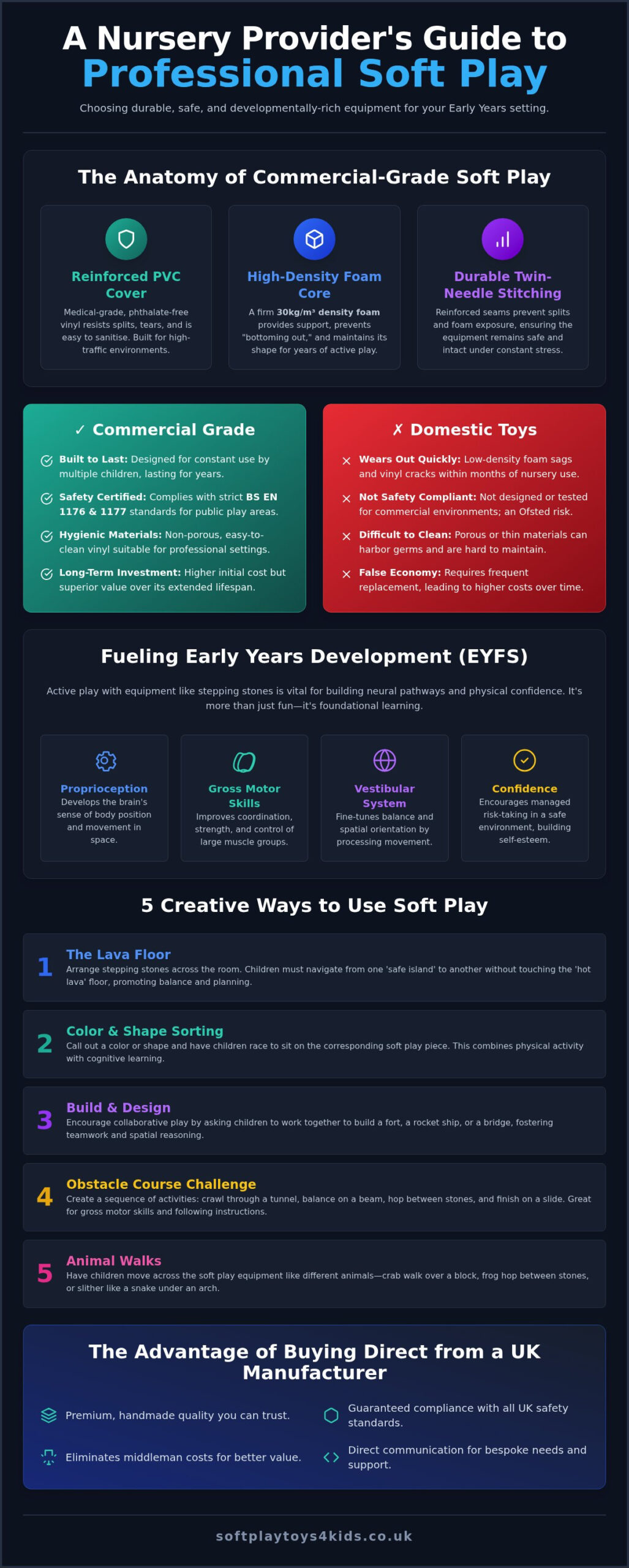
What’s actually inside your play shapes? At our West Yorkshire factory, we ensure every piece features an internal core of at least 30kg/m3 density foam. This is the gold standard for nursery use because it offers the perfect balance of comfort and resistance. We wrap this core in a reinforced, phthalate-free PVC skin that’s specifically designed to resist splits and tears. To make sure these covers stay put, we use twin-needle stitching on all seams. This level of craftsmanship ensures the equipment holds up under constant jumping, preventing the foam from becoming exposed or the covers from sagging over time.
Soft Play vs. Hard Plastic in the Classroom
While hard plastic has its place, soft play offers unique advantages for a busy nursery setting. The primary benefit is superior impact absorption. As children test their limits, falls are inevitable; soft mats and shapes significantly reduce the risk of injury. There’s also a hidden benefit for staff: noise dampening. Foam equipment absorbs sound rather than reflecting it, creating a much calmer indoor environment for both practitioners and children. Plus, the lightweight nature of our soft play equipment for nurseries means your team can easily reconfigure the layout every morning, keeping the learning environment dynamic and engaging without needing a team of movers.
The Developmental Science: Why Active Play is Vital for Early Years
Research into Early Childhood Motor Skills Development shows that active play is fundamental to both physical health and cognitive function. One of the most critical systems developed through soft play is the vestibular system, which manages balance and coordination. When a toddler navigates a soft play tunnel or balances on a foam beam, they’re fine-tuning their inner ear’s ability to process movement. This isn’t just about avoiding falls; it’s about giving them the physical confidence to explore the world around them.
Boosting Coordination and Core Strength
Stepping stones play a starring role in physical development. Navigating uneven heights and varied distances forces a child to engage their core muscles constantly to maintain stability. This is where proprioception comes into play. Proprioception is the brain’s ability to sense body position and movement without needing to look at individual limbs. By providing a safe, cushioned environment, you allow children to take managed risks. They learn where their bodies end and the world begins, building genuine physical confidence that translates into better posture and finer motor control later in life.
Cognitive Benefits of Structured Play
Active play is a mental workout too. Planning a route across a trail of sensory stepping stones requires significant problem-solving skills. Children must judge distances, predict how a surface might feel, and decide their next move. You can easily integrate EYFS learning by using different coloured shapes for counting games or colour recognition tasks. If you’re looking to upgrade your setting’s developmental tools, our range of soft play equipment for nurseries including commercial-grade play mats and shapes is designed to support every developmental milestone.
- Improved Focus: Regular physical activity leads to significantly better concentration during quiet classroom tasks.
- Social Growth: Building a path together encourages turn-taking and collaborative communication between peers.
- Emotional Resilience: Overcoming a physical challenge on a soft play climb boosts self-esteem and independence.
Choosing the Right Equipment: Commercial Nursery vs. Home Standards
Don’t be fooled by the aesthetic appeal of residential play sets you might see online. While they look lovely in a quiet corner of a house, they simply aren’t built for the non-stop energy of a professional setting. True soft play equipment for nurseries is an investment in long-term durability. You need gear that stands up to constant, heavy use while keeping every child safe and every surface hygienic. Choosing commercial-grade apparatus ensures your foam won’t bottom out and your covers won’t split after just a few months of enthusiasm.
When planning your layout, you’ve got to consider ‘clear zones’. This involves ensuring there’s enough space around each piece to prevent collisions during high-energy play. You also need to account for safe fall heights. This means making sure your flooring and mats are rated for the specific impact level of your tallest climbing block or stepping stone. It’s about creating a space where children can test their limits without you worrying about their safety.
Nursery Hygiene and Maintenance Requirements
Hygiene is a top priority for practitioners and a key focus for Ofsted inspectors. Our medical-grade vinyl isn’t just easy to wipe down; it’s designed with anti-fungal and anti-bacterial properties to resist the growth of germs. We also use hidden zips as a standard feature. They protect little fingers from traps and make the disinfecting process much smoother. A quick daily wipe with a non-toxic cleaner keeps your area fresh, while a weekly deep clean ensures you’re always maintaining premium standards.
Safety Standards for Early Years Settings
Compliance with BS EN 1176 and BS EN 1177 is essential for any nursery setting. These standards ensure the equipment is structurally sound and provides adequate impact absorption for falls. Integrating high-quality soft play mats is the best way to meet these requirements and protect your little ones. Don’t forget about non-slip bases either. On a typical polished nursery floor, these are non-negotiable to keep the play area stable and secure during use.
Budgeting for longevity means looking past the initial price tag. By choosing handmade equipment direct from our West Yorkshire factory, you’re cutting out the middleman and investing in craftsmanship that lasts. It’s about getting the best value for your budget while ensuring the highest safety standards. We take immense pride in our manufacturing process, providing you with the confidence that your equipment is built to survive the rigours of a busy nursery environment for years to come.
5 Creative Games to Maximise Your Nursery Soft Play Area
How often do you see children simply sitting on play mats during free-flow time? While relaxation has its place, your soft play equipment for nurseries is actually a powerful engine for EYFS learning. By turning your play area into a structured game zone, you can target specific physical and cognitive milestones while the children think they’re just having a blast. It’s about taking that “passive” foam and turning it into an active teaching tool that practitioners can use to guide development.
Adapting these activities for different age groups is easy. For your crawlers, focus on low-level obstacles that encourage “cruising” and reaching. For pre-schoolers, you can ramp up the complexity with themed ‘obstacle course’ days. These sessions don’t just burn off energy; they build the confidence children need to tackle new physical challenges in a safe, supportive environment.
Active Play and Problem Solving
The Floor is Lava: This classic game is a brilliant way to test spatial awareness. Arrange your stepping stones and mats as “islands” across the room. For younger children, keep the islands close together to build confidence. For older ones, widen the gaps to encourage jumping and balance. You can even integrate larger indoor playground equipment like tunnels or slides to create complex bridges and high-altitude escapes.
Animal Crossing: Challenge the children to navigate a path of soft play shapes while mimicking animal movements. Can they hop like a frog from stone to stone? Perhaps they can slither like a snake across the long mats? This encourages creative expression while forcing them to use different muscle groups they might not engage during standard play.
Educational and Sensory Integration
You can easily weave curriculum goals into physical movement. Try a Colour Match game: call out a colour and have the children race to find a matching piece of equipment. It’s a high-speed lesson in colour recognition. Alternatively, set up a Number Trail where children must step on stones in a specific sequence to reach the “finish line.” This teaches basic counting and order in a way that sticks because it’s tied to physical action.
For a more tactile experience, create a Sensory Path. Combine stones of varying heights with mats that offer different textures. This variety provides essential tactile feedback, helping children process sensory information as they move. If you’re ready to upgrade your setting with these versatile tools, view our handmade nursery soft play collections and start building your custom curriculum today.
Why Buying Direct from a UK Soft Play Manufacturer Matters
Why risk your annual budget on imported equipment that might not survive the first term? When you choose to invest in soft play equipment for nurseries, you deserve to know exactly where and how it was made. At SoftplayToys4kids, we take immense pride in our West Yorkshire factory, where every single piece is handmade by skilled craftsmen. By skipping the middleman and buying direct from the manufacturer, you’re not just saving money; you’re ensuring that every pound goes toward premium materials and superior durability rather than a distributor’s markup.
Our “factory-direct” model allows us to maintain a level of quality control that international importers simply can’t match. Every ball pit, mat, and stepping stone undergoes a rigorous inspection by the very people who built it before it ever leaves our doors. We invite you to compare our reinforced PVC and high-density foam with any mass-produced alternative. You’ll quickly see why local craftsmanship is the superior choice for a busy educational environment. It’s about combining the commercial credibility of a professional manufacturer with the genuine care of a local partner who understands your setting’s needs.
The Benefits of Local British Craftsmanship
Choosing British-made equipment drastically reduces your nursery’s carbon footprint by eliminating thousands of miles of shipping. It also means you benefit from significantly faster lead times and reliable, UK-based customer support. If you have a question or need a replacement part, you can speak directly to the team in West Yorkshire. Your purchase also supports local jobs and the regional economy, ensuring that the skills required for high-quality manufacturing stay right here in the UK. We don’t just sell products; we build lasting partnerships with nursery providers across the country.
Bespoke Design for Nursery Spaces
Most nurseries aren’t perfect squares, and we know that “off-the-shelf” solutions often leave awkward gaps or wasted space. Because we manufacture everything in-house, we can offer bespoke sizes and shapes tailored to your specific room layout. Whether you’re looking to fill a small sensory corner or create a massive active play zone, we can help. You can even choose specific colour palettes to match your nursery’s branding or to create a calming environment for children with sensory sensitivities. Ready to transform your space? Contact us for a bespoke nursery soft play quote and let’s build something extraordinary together.
Upgrade Your Nursery with Commercial-Grade Play
Investing in high-quality soft play equipment for nurseries is about more than just filling a room; it’s about creating a safe, compliant laboratory for early years development. You’ve seen how the right stepping stones and mats build essential gross motor skills while ensuring you meet strict BS EN 1176 and 1177 safety standards. By choosing commercial-grade apparatus over flimsy retail toys, you protect your long-term budget and the children in your care. Don’t settle for imported imitations that crack or sag; instead, invest in British craftsmanship that survives the daily rigours of a busy setting.
We take immense pride in our work. Every piece is handmade in our West Yorkshire factory, allowing us to offer you direct-from-factory prices without middleman markups. You get premium, durable, and hygienic play tools that both Ofsted and parents will admire. Ready to transform your setting into a vibrant hub of active learning? Shop our Nursery-Grade Soft Play Equipment Range today and see the difference that British quality makes. Let’s create a space where every child can jump, climb, and grow with total confidence.
Frequently Asked Questions
Is soft play equipment safe for babies in a nursery setting?
Soft play is incredibly safe for babies when you choose professional-grade equipment designed specifically for early years. Our high-density foam and soft PVC covers provide a cushioned environment that protects against bumps during those first wobbles and crawls. It’s the ideal way to encourage cruising and physical exploration without the risks associated with hard furniture. Always ensure your equipment is placed on safety mats to meet impact attenuation requirements.
What safety standards should nursery soft play equipment meet in the UK?
In the UK, all nursery-grade soft play must comply with BS EN 1176 for general equipment safety and BS EN 1177 for impact-absorbing surfaces. These standards are vital for passing Ofsted inspections and ensuring your setting is legally compliant. Additionally, materials must meet BS 5852 fire safety regulations. Choosing UK-made products ensures these specific British standards are met, providing peace of mind for both practitioners and parents.
How do I clean and disinfect vinyl soft play stones and mats?
Cleaning our reinforced PVC is straightforward and efficient. Simply use a soft cloth with mild soapy water for daily maintenance, or a non-toxic, child-safe disinfectant for deep cleaning. Because we use medical-grade vinyl with anti-fungal properties, the surface resists bacterial growth. Avoid harsh abrasive cleaners or bleach; these can damage the vinyl’s protective coating and reduce its longevity over time.
What is the best density of foam for commercial nursery equipment?
For soft play equipment for nurseries, a foam density of at least 30kg/m3 is the industry standard for commercial longevity. This specific density ensures the blocks are firm enough to support a child’s weight without “bottoming out,” yet soft enough to absorb impacts safely. Lower-grade retail foam often collapses within months, whereas our high-density cores maintain their shape through years of heavy daily use.
Do you offer discounts for bulk nursery or school orders?
We certainly do! Because we manufacture everything in our West Yorkshire factory, we already offer direct-from-factory pricing that cuts out middleman costs. For larger nursery fit-outs or multi-site school orders, we can provide bespoke bulk quotes tailored to your specific budget and requirements. Contact our team directly to discuss your project and see how much your setting can save by buying British.
Can soft play stepping stones be used for SEN (Special Educational Needs) children?
Absolutely, our stepping stones are fantastic tools for SEN settings. They provide essential sensory feedback and help children with proprioceptive or vestibular challenges develop better body awareness. The vibrant colours and varied heights offer a stimulating environment for therapeutic play. We can even customise colour palettes to create “low-arousal” zones for children who benefit from a more calming, neutral sensory experience.
How long does handmade UK soft play equipment typically last?
When properly maintained, our handmade UK equipment is built to last for several years of heavy commercial use. Unlike imported alternatives that use thin vinyl and low-grade foam, our reinforced covers and twin-needle stitching are designed for the rigours of a daily nursery environment. This durability makes it a much smarter long-term investment for your setting, justifying the initial budget through years of reliable service.
Do your stepping stones have non-slip bases for safety?
Yes, we include non-slip bases on our soft play equipment for nurseries as a standard safety feature. This is non-negotiable for busy classrooms with polished wooden or lino floors where equipment could otherwise slide during active play. These high-grip bases ensure that stepping stones and mats stay exactly where you place them, preventing slips and falls while children are confidently navigating their obstacle courses.
Leave a Reply