
Soft Play Building Blocks for Toddlers: How to Encourage Creativity

What if one of the best ways to spark your toddler’s creativity is to step back, rather than show them what to build? It’s natural to want to help when a tower topples or play seems to stall, but an open-ended starting point gives little ones room to explore. With soft play building blocks for toddlers, there doesn’t have to be one right result.
Offer a few pieces, then let your child decide what happens next. A stack might become a tunnel, a pretend counter or something entirely unexpected. Stay close, follow their lead and choose a setup that suits their age and the space you have.
This guide shares adaptable prompts to help toddlers experiment, make choices and stay interested without turning play into a set of instructions. You’ll find ways to introduce small challenges, join in when invited and create a reassuring play routine at home. We’ll also cover practical ways to choose and arrange soft play equipment, so your toddler can explore at their own pace while you keep the play area comfortable and manageable.
Key Takeaways
- Open-ended play lets toddlers use blocks in their own ways, without aiming for one finished result.
- Notice how your child stacks, sorts, balances and rebuilds, then let their changing ideas guide the play.
- When choosing soft play building blocks for toddlers, consider versatility, manageable pieces, storage, care instructions and the space available.
- Keep activities simple: prepare a clear area, offer blocks, observe and follow your toddler’s lead.
- Choose a setup that fits your family’s space and routine, balancing convenient storage with room to play.
Soft Play Building Blocks for Toddlers: Why Open-Ended Play Matters
How can simple blocks lead to different kinds of play? Leave room for your toddler to decide what the pieces become. A few blocks might make a path across the floor, then get rearranged into a pretend hiding place. You don’t need to demonstrate a finished design or keep the play moving with instructions. Your child’s changing ideas can lead the way.
Toddler-friendly open-ended block play means exploring, arranging and reimagining blocks without one prescribed result or single correct use.
Creativity is an opportunity, not a guaranteed developmental outcome. The value is in making space for exploration: your toddler can try an idea, change it, repeat it or move on. Toy blocks come in different forms and have a long history of use in play; Wikipedia offers a general overview of the educational benefits of toy blocks. For your child, the immediate invitation can be simple: clear some floor space, offer blocks and stay nearby.
What makes a toy open-ended for a toddler?
An open-ended toy can be used in more than one way. Blocks that can be stacked, placed side by side, moved around or brought into pretend play give a child choices about what to do. By contrast, a toy designed around one fixed outcome tends to guide play towards a particular finish. Neither has to be excluded, but flexible materials leave more room for the toddler to build, rearrange, imagine or start again.
Keep your prompts flexible, too. Instead of saying, “Let’s build a tower,” try, “What could these blocks be?” Then give your toddler time to respond through words, gestures or actions. Offering two pieces or asking where one should go can invite participation without taking over. If they use the blocks differently than you expected, follow their idea rather than correcting it.
Why soft play blocks invite hands-on exploration
During supervised play, toddlers can move and combine soft play blocks, then rearrange them as their ideas change. A line of blocks could become a path to follow, while a loose grouping might suggest a pretend hiding place. Your child may take it apart and begin again. That’s part of the play, not a problem to solve.
Offer a gentle starting point, then watch what happens. “Where could this path go?” or “Who might hide here?” gives your toddler an invitation, not a task with a required result. They might respond by shifting one block, bringing over another or simply looking. Let that response set the pace. If interest fades, pause or tidy up together rather than stretching one activity beyond your child’s attention.
Soft play building blocks for toddlers can offer a welcoming starting point for exploration when the play suits your child and is supervised. Stay close, notice how they handle the pieces and keep the surrounding area clear. Your role isn’t to create the cleverest structure. It’s to make room for play, notice what interests your toddler and leave space for their next idea.
How Toddlers Use Soft Play Blocks to Explore Ideas
Watch what your toddler does before deciding what the blocks are “for”. They may stack pieces, compare one arrangement with another, move blocks into a line, group them together or rebuild after knocking something down. These visible actions are the play: your child is trying out possibilities and choosing what to do next.
Blocks can be stacked, balanced, sorted, enclosed, moved, combined and rebuilt, then imagined as objects or places in a toddler’s own play. A child might repeat the same action several times, then change one detail. That new arrangement might suggest another idea, or simply offer a fresh way to continue.
From stacking and sorting to pretend play
A stack might begin as a tower, then become a pretend shop counter, a seat for a toy or something your toddler names for themselves. They don’t need an adult to supply the story. If the blocks vary in colour, shape or size, your child might group them by one feature, mix them up or ignore those differences entirely. Let their arrangement mean what they decide.
Repetition is welcome. Your toddler might stack, topple and stack again, or place the same pieces side by side each time. Rather than treating this as a finished activity, notice whether they change the order, add a piece or give the arrangement a new meaning. Sometimes one small change is enough to start another round of play.
The adult’s role: support without taking over
Stay nearby and describe what you see: “You’ve put those together,” or “That one moved.” Then pause. If you’re curious, ask an open question such as, “What could happen next?” Give your toddler time to respond through words or actions. Avoid correcting an unusual idea or rebuilding the arrangement for them; their interpretation is part of the play.
Offer help when it’s invited. Your toddler may hand you a block, point to a place for it or ask you to join their pretend game. Follow that cue, then leave space for them to take the lead again. If they’re content exploring alone, quiet attention can be more useful than a stream of suggestions.
To make the play easier to follow, watch for your toddler’s current interest and respond in kind:
- Repeating an action: Wait and see whether they keep going or change something.
- Moving pieces around: Offer a neutral observation, then let them choose where the blocks go.
- Giving blocks a new meaning: Join their pretend idea without deciding the story for them.
- Pausing or moving away: Let the play rest rather than insisting on a finished build.
With soft play building blocks for toddlers, there’s no need to direct every move. A relaxed, supervised play space and a few attentive pauses can help you notice the ideas your child is already exploring. Families planning a wider play area can also explore soft play equipment for home and consider what fits their space.
What to Look for in Soft Play Building Blocks for Toddlers
Choosing blocks is about finding a setup that fits your child and your home, not chasing one perfect play style. Some toddlers enjoy arranging a few pieces on the floor; others may prefer room to move around a larger setup. Compare the play possibilities with the practical details you’ll manage every day, including storage, care and the floor space available.
| Play quality or practical feature | Questions to consider | Why it matters |
|---|---|---|
| Versatility | Can the pieces be rearranged into different simple setups? | More than one possible arrangement leaves room for your toddler’s own ideas. |
| Manageable pieces | Can your child handle the pieces in a way that suits their age and abilities? | Pieces that feel manageable can make it easier for your toddler to take part. |
| Storage | Where will the pieces go when play is finished? | A clear storage plan helps the play area fit into your family’s routine. |
| Cleaning guidance | What care instructions does the maker provide? | Knowing how to care for the product makes everyday tidying more straightforward. |
| Fit with your space | Can your child play with the pieces in the floor space you have available? | A suitable layout makes it easier to supervise and keep the surrounding area clear. |
How versatility supports repeat play
Look for a format that can be rearranged without requiring a particular finished design. A few pieces might create a short line, a small enclosed space or a simple structure to take apart and remake. No one setup is right for every child. Think about what your toddler enjoys, then choose a format that leaves room to explore instead of prescribing how each piece should be used.
Fit, care, and age guidance
Before choosing soft play building blocks for toddlers, picture where they’ll be used and stored. Allow enough clear floor space for supervised play, and consider whether putting the pieces away will be straightforward. A compact setup may suit a shared room, while a larger play area needs more room to remain practical.
Product details matter. Follow the maker’s age guidance and care instructions, and inspect the pieces before play for visible damage. Supervise your toddler in line with the product guidance. Don’t assume that materials, dimensions or safety standards are the same across products. Review the information for the specific item rather than relying on general descriptions of soft play blocks.
Imagine the full routine: taking the blocks out, giving your child room to use them, supervising play, cleaning as instructed and putting everything away. If that feels workable, the setup is more likely to fit naturally into family life. A good match respects your available space and your toddler’s interests, while leaving room for play to change from one day to the next.
How to Set Up Creative Soft Play Block Activities at Home
A relaxed setup makes it easier for your toddler to get started and for you to see what catches their interest. Soft play building blocks for toddlers don’t need a detailed plan. Begin with a clear space, offer a few pieces and let your child decide what happens next.
Open-ended prompts offer a starting point while leaving the choices and direction of play to the toddler. Keep invitations short and playful. There’s no structure to complete, and your child can change the idea or stop whenever they’re ready.
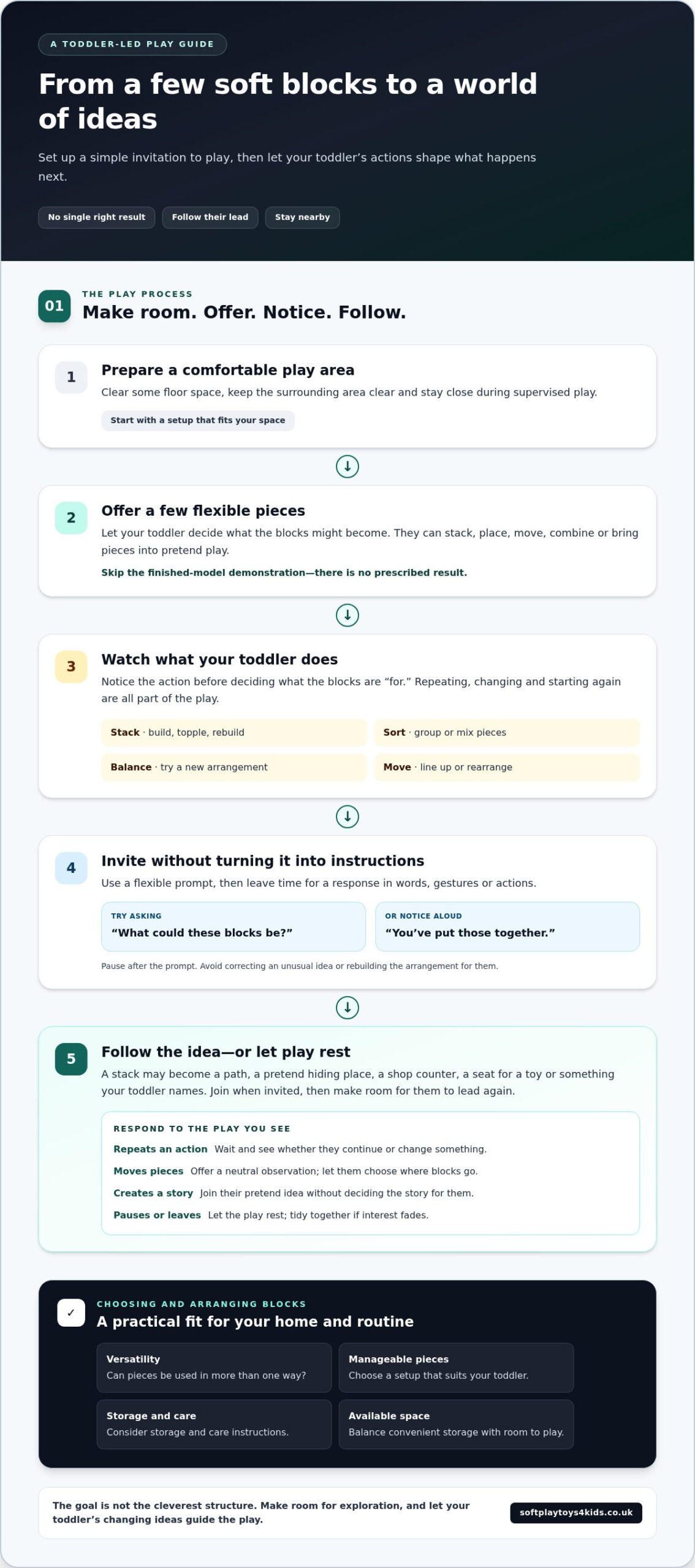
- Prepare a clear space. Choose an area with enough room for your toddler to move and for you to stay close. Move everyday clutter out of the play zone.
- Offer the blocks. Set out a manageable selection rather than arranging a design for your child to copy.
- Observe first. Give your toddler time to touch, move or arrange the pieces. Notice what interests them before suggesting anything.
- Follow their lead. Join in if invited, or offer one open prompt. Let your toddler adapt it, ignore it or come up with another idea.
For more ideas on planning a suitable home setup, this guide to creating a soft play area at home offers useful context for arranging the space around your family’s routine.
Easy play prompts for a first session
Try one invitation at a time, then wait to see where it leads. You might ask, “Could a toy sit somewhere here?” or “Where could your toy hide?” Other simple ideas include making a path to follow, a low wall beside a favourite toy or a space for pretend play. Your toddler may take the blocks in a completely different direction. Follow their choice rather than repeating the prompt.
- Somewhere to sit: Invite your child to arrange blocks beside a toy.
- A path to explore: Suggest placing pieces in a line, then let your toddler decide what the path is for.
- A place to pretend: Offer the idea of a hiding place without deciding who or what belongs there.
Keep play comfortable, flexible, and supervised
Stay close and keep the play area clear and comfortable. If your toddler loses interest, becomes unsettled or seems ready for a break, pause the activity or simplify the setup. There’s no need to finish a build. For another kind of play invitation, explore ideas in this sensory toys guide.
Choose prompts that fit the room and your child’s mood, and supervise in line with the product guidance. If you’re planning a home play space, explore soft play equipment and consider how it could fit your family’s setup.
Choosing Soft Play Building Blocks and Taking the Next Step
The right play setup gives your toddler room to explore and fits comfortably into family life. When considering soft play building blocks for toddlers, think beyond what a child might build today. Look for flexible play possibilities, then weigh them against your available space, storage and the routine that works for your household.
Match the play setup to your toddler and your space
Start with the practical details. Where will play happen? Is there enough clear floor space for your child to move around while you supervise? Where will everything go afterwards? A smaller arrangement can be simpler to put away and may suit a shared room. A larger play area offers more room to spread out, but it also needs enough space to stay clear and comfortable to supervise.
Think about your toddler’s changing interests, too. A flexible setup can be rearranged as play ideas shift, rather than being tied to one activity or finished result. For a broader look at planning a play space, the soft play equipment buying guide can help you think through the wider choices for home or a larger setting.
What a UK soft play manufacturer brings to the conversation
SoftplayToys4kids is a UK soft play manufacturer and supplier, with a factory in West Yorkshire where handmade soft play products are made for families and organisations. This hands-on manufacturing experience informs a practical approach to planning play areas around how they’ll be used. For larger commercial projects, the company provides design and installation to help organisations plan a soft play space for their setting.
Base product decisions on the details of the specific item. Soft play products can differ in materials, dimensions, age guidance and care instructions. Reviewing the product information helps you assess how a setup may fit your child, your room and your day-to-day routine. The aim is a play area that feels manageable for adults and leaves the toddler free to explore.
Before deciding, picture an ordinary day: bringing the play pieces out, making room for supervised play, then putting everything away. If a compact setup suits your space and routine, easy storage may matter most. If you have room for a larger area, the extra space may better suit how your family wants to play. Neither choice is automatically better; choose what feels practical for your home and child.
Ready to explore soft play options for your setting? Explore SoftplayToys4kids and find ideas for planning a play space that works for your family or organisation.
Let Your Toddler’s Ideas Shape What Comes Next
Let the play space grow from what your toddler chooses to return to. Notice which pieces they reach for, how they arrange them and whether they prefer a little floor space or room to spread out. Those clues can help you decide what to keep within easy reach and when to change the setup. There’s no need to make every play session different. Familiar pieces can still invite fresh ideas when your child decides what happens next.
Start with a simple invitation, then give your toddler time to explore it in their own way. Your attention and a little room to experiment create a welcoming setting for imaginative play. If you’re planning a larger play area, SoftplayToys4kids offers design and installation for commercial projects, alongside handmade soft play products for families and organisations.
Explore SoftplayToys4kids to find inspiration for a play space that feels right for your family. Let the next idea begin with your toddler.
Frequently Asked Questions
Can soft play building blocks help toddlers be more creative?
They offer flexible pieces for toddlers to arrange, combine and bring into pretend play, but no toy can guarantee a particular outcome. Treat play as a chance to explore, not a test of creativity. Notice whether your child returns to an arrangement or changes it, and respond with interest rather than judging the result. A relaxed adult presence gives your toddler room to keep exploring at their own pace.
What age can toddlers use soft play building blocks?
There isn’t one age recommendation that applies to every set. Suitability depends on the product’s design and the maker’s stated age guidance, so read the product information before offering it. Consider your child’s abilities and supervise closely. If your toddler still mouths objects, take particular care with the pieces and follow the product guidance. Choose play you can monitor comfortably, and put the blocks away when you can’t supervise.
Are soft play building blocks safe for toddlers?
Safety depends on the particular product, its condition and how it’s used. Before each play session, look over the pieces and stop using any that appear damaged. Follow the maker’s age and care instructions, and supervise your toddler. Keep the play area suited to your child and move nearby items that could get in the way. Products can differ in materials and safety features, so review the information for the specific set.
How can I encourage my toddler to build without telling them what to make?
Offer one open invitation, such as, “I wonder where this piece could go,” then give your toddler time to respond. You could describe an action, like, “You’ve moved that one beside the other,” without suggesting what the result should be. If your child changes direction or starts a different game, follow along. Resist correcting an unusual arrangement; your toddler doesn’t need to make a recognisable model for the play to be worthwhile.
Can toddlers use soft play blocks indoors?
Use them indoors only when the specific product instructions and the space are suitable. Choose a spot where the blocks won’t obstruct a doorway or walkway, and move fragile or unsuitable objects out of reach. Stay with your toddler while they play. When the session ends, store pieces where they won’t create a trip hazard, and follow the maker’s care directions. Indoor suitability shouldn’t be assumed for every soft play product.
How do I clean soft play building blocks?
Follow the cleaning instructions provided for the specific product. Materials and construction can differ, so a method that suits one set may not suit another. Avoid applying a cleaner or using a method the maker hasn’t recommended. If the instructions aren’t available, look for the product’s care information before cleaning rather than guessing. Once the blocks are clean and dry according to those directions, inspect them for visible damage before returning them to play.
What can toddlers build with soft play blocks?
Toddlers can arrange blocks into simple forms, then decide what those forms represent. A low arrangement might become a pretend stage, while a few pieces set apart could mark a waiting area in an imagined game. These are starting points, not models to copy. Your child might rename the setup, take it apart or leave it unfinished. Let their interpretation guide the play, even if it’s different from what you first imagined.
Leave a Reply