
Creating a Child-Friendly Office Space: A Practical Guide

What if an office could feel welcoming to children without turning into a childcare setting or disrupting the working day? Creating a child-friendly office space takes more than adding toys: the accompanying adult remains responsible for supervision, and the layout needs to support safe movement as well as focused work. When space is limited, it helps to decide first where children can spend time comfortably while staff continue their work.
A thoughtful plan can make room for both. This guide will help you shape an age-aware child-friendly zone, whether you have a spare room, a shared meeting area or a small corner. You’ll find practical ways to separate play from work, compare soft-play options such as mats and ball pits, and choose sizes and colours to suit the space. The aim is a more welcoming workspace with clear boundaries, realistic expectations and adult supervision at its centre.
Key Takeaways
- Define the space as a place for children accompanying responsible adults, not as a childcare service.
- Plan sightlines and keep the child-friendly zone clear of entrances, busy routes and active work equipment.
- Compare a shared corner, separate room and temporary setup against your needs for space, privacy and visibility.
- Use a step-by-step plan for creating a child-friendly office space, from assessing who will use it to reviewing the setup after use.
- Choose soft-play options to suit the footprint and planned activities. Mats, sensory toys and ball pits serve different purposes.
Creating a Child-Friendly Office Space: What It Means and What It Does Not
A child-friendly office is a workspace arranged to welcome children who are accompanying a responsible adult. It might include a clearly defined place to sit, read or play, while the rest of the office continues to function as a workplace. Creating a child-friendly office space means planning for how the room is used, rather than placing toys beside desks and hoping the arrangement works.
The idea shares a broad aim with Child Friendly Spaces, which provide children with safe, stimulating environments. In an office, the setup also needs to fit the work taking place and the adults present. A welcoming corner can make a brief visit feel more comfortable for a parent, child or visitor, but it doesn’t make every room appropriate for children.
How is a child-friendly office different from workplace childcare?
A child-aware workspace makes reasonable room for children who are with their responsible adult. Workplace childcare is different: it involves a dedicated, staffed care arrangement. A play corner, soft-play mat or sensory toy doesn’t provide childcare, and it shouldn’t be presented as a replacement for childcare arrangements or the organisation’s workplace policies.
Adults remain responsible for supervising children in the office. Arrange the space so an accompanying adult can stay attentive, rather than relying on equipment to keep a child safe or occupied without oversight. A comfortable place to play may support a visit, but it doesn’t transfer responsibility to colleagues or turn the area into a staffed facility.
Who benefits from a more child-aware workspace?
Parents bringing a child to the office briefly may value a small, clearly defined spot where the child can settle nearby. Visitors attending a meeting with a child can also benefit from a more thoughtful welcome. For organisations planning regular family-aware spaces, a dedicated room or a considered layout may work better than an improvised corner.
Occasional visits and recurring use call for different levels of planning. A short visit may need a simple arrangement close to the accompanying adult. Regular use makes it more important to consider how the space fits office routines, who will supervise and whether the setup remains practical throughout the day. Neither arrangement removes the adult’s responsibility.
There’s no single layout or equipment choice that suits every child. A toddler’s needs differ from those of a school-age child, and the office itself matters too. A quiet desk area, a reception space and a room with active work equipment each present different considerations. Think about the child’s age and needs, nearby activities, the available footprint and whether the accompanying adult can keep watch. Soft-play mats, sensory toys and ball pits offer different ways to create an inviting zone, so choose for the setting rather than assuming one option works for all.
The guiding principle is simple: make the environment more accommodating while keeping adult supervision and normal workplace responsibilities clear. That distinction helps families and visitors feel welcome without confusing a child-friendly office with childcare provision.
Designing a Child-Friendly Office Around Safety, Comfort, and Work
A good layout helps children feel welcome without asking the office to stop functioning. Start by viewing the room from a child’s perspective, then consider whether an accompanying adult can keep them in view while doing appropriate work. Sightlines help with supervision, but they don’t replace it: the adult remains responsible for watching the child and responding when needed.
Where should a child-friendly zone sit in an office?
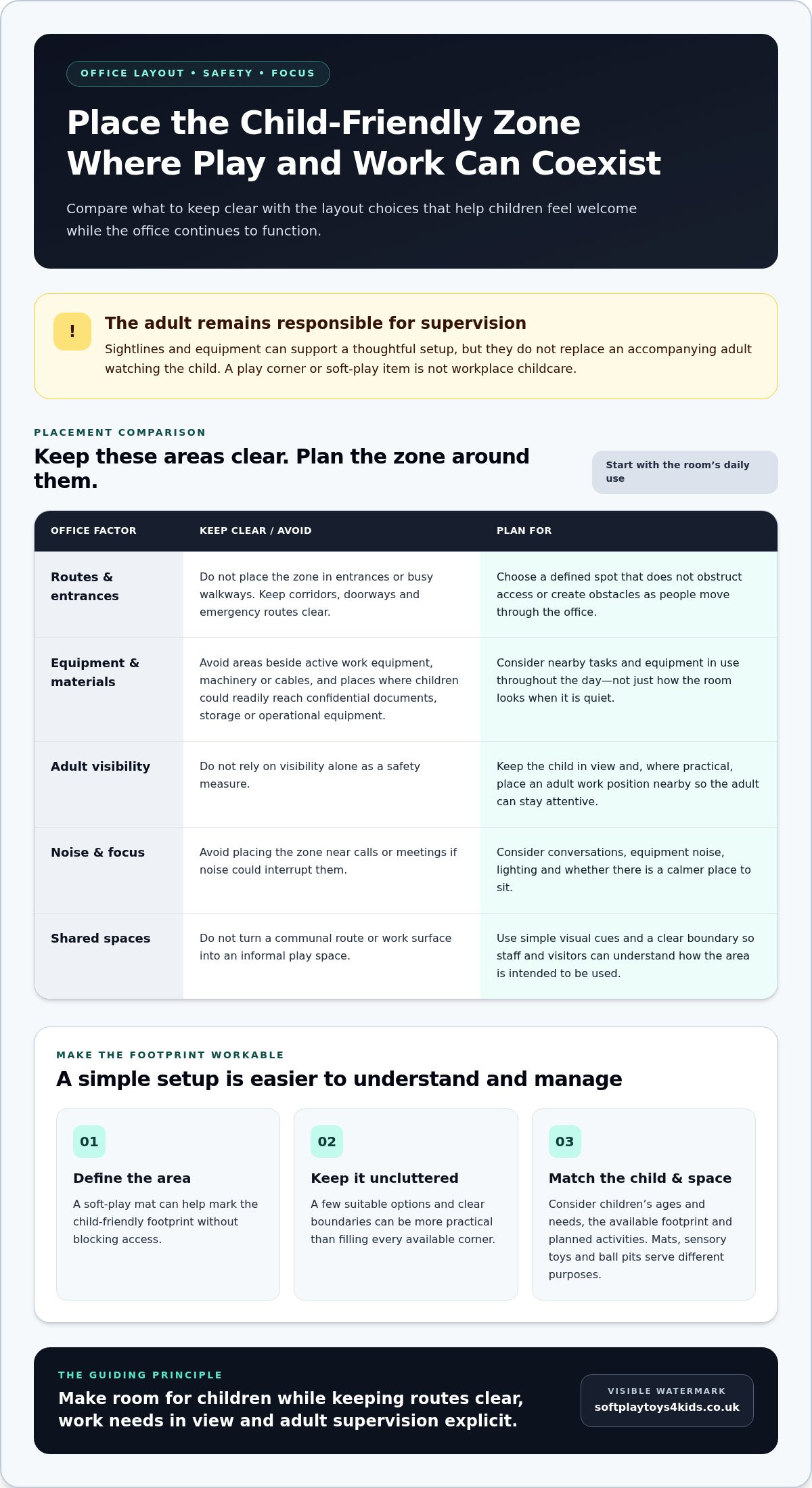
Look for a defined spot away from entrances, busy walkways and active work equipment. Keep corridors, doorways and emergency routes clear, and avoid areas where children could readily reach confidential documents, storage or operational equipment. Placing an adult work position nearby can make it easier to stay attentive, but don’t rely on visibility alone.
Consider what happens around the zone throughout the day. A place beside a reception desk may have frequent foot traffic; a corner near machinery, cables or equipment in use may have different hazards. Think through who passes by, what tasks take place nearby and how a child would move in and out. Keep the layout straightforward, with a clear boundary that distinguishes the child-friendly area without blocking access or creating obstacles.
How can the space feel comfortable without becoming distracting?
Use simple visual cues to distinguish play, quiet and working areas. A soft-play mat can help define the child-friendly footprint, while uncluttered surroundings make it easier for adults and other office users to understand how the space is intended to be used. Choose furniture and equipment to suit the ages and needs of the children expected, not appearance alone.
Comfort also depends on the office around the zone. Consider lighting, noise from conversations or equipment, and whether there is a calmer place to sit. Keep the arrangement manageable: too many toys or competing activities can make a small space feel busy and distract nearby staff. A few suitable options with clear boundaries can be more practical than filling every available corner.
Plan for people who don’t use the play area, too. Staff need room to concentrate and move through the office, and visitors may need a quiet place to talk. If noise could interrupt calls or meetings, position the zone away from those work areas where possible. In a shared room, make sure the layout remains clear to everyone and doesn’t turn a communal route or work surface into an informal play space.
Before setting up, review the organisation’s relevant workplace policies, insurance conditions and site-specific fire-safety guidance. Check that the planned area fits those arrangements, and reconsider potential hazards if equipment or office use changes. For larger organisational spaces, a tailored layout can help make the footprint work harder; custom-sized soft-play equipment can be planned as part of the wider space. Keep the central principle in view: design can support comfort and attentiveness, but it can’t replace adult supervision.
Shared Play Corner or Dedicated Room? Compare Office Layout Options
There’s no single best layout for every workplace. A shared corner can make use of a small office and suit occasional visits, while a dedicated room may offer more separation if children are expected regularly. A flexible setup sits between the two: equipment is brought out when needed and put away afterwards. Compare the options against your available space, how visible the area needs to be and how it may affect work. Whatever the layout, the accompanying adult remains responsible for supervision.
| Layout | Space | Privacy | Visibility | Disruption | Supervision considerations |
|---|---|---|---|---|---|
| Shared play corner | Uses part of an existing room | Low | Can be close to adult work areas | Play and work share the room | Adults need to remain nearby and attentive |
| Dedicated room | Needs a separate room | Higher | May be less visible from desks | Can separate play from focused work | Plan for adults to stay with children |
| Flexible setup | Uses space when required | Depends on the room | Depends on where it is arranged | Room use changes at different times | Supervision remains necessary whenever children are present |
When does a shared play corner make sense?
A shared corner can suit a small office where children visit occasionally and there isn’t room for a separate space. Mark its footprint with a mat or another clear boundary, keep toys together in suitable storage, and place adult seating nearby. Don’t let the setup spill into circulation routes. Agree who tidies the area and when, so it remains usable for play and other office activities.
When might a dedicated room or flexible setup work better?
A dedicated room can create clearer separation from busy desks, calls or meetings, but a closed-off space may make it harder for an adult working elsewhere to stay attentive. A flexible setup can suit a meeting or break room used for different purposes, provided equipment can be arranged without obstructing the room’s normal use. Both options need a clear plan for adult presence, access and resetting the space after use.
For smaller offices, think in terms of a defined, adaptable footprint rather than squeezing in a full play area. A mat and a small selection of suitable items may distinguish the zone while leaving the rest of the room functional. Equipment can be customised by size and colour to fit an office plan. For a larger organisational space, soft-play area design and installation can help shape a layout around the available footprint. Choose the option that fits the way the space is used while keeping supervision clear.
How to Plan and Set Up a Child-Friendly Office Space
A useful plan starts before you choose equipment. Creating a child-friendly office space means matching the setup to the children who may use it, the work happening nearby and the adult supervision available. Follow these steps to turn that picture into a practical arrangement, then refine it after people have used the space.
- Define who the space is for. Consider likely ages, how often children will be present, accessibility needs and activities they may enjoy. Be clear about which responsible adult will supervise. Occasional family visits may need a simple arrangement; regular use calls for broader planning around routines and office operations.
- Review the room and its rules. Note nearby tasks, workplace policies and site-specific requirements that affect where children can go. Identify areas to keep separate, such as confidential work zones or places with active equipment.
- Measure and map the footprint. Mark the proposed play area, adult work positions, storage and the routes people use to move through the office. Include entrances and exits, and make sure the arrangement doesn’t obstruct circulation or access routes.
- Choose a layout and suitable equipment. Select items according to the intended activities, available space and children’s needs. A play mat can help define a zone; sensory toys or a ball pit may suit different kinds of play. Choose for the planned use, not appearance alone.
- Set expectations before use. Make clear who is responsible for supervision, where children may go, how shared areas are used and who puts equipment away. Ensure staff and accompanying adults understand the arrangements.
- Review and adjust. After use, consider whether the setup worked as intended. Note any noise, congestion, visibility issues or equipment that moved outside the planned area. Update the layout or expectations if the space or its users change.
What should an office needs assessment cover?
Make the assessment specific: who is likely to visit, how often, what ages and needs might be involved, and what activities suit the office. Record space limits, nearby work tasks and relevant workplace rules. Distinguish a short visit from recurring use, which may need more coordination. This gives you a practical basis for choosing a layout before arranging the room.
How should the space be introduced and reviewed?
Explain the boundaries and expectations to staff and accompanying adults before the space is used. Adults remain responsible for supervision; equipment doesn’t replace it. After visits, note what happened: did play create noise near calls, narrow a route or make it difficult for an adult to keep watch? Use that feedback to adjust the boundary, equipment position or shared-use arrangements.
For a larger organisational space, a tailored plan can bring the footprint, equipment and office use together. Plan a soft-play space for your office with design and installation support for larger projects.
Adding Soft Play to a Child-Friendly Office: Practical Options and Next Steps
Soft play can make a child-friendly zone feel more welcoming, but choose equipment only after considering the plan. Think about the available footprint, the activity you want to make room for, and the ages and needs of the children expected. Creating a child-friendly office space still depends on adult supervision and a layout that works alongside normal office activities.
Which soft-play options could fit an office plan?
A play mat can help mark out a soft-surface zone where it suits the room. Sensory toys offer options for varied activities, while a ball pit may suit a larger area where its placement, use and supervision have been considered. These options serve different purposes, so choose according to your intended use rather than treating them as interchangeable.
Before selecting equipment, sketch the space and decide how much of it can be set aside without affecting the room’s other uses. Consider where an adult will sit, how children will access the area and whether people can move around it easily. A compact mat with a small selection of toys may make more sense in a shared office than a larger play feature. In a broader space, more equipment may fit, provided the overall layout remains practical.
Think about nearby activities, too. A play area may not suit every office task, and equipment can’t supervise children or make an otherwise unsuitable activity appropriate. Adults remain responsible for watching children and deciding whether the space works for them. Keep the intended use clear, and review the arrangement if the office routine, children’s needs or available space changes.
Size and colour are practical design choices as well as decorative ones. Equipment sized to fit the planned footprint can help define the zone without taking over the room, while colour can help it sit comfortably within the wider office. SoftplayToys4kids makes handmade soft-play products in Bradford, West Yorkshire, and can customise product sizes and colours on order.
How can SoftplayToys4kids support a larger space?
For a larger organisational area, design and installation support can bring the room layout and soft-play equipment together. Planning around the actual footprint helps show how the zone can fit with everyday use. The equipment remains part of the environment, not a substitute for adult supervision or the workplace’s own arrangements.
Start with the activity, footprint and supervision plan, then choose suitable equipment. For larger projects, consider how a tailored layout could work within the wider space. Explore soft-play options for your office, including handmade products that can be customised by size and colour.
Take the Next Step Towards a More Welcoming Workspace
Start with one practical question: what would help your office work better for children who may visit, the adults accompanying them and the people carrying on with their day? Use the answer to shape a space that feels considered rather than improvised. A small, well-planned change can be a useful starting point, and you can refine the setup as you learn what suits your workplace.
Creating a child-friendly office space is an ongoing process, not a one-off decorating decision. Keep the purpose of the area clear, involve the people who will use it and make supervision part of the plan from the outset. With suitable soft-play options, a child’s visit can feel more comfortable while the office stays focused on its work.
Ready to plan your space? Explore handmade soft-play options for your office and take a practical first step towards a more welcoming workspace.
Frequently Asked Questions
What makes an office child-friendly?
A child-friendly office makes it easier for children to be present comfortably without losing sight of its purpose as a workplace. Practical touches might include a place to sit, a few suitable activities and clear information for visiting families about where children can spend time. Match the setup to the organisation’s daily routines and the children likely to visit. Creating a child-friendly office space is about considered choices, not making every part of the office accessible to children.
Can an office have a play area without providing childcare?
Yes. An office can make room for a play area while the accompanying adult remains responsible for the child. For example, a parent might bring a child during a short visit and stay with them in the designated area. The play space itself doesn’t provide care, supervise children or cover a gap in someone’s childcare arrangements. Set expectations before use so visitors and staff understand the difference.
How do you make a small office child-friendly?
Use a small, clearly bounded area and keep its setup simple. A mat and a few selected activities can be easier to manage than a collection of bulky equipment. Decide where items will be stored when the area is not in use, and make sure the arrangement doesn’t interfere with the room’s usual purpose. Even in a compact office, the accompanying adult remains responsible for supervision.
What should be included in an office play area?
Include only items that suit the children expected and the activities the space can accommodate. A play mat, sensory toys or a ball pit may fit different plans, while nearby adult seating can help an accompanying adult stay close. Set aside a clear place to put toys away after use. Avoid filling the area just to make it look like a playroom; keep the selection manageable.
Is a child-friendly office the same as a workplace nursery?
No. A child-friendly office is a workspace that accommodates children who are with their responsible adults. A workplace nursery is a childcare provision with its own care arrangements, rather than simply a space containing toys or soft-play equipment. The distinction matters for planning: an office play area shouldn’t be presented as a nursery or relied on to provide childcare. Organisations considering regular childcare provision need to plan for that separately.
How can a child-friendly office reduce disruption to staff?
Clear expectations and a predictable routine can help staff know what to expect when children visit. For instance, a team might agree how shared rooms are used during meetings, where play items are kept and how the area is reset afterwards. Consider whether calls or focused tasks could be affected, then choose the location and visit arrangements accordingly. The aim is to accommodate children without assuming play will always be quiet.
Are soft-play products suitable for every office?
No. Suitability depends on the room, its activities, the equipment selected and the children expected to use it. A small mat may fit one setting, while a ball pit may not be practical in a busy shared room. Consider the footprint and how the equipment fits into normal work routines. Soft-play items don’t supervise children or make every office activity suitable for them.
Leave a Reply