

Commercial Soft Play Equipment in the UK: Costs and Payment
The headline price is only part of a commercial soft play investment. When comparing commercial soft play equipment suppliers in the UK, the total depends on the equipment and your venue’s requirements, while payment depends on the supplier’s terms. Understand both before committing.
Look beyond the initial figure: a clear breakdown shows what the equipment includes and how the payment schedule fits your plans. Since prices vary by project, focus on what shapes the quote for your venue.
This guide explains the factors that affect commercial soft play equipment costs, what to look for in a quotation and how to assess payment terms before ordering. It also outlines equipment and services available in the UK, helping you choose options for your space and the play experience you want to create.
Key Takeaways
- Break down a quote by equipment, venue requirements and project scope to understand what drives the overall cost.
- Review payment terms alongside the quote so you know how the purchase fits your project budget.
- Match equipment choices to your venue and the children’s play needs, whether you’re planning a leisure space, early-years setting or indoor play area.
- Explore soft play ball pits, mats, sensory toys and lamp post protectors to identify options that suit your venue.
UK indoor play equipment design, manufacture and installation
A commercial indoor play area should reflect the venue’s layout, intended use and project scope. Design, manufacture and installation all shape the finished space and its overall cost.
Installation and Project Planning
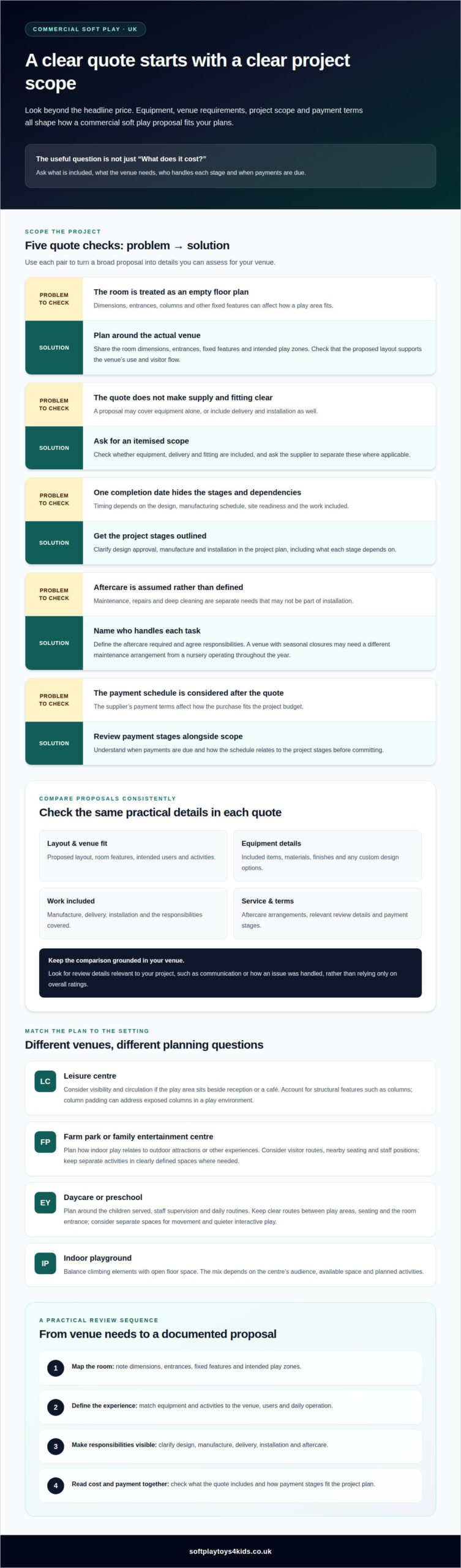
Start planning with the room: its dimensions, entrances, fixed features and intended play zones. A bespoke design can show how equipment fits the floor area and supports your plans. Installation timing depends on the design, manufacturing schedule, site readiness and work included. Ask for these stages and dependencies to be outlined in the project plan instead of relying on a single completion date.
Clarify whether the proposal covers delivery and installation or equipment supply alone. Maintenance, repairs and deep cleaning are separate needs to define in the project scope. For example, a venue planning seasonal closures may need a different maintenance arrangement from a nursery operating throughout the year. A clear scope helps establish who handles each task after installation.
Supplier Products and Service
How do suppliers compare on products, service and customer reviews? Compare the equipment range, custom design options, installation arrangements and aftercare described in each proposal. Look for review details relevant to your project, such as communication or how an issue was handled, rather than relying only on overall ratings. Check product information for materials and finishes, including whether items have features such as digital printing or protective lacquer.
Commercial soft play equipment ranges from individual padded elements to coordinated play areas. The right fit depends on the venue’s floor plan, intended users and activities. A leisure space may need a different layout from a nursery, so compare proposals against the same practical requirements and itemise what each includes.
Choosing a Supplier
What should businesses check when choosing a commercial soft play equipment supplier? Review the proposed layout, product details, manufacturing information, installation scope and payment stages together. Check that the quotation separates equipment, delivery and fitting where applicable. Clear documentation shows how design choices affect cost and what the project team is responsible for at each stage.
Ask for a defined process covering design approval, manufacture, installation and agreed aftercare. Consider how the play area will support daily operations, cleaning access and future repairs. For example, column padding can address a specific room feature, while other equipment shapes the play zone. Match each element to a venue need before approving the project.
Commercial venues including leisure centres and farm parks
Leisure centres, farm parks and family entertainment centres attract different visitors and organise play differently. A leisure centre may place an indoor play area beside reception or a café, so visibility and circulation matter. At a farm park, operators may plan indoor play as an all-weather option alongside outdoor attractions. In both settings, the layout should make sense for the venue’s visitor flow, available space and day-to-day operation.
Inflatable play centres and bouncy castles offer a different format from fixed soft play equipment. Their use may depend on how operators schedule activities, manage storage and prepare the space between sessions. If planning both formats, consider where each activity fits and whether one area needs to serve multiple purposes. For example, a family entertainment centre might place a defined soft play zone alongside a separate inflatable attraction, rather than combining activities in one crowded space.
Family entertainment venues can bring several experiences together, but each element needs a clear role. Consider the route from the entrance to the play area, nearby seating and staff positions. A technical plan helps operators assess these relationships before settling on a layout. Prioritise a practical design suited to visitors and operating patterns, rather than adding features without a clear purpose.
For a commercial venue, list the activities the play area should support, then map them against the room and its fixed features. Note columns, entrances and neighbouring attractions, since each can affect how the space is arranged. A leisure centre with a structural column, for instance, may need padding around that obstacle. Explore column padding for indoor venues as one way to address exposed columns within a play environment. These details help turn a broad entertainment concept into a venue-specific plan.
Equipment for daycares, preschools and indoor playgrounds
Daycares and preschools use indoor play to create active, engaging spaces within daily routines. A low, open play zone may suit younger children, while an indoor playground can include climbing features for more energetic play. Plan each area around available floor space, the children it serves and how staff supervise activities. For example, keep clear routes between the play zone, seating and the room entrance.
Soft play equipment can support different kinds of play without making every area serve the same purpose. A daycare might create one space for movement and another for quieter, interactive play. Preschool operators can consider how children move between activities, where equipment sits and whether the layout leaves room for group sessions. These choices help create an inviting venue and give families a reason to return.
Commercial indoor play centres need layouts that attract families and support day-to-day operations. An indoor soft play area might combine climbing elements with open floor space instead of filling every corner with equipment. This gives children room to move and operators space to organise the surrounding area. The right mix depends on the centre’s audience, available space and planned activities.
UK-made indoor play equipment gives venues a domestic manufacturing option. UK manufacturers can produce equipment for commercial and educational settings, including nurseries and playgroups. Define the intended use first, then consider the room layout, activity mix and equipment types that fit. For example, column padding can address a structural column while keeping the layout centred on children’s movement. A clear brief helps match equipment to the venue, whether it’s a preschool room or a dedicated indoor playground.
Commercial soft play equipment
Commercial soft play equipment is more than a collection of bright structures. In play centres, it shapes how children move, explore and share an active space. A clear design brief should identify the intended users, available floor area and types of play to encourage. For example, a centre could plan distinct zones for climbing, open movement and quieter sensory activities rather than filling the room with one kind of structure.
Equipment choices affect both the play experience and project scope. Sensory elements offer a different activity from climbing structures, while open areas give children room to move between features. The right combination depends on the venue’s aims and how families use the space. A smaller play area may benefit from carefully selected elements, while a larger centre can organise separate activity zones. Each item should have a clear purpose in the overall layout.
Cost follows the project’s scope, not simply the number of items. Bespoke design, equipment choices and the work included all shape the quotation. Ask for equipment and related project costs to be listed separately so you can see how design decisions affect the total. Read payment terms alongside the order stages to understand the financial commitment before approval.
Think about operation as well as first impressions. Staff need to supervise the play area, and the equipment should fit the way children and families use the venue. For instance, a padded column can address an exposed structural feature without making it the centre of the play design. Sensory toys can also add a quieter option beside more active play. Explore sensory toys for your venue as you shape an equipment mix that feels purposeful, welcoming and suited to your play centre.
SoftplayToys4kids
SoftplayToys4kids can help you identify soft play products suited to your venue and project requirements. As a UK-based manufacturer and supplier, it offers handmade equipment for commercial organisations, including schools, nurseries and playgroups.
Consider how specific items fit your setting: Sensory Toys can add a different play experience, while Lamp Post Protectors address exposed posts in an outdoor area. These examples can help you narrow down what you need before reviewing a product order and its payment terms. The right choice depends on your venue, the space and the purpose of the equipment.
If you’re planning a commercial play space and want to discuss suitable products, contact SoftplayToys4kids.
Turn your plans into a welcoming play space
Decide what children should experience in your venue, then define the equipment priorities that support it. A focused brief keeps the project centred on your setting, rather than adding features without a clear purpose. It also gives you a practical basis for discussing products and payment arrangements that suit your plans.
As you consider commercial soft play equipment suppliers in the UK, think about how individual items could contribute to the experience you want to create. SoftplayToys4kids offers Soft Play Ball Pits, Soft Play Mats and Sensory Toys for children’s play environments. Each can play a different role in shaping a space that feels active, comfortable and engaging.
Ready to explore suitable options for your venue? Contact SoftplayToys4kids to discuss your project and take the next step towards a play space children will love.
Frequently Asked Questions
How much does it cost and how is it paid?
Product prices vary by item, and online orders are paid through checkout. Phone orders are also available, with Call & collect in Bradford for same-day pickup. For custom or larger commercial projects, request a quote to establish the project scope and payment arrangement.
How much will my project cost?
Your project cost is shaped by the products selected and any additional work included. A straightforward order of existing products differs from a project involving custom sizes, colours, design or installation. SoftplayToys4kids provides free, no-obligation quotes for project requirements. Set out the equipment and services you need so the quotation can reflect the actual scope, rather than relying on a product price as a project total.
What safety regulations do you work to?
SoftplayToys4kids states that its products meet BS safety standards. All items are handmade in the UK, cut, sewn and filled in our Bradford workshop. Products use flame-retardant foam and wipe-clean PVC covers. These are the stated product and material details; they don’t identify a specific regulation number. For a commercial purchase, keep the product information with your venue’s equipment records.
Which UK suppliers manufacture and install commercial soft play equipment?
SoftplayToys4kids is a UK-based manufacturer and supplier, and offers design and installation for larger projects. Businesses comparing commercial soft play equipment suppliers in the UK can consider whether they need product supply alone or a planned play area with installation. SoftplayToys4kids serves commercial organisations such as schools, nurseries and indoor play centres, so its offering is relevant to those settings.
What types and sizes of commercial soft play equipment are available for indoor play centres, nurseries and family venues?
Options include Soft Play Ball Pools, Soft Play Mats, Sensory Toys and Lamp Post Protectors. Product sizes vary, and custom sizes and colours are available. Custom sizes & colours – tell us what you need for a free, no-obligation quote. This helps you discuss how an item will fit its intended space, whether that’s a nursery play area or a family venue.
How much does commercial soft play equipment cost in the UK, including design, delivery and installation?
There isn’t one price for a complete commercial project: the total reflects the equipment and work included. Published product prices provide a starting point, while design, customisation and installation affect a larger project’s quote. Fast UK delivery is available. For design or installation, request a free, no-obligation quote covering the specific items and services you need.


