
Soft Play Buying Guide for Homes and Nurseries
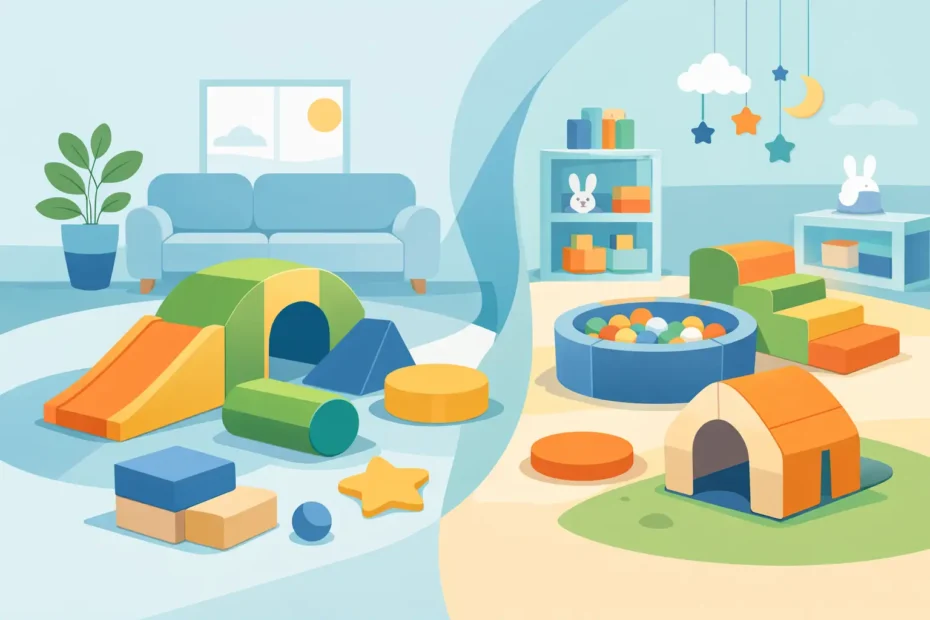
A cheap soft play set that splits at the seams after a few weeks is no bargain. The right soft play buying guide helps you avoid exactly that problem – whether you are fitting out a nursery corner at home, refreshing a preschool room or planning a full commercial play area.
Soft play is one of those purchases where the photos can look similar, but the real difference shows up in safety, durability, finish and long-term value. Parents need equipment that keeps children active without taking over the whole house. Nurseries and commercial venues need products that can cope with daily use, regular cleaning and constant movement. In both cases, buying on price alone usually costs more later.
What a good soft play buying guide should help you decide
Start with the purpose, not the product. That sounds obvious, but it is where many buyers go wrong. A home setup for one toddler has very different demands from a baby room in a nursery or a soft play centre handling high footfall every day.
If you are buying for home, think about how your child will actually use the set. Climbing, crawling, balancing and simple imaginative play all matter more than buying the biggest bundle available. A compact step-and-slide, a few shapes, a small ball pit or a folding mat can often deliver more day-to-day use than a large set that barely fits the room.
If you are buying for a nursery, school or commercial environment, focus on age range, daily capacity and supervision. Equipment needs to suit the children using it, but it also needs to work for staff. That means easy-clean surfaces, shapes that can be rearranged, layouts that support safe circulation and products made to stand up to repeated use.
Safety comes first, but safety is more than soft edges
Every buyer says safety matters. The problem is that many only check whether the equipment looks padded. Good soft play should go further than that.
Look closely at the foam quality, the density of the shapes and the strength of the covers. Foam that is too soft can lose structure quickly. Foam that is too firm may not give younger children the confidence they need. Covers should be durable, wipe-clean and properly finished, with stitching and fastening designed for regular use.
You also need to think about the environment around the product. A ball pit or slide unit placed in a cramped space is not suddenly safe just because the equipment itself is soft. Leave enough clearance for children to climb on and off comfortably. In commercial spaces, include protective elements such as safety pads and post protectors where needed. A supplier that understands complete play areas, not just individual items, is often a safer choice.
For younger babies and toddlers, lower-profile shapes and soft play mats are usually the strongest starting point. For older toddlers and preschool children, balance beams, wedges, steps and slides add more physical challenge. The best choice depends on age, confidence and how much active play you want to encourage.
Size matters more than most people expect
The most common buying mistake is choosing without measuring properly. Not roughly. Properly.
Measure floor area, ceiling height, nearby furniture and access points. A brilliant set is no use if it cannot get through the doorway or if it leaves no room for children to move safely around it. Home buyers often benefit from modular pieces that can be packed away, reconfigured or moved between rooms. Commercial buyers often need the opposite – a layout designed to maximise the space and create clear play zones.
This is where custom sizing can make a genuine difference. Standard products are fine when the room is straightforward, but awkward corners, narrow walls or unusual layouts can waste valuable space if you force in off-the-shelf equipment. Bespoke sizing helps you use the area properly instead of compromising around it.
Materials, finish and cleaning
Soft play takes a lot of wear. Shoes, socks, spills, wiping, dragging and climbing all test the finish far more than an online product image suggests.
For parents, wipe-clean surfaces are essential. You want something that can handle snacks, sticky hands and the everyday mess that comes with babies and toddlers. For nurseries and play venues, cleaning matters even more. Surfaces need to be practical for frequent sanitising without quickly looking tired.
Check the quality of the stitching and the neatness of the finish. Poor finishing is usually an early warning sign. If the corners, seams and fastening details look rushed, the set may not hold up well under regular use. This is one of the clearest differences between mass-produced low-cost imports and well-made UK-manufactured soft play.
The right products for different buyers
A useful soft play buying guide should not pretend there is one perfect setup for everyone. There is not.
For homes
Most families get the best value from a small but versatile setup. Baby play mats, simple foam shapes, mini slides and compact ball pits are popular because they support active play without demanding a dedicated playroom. If storage matters, look for sets that can be moved easily and reused in different ways as your child grows.
At home, educational value also counts. Climbing, balancing and crawling all help build coordination and confidence. The strongest products are not just colourful – they keep children engaged enough to come back to them every day.
For nurseries and preschools
Nurseries usually need a broader mix. Soft play shapes, activity sets, mats and climbing pieces work well because they support supervised group play and different stages of development. Durability is critical here. So is flexibility. Products that can be rearranged give staff more options and make better use of the room.
For commercial soft play environments
Commercial operators need to think bigger and more strategically. Layout, traffic flow, custom sizing, protective padding and visual impact all matter. Children need an exciting space, but operators also need practical installation, dependable supply and equipment built for sustained daily demand. This is where working with a manufacturer rather than just a reseller can pay off.
Price versus value – the trade-off buyers should understand
Everyone wants affordable pricing. Quite right too. But there is a difference between competitive pricing and false economy.
The cheapest set on the market may look attractive, especially for first-time buyers. Yet if the foam compresses quickly, the covers crack, or the finish starts failing under normal use, you are replacing it far sooner than planned. A better-built set usually gives stronger long-term value, even if the upfront cost is slightly higher.
That said, not every buyer needs a fully bespoke or heavy-duty commercial-grade setup. For home use, buying sensibly often means choosing fewer pieces of better quality. For institutions, value often comes from matching the specification to the environment instead of overbuying where lighter use is expected.
A dependable supplier should be able to help you balance budget, safety and expected usage rather than pushing the most expensive option every time. That is a major part of real customer service.
Why UK manufacturing makes a difference
For many buyers, UK manufacturing is not just a patriotic preference. It is practical.
When your soft play is made in the UK, communication is usually clearer, lead times can be more manageable and bespoke work is more straightforward. You also have more confidence in what you are getting, particularly when safety, sizing and finish are important.
For commercial buyers, this matters even more. If you need tailored dimensions, specific colour combinations or a coordinated installation, dealing direct with a UK manufacturer can save time and reduce the back-and-forth that slows projects down. Softplay Toys4Kids has built its reputation around exactly that mix of value, custom production and direct support.
Questions to ask before you buy
Before placing any order, ask yourself a few direct questions. Who is using the equipment? How many children will use it at once? How often will it be cleaned? Does the space need standard sizes or made-to-measure pieces? Are you buying for now, or do you want the setup to grow with the child or setting?
Those answers shape everything else. They tell you whether you need a compact starter set or a larger combination, whether a mat-based setup is enough or climbing elements make more sense, and whether bespoke options will save money and hassle in the long run.
The strongest buying decisions usually come from being clear about the job the product needs to do. Once that is settled, comparing quality, finish, service and price becomes much easier.
Soft play should earn its place. It should be safe, hard-wearing, easy to maintain and genuinely fun for children to use. Buy with that standard in mind, and you are far more likely to end up with equipment that works properly from day one and keeps delivering long after the novelty wears off.
Leave a Reply