
Nursery Soft Play Equipment: The Complete Guide for UK Early Years Providers 2026

Did you know that with 1.3 million children currently enrolled in UK childcare, your play area is likely facing more heavy-duty action than ever before? You need nursery soft play equipment that doesn’t just look the part on day one but actually survives the relentless energy of toddlers and the strict scrutiny of safety inspectors. We know the frustration of watching expensive foam shapes lose their bounce or worrying if your layout meets the latest BS EN 1176 standards. You want a vibrant space where children can thrive, but you also need gear that is easy to clean and built to last.
We agree that your facility deserves the durability of premium, handmade craftsmanship. We invite you to compare our quality with any other provider. This guide will teach you exactly how to select, layout, and maintain high-quality nursery soft play equipment that boosts early years development while staying fully compliant with UK safety regulations. We will explore how to maximize irregular room shapes with bespoke safety pads and ball pits, ensuring your nursery remains a safe haven for growth. From understanding impact-absorbing flooring to choosing wipe-clean materials, here is everything you need to create a world-class play environment in 2026.
Key Takeaways
- Learn how to align your play area with EYFS requirements to support vital sensory and motor skill development in early years.
- Discover the critical technical differences between home-grade gear and commercial nursery soft play equipment, including foam density and medical-grade PVC standards.
- Master the art of nursery layout by creating distinct zones and essential clear zones to keep active play both safe and stimulating.
- Understand why sourcing directly from a UK manufacturer ensures faster delivery, bespoke designs, and better value for your specific nursery budget.
- Get expert tips on maintaining wipe-clean, antimicrobial surfaces to ensure your investment stands up to heavy daily use and strict health inspections.
Why Quality Nursery Soft Play Equipment is Vital for Early Years Development
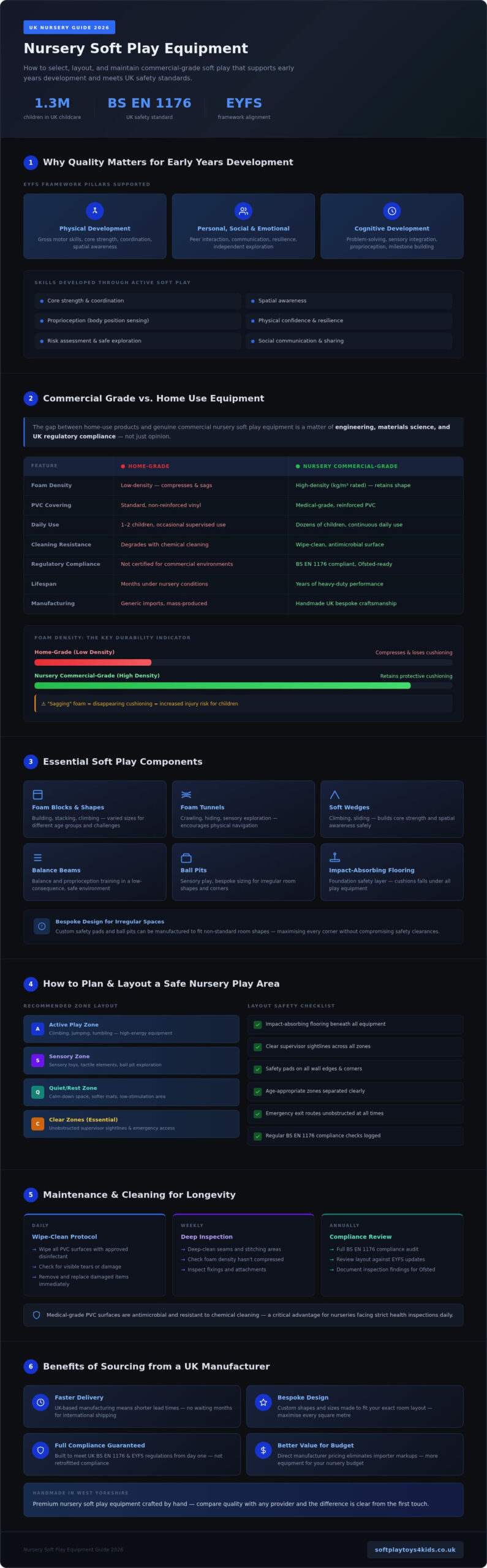
What transforms a simple room into a powerhouse for learning? It isn’t just about bright colours; it’s about the tools you provide. Professional nursery soft play equipment consists of high-density foam shapes encased in durable, reinforced PVC. These aren’t just toys. They’re specifically engineered apparatus designed to withstand the rigorous demands of a busy UK nursery. When you invest in premium gear, you’re creating a foundation for safe, active play that lasts for years rather than months. We invite you to compare our handmade West Yorkshire quality with generic imports; the difference in durability is clear from the first touch.
For UK providers, this equipment is a vital asset for meeting Early Years Foundation Stage (EYFS) requirements. It directly supports the “Physical Development” and “Personal, Social and Emotional Development” pillars of the framework. By providing a varied landscape of blocks, tunnels, and mats, you give children the physical challenges they need to hit their milestones. It’s about more than just burning off energy. It’s about building the cognitive and physical architecture that children will use for the rest of their lives.
Supporting Physical and Cognitive Milestones
Gross motor skills don’t develop in a vacuum. They require practice. When a toddler climbs a soft wedge, crawls through a foam tunnel, or balances on a beam, they’re building core strength and coordination. This active engagement is essential for early years development. It helps children master spatial awareness and proprioception, which is the body’s ability to sense its own position. We also see that integrating sensory toys into these areas encourages problem-solving. Children learn to navigate obstacles, share space with peers, and communicate their intentions, turning a simple play session into a complex social and cognitive workout.
Creating a Safe Space for Risk-Taking
Toddlers are natural-born explorers, but they need a safe harbour to test their limits. High-quality nursery soft play equipment creates a “low-consequence” environment. Here, a tumble doesn’t result in a bruised knee or a tearful afternoon. This safety net builds immense physical confidence. When children feel safe, they’re more likely to try something new, like jumping from a small height or balancing on an uneven surface. This independent exploration is key to building resilience. For practitioners, it also reduces “injury anxiety” during high-energy sessions. You can let the children lead their own play, knowing the high-density foam and safety padding are there to protect them every step of the way.
Commercial Grade vs. Home Use: What Defines ‘Nursery Grade’ Equipment?
Walk into any high street toy shop and you’ll find foam play shapes that look, at first glance, remarkably similar to what you’d see in a professional nursery setting. They’re colourful, soft, and cheerful. But that visual similarity is where the comparison ends. The gap between home-use products and genuine commercial nursery soft play equipment isn’t a matter of opinion; it’s a matter of engineering, materials science, and UK regulatory compliance. Getting this distinction wrong is an expensive mistake that compromises both your budget and, far more critically, your children’s safety.
Home-grade products are designed for occasional, supervised use by one or two children. Nursery environments are an entirely different proposition. Your equipment faces dozens of children daily, repeated chemical cleaning, and the scrutiny of Ofsted inspectors. The materials specification has to match that reality.
The Science of High-Density Foam
Foam density is the primary indicator of durability in commercial play gear. It’s measured in kilograms per cubic metre (kg/m³), and the difference between a cheap import and a professionally manufactured piece is immediately apparent. Low-density foam, common in home-use products, compresses under repeated impact and doesn’t fully recover. That “sagging” isn’t just an aesthetic problem; it means the protective cushioning your children depend on is gradually disappearing beneath their feet. Quality soft play equipment uses high-density foam specifically chosen for its rebound factor, meaning it returns to its original shape after impact, session after session, year after year. This resilience is what keeps a tumble consequence-free and keeps your investment performing long-term.
For settings where physical development is vital for early years development, that consistent cushioning isn’t a luxury. It’s a safeguard.
Hygiene and Maintenance in the Nursery
Here’s where the difference becomes impossible to ignore. Boucle fabric and decorative home textiles are simply incompatible with nursery infection control protocols. Wipe-clean, medical-grade PVC is the gold standard for commercial settings, and for good reason. It must be:
- Non-toxic and phthalate-free, meeting strict safety standards for direct contact with young children
- Antimicrobial, actively resisting the bacterial build-up that warm, busy environments encourage
- Resistant to chemical cleaning agents used in daily nursery sanitisation routines without degrading or cracking
Beyond the cover material, the construction details matter enormously. Reinforced stitching prevents seam failure under stress, while hidden, tamper-resistant zips stop curious little fingers from accessing the foam interior. These aren’t minor finishing touches; they’re deliberate design choices that extend the lifespan of each piece significantly.
UK commercial and educational premises also carry a legal obligation to meet fire-retardant standards. All foam and cover materials used in genuine nursery-grade equipment must comply with relevant UK fire safety regulations for public spaces. This is non-negotiable, and it’s a specification that home-use products simply don’t carry.
At SoftplayToys4kids, every piece is handmade in West Yorkshire using premium, durable materials built to these exact commercial standards. If you’re ready to specify equipment that will genuinely stand up to daily nursery life, explore our range of nursery soft play mats and safety pads to see the quality difference for yourself.
Essential Soft Play Components for a Stimulating Nursery Environment
Knowing your equipment needs to be commercial-grade is one thing. Knowing exactly which pieces to invest in is another. The right combination of components transforms a bare room into a genuinely developmental environment, one where every corner offers a new physical or sensory challenge. Here’s a practical breakdown of the core pieces every nursery should consider, and what to look for when specifying each one.
Ball Pits and Sensory Pools
A ball pit is far more than a crowd-pleaser. For young children, the tactile feedback of wading through hundreds of coloured balls provides genuine proprioceptive input, helping to regulate sensory processing and calm overstimulated nervous systems. When sizing a ball pool for a nursery setting, match the footprint to your typical group size. A pool that’s too small creates bottlenecks and frustration; too large and it becomes difficult to supervise safely.
The balls themselves matter just as much as the pool frame. Specify crush-proof, hollow balls that won’t crack under pressure or create sharp edges. They should be non-toxic, phthalate-free, and sized appropriately to eliminate choking hazards for your youngest children. Integrating a ball pool into a wider sensory corner, perhaps alongside tactile wall panels or soft lighting, amplifies its developmental impact considerably.
Modular Blocks and Active Play
Modular nursery soft play equipment is the backbone of a flexible, engaging layout. Soft play blocks in varied sizes and shapes invite children to build, knock down, and rebuild, a cycle that develops spatial reasoning and collaborative play simultaneously. Steps and low slides are particularly valuable for building leg strength and teaching children to sequence movements: climb, pause, assess, descend. These are foundational physical literacy skills.
One often-overlooked strategy is equipment rotation. Rearranging your modular pieces every few weeks keeps the environment feeling fresh without any additional spend. A tunnel placed alongside a wedge one month becomes an obstacle course the next. Children re-engage with familiar pieces as though encountering them for the first time.
Safety Pads, Play Mats, and Column Padding
No layout is complete without addressing the structural hazards in your room. Play mats placed beneath climbing frames and active zones absorb the impact of falls that are simply inevitable in any honest nursery session. Equally critical is column padding for open-plan rooms. Exposed structural pillars are a genuine head-injury risk, and purpose-made column padding wraps them securely in high-density foam covered in wipe-clean PVC.
At SoftplayToys4kids, our safety pads and column padding are handmade in West Yorkshire to bespoke dimensions, meaning awkward pillars and irregular room shapes are never a problem. We invite you to compare our build quality with any other supplier. The difference is immediate.
How to Plan and Layout a Safe Nursery Play Area
A brilliant piece of equipment placed in the wrong spot can create more problems than it solves. Planning your layout before you order a single item is the single most impactful decision you’ll make for your nursery play space. It determines supervision quality, injury risk, and how effectively children can actually use the environment you’ve invested in.
Start with your hazards. Walk the room and identify every fixed obstacle: radiators, structural columns, low windowsills, and electrical sockets. Each one needs to be either padded or excluded from the active play zone entirely. Exposed columns are a particular concern in open-plan nurseries, and purpose-made column padding wraps them securely without reducing your usable floor area. Radiators should have a clear buffer zone of at least 500mm, keeping them well outside the reach of children mid-tumble.
Traffic flow matters more than most nursery managers initially expect. Every zone needs at least one clear entry and exit point that staff can monitor simultaneously. Avoid layouts where furniture or large equipment creates corridors that funnel children out of sightlines. The goal is an open, legible space where a practitioner standing in one position can see the majority of the room.
Zoning is your most powerful layout tool. Separate high-energy active play, think climbing, jumping, and rolling, from quieter sensory corners where children can decompress. These zones don’t need physical walls between them; a change in flooring texture or a low soft boundary is often enough to signal a shift in pace to young children. This structure also makes supervision far more manageable during peak sessions.
Measuring for Custom Fit-Outs
Before ordering any nursery soft play equipment, create a simple floor plan sketch to scale. Measure your room’s full dimensions, then subtract for skirting boards, typically 100-150mm per wall, and note the position of every socket, vent, and door swing. Corner ball pits and bespoke wall padding must account for these details precisely; a few centimetres of error creates gaps that become both a safety risk and an aesthetic problem. At SoftplayToys4kids, our bespoke design service is built around your exact measurements, so nothing arrives and fails to fit.
Safety and Supervision Layouts
Blind spots are the enemy of safe active play. Avoid placing tall modular pieces against walls in ways that create hidden pockets behind them. For indoor playground equipment in nursery settings, keeping maximum heights appropriate for the age group ensures children remain visible throughout. Colour choices also play a practical role; stimulating primary colours work well in active zones, while softer, muted tones in sensory areas help children regulate their energy levels naturally.
Ready to turn your measurements into a layout that works? Talk to our team about a bespoke nursery fit-out and see how our handmade West Yorkshire craftsmanship fits your exact space.
Why SoftplayToys4kids is the Trusted Partner for UK Nurseries
Choosing a supplier isn’t just a purchasing decision. It’s a partnership that affects the safety, development, and daily experience of every child in your care. SoftplayToys4kids is a Bradford-based manufacturer that has built its reputation by doing one thing exceptionally well: crafting premium, handmade nursery soft play equipment that genuinely performs in the real world of busy UK nurseries. We invite you to compare our quality with any other provider. The difference speaks for itself.
Every piece we produce is handmade in our West Yorkshire factory using locally sourced materials. This isn’t a marketing phrase; it’s a manufacturing commitment that shapes every decision we make, from the foam specification to the final stitch on each PVC cover. When you order from us, you’re not waiting on a container ship from overseas or accepting the quality compromises that come with mass-produced imports. You’re getting a product that a skilled craftsperson in West Yorkshire has built to last.
The Advantage of UK Manufacturing
Sourcing direct from a UK manufacturer changes the economics of your nursery budget significantly. Because we control every stage of production, we eliminate the middlemen and the markups they add. That saving comes straight to you as direct-from-manufacturer pricing. Beyond cost, our domestic supply chain means we have full visibility over every material and process, ensuring BS safety compliance isn’t something we hope for; it’s something we can verify and guarantee at source.
Lead times are another area where UK manufacturing wins decisively. International imports are subject to shipping delays, customs complications, and quality inconsistencies that only become apparent after arrival. Our nursery clients across the country receive their orders faster and with complete confidence in what’s inside the packaging. We’re proud to support West Yorkshire craftsmanship and the wider UK economy while delivering a product that outperforms anything imported at a comparable price point.
Ordering Your Bespoke Nursery Equipment
Every nursery is different. Awkward room shapes, specific brand colour palettes, and unusual dimensions are exactly the kind of challenges our bespoke design service is built for. Getting a custom quote is straightforward. Share your measurements and requirements with our team, and we’ll design pieces that fit your space precisely, whether that’s a corner ball pool, custom-dimensioned safety pads, or column padding in your nursery’s exact brand colours.
Our commitment is simple: every item that leaves our West Yorkshire factory is built to last for years, not months. Durable. Safe. Vibrant. That’s the SoftplayToys4kids standard, and it’s why nurseries nationwide keep coming back to us.
Contact our Bradford-based team today for a nursery soft play quote and discover how our handmade craftsmanship fits your exact space and budget.
Build a Play Space That Works as Hard as You Do
Your nursery deserves nursery soft play equipment that genuinely keeps pace with the children using it every single day. From understanding why foam density matters to planning a layout that keeps every child visible and safe, the decisions you make at the specification stage shape everything that follows: compliance, durability, and the quality of play your children experience.
Three things are worth carrying forward. Commercial-grade materials aren’t optional in a professional setting; they’re foundational. A well-zoned layout does as much work as the equipment itself. And sourcing from a UK manufacturer means you get bespoke fit, faster delivery, and real accountability for quality.
SoftplayToys4kids is trusted by schools and nurseries across the UK, and every piece is handmade in West Yorkshire with a bespoke design service built around your exact space and requirements. We invite you to compare our quality with any other provider.
Ready to create something exceptional? Shop our commercial nursery soft play range and let’s build a space where children genuinely thrive.
Frequently Asked Questions About Nursery Soft Play Equipment
What safety standards must nursery soft play equipment meet in the UK?
Commercial nursery soft play equipment in the UK must comply with BS EN 1176, which governs playground equipment safety, alongside relevant fire safety regulations requiring all foam and cover materials to meet fire-retardant standards for public spaces. Equipment used in nursery settings also falls under EYFS regulatory requirements, meaning it must be age-appropriate and free from hazards including sharp edges, choking risks, and toxic materials. Always request documentary evidence of compliance from your supplier before purchasing.
How do I clean and disinfect soft play mats and ball pits effectively?
Wipe all PVC surfaces daily using a diluted, non-abrasive disinfectant solution that’s approved for use around children. Avoid bleach-heavy products at high concentrations, as repeated use can degrade cover materials over time. Ball pits require a more thorough routine: remove and wash balls regularly using warm soapy water, then allow them to dry fully before returning them to the pool. Keeping a cleaning log is good practice for Ofsted inspections and helps identify any equipment showing early signs of wear.
Is it better to buy modular sets or a fixed soft play installation?
For most nurseries, modular nursery soft play equipment offers far greater long-term value. Modular pieces can be rearranged regularly to keep the environment stimulating without additional cost, and individual components can be replaced if damaged rather than replacing an entire fixed structure. Fixed installations suit larger dedicated play rooms where layout is unlikely to change, but they offer little flexibility as your group sizes or EYFS focus areas evolve. Most UK nurseries find modular setups easier to manage, store, and adapt.
What is the best foam density for commercial nursery use?
High-density foam rated for commercial use is the correct specification for any busy nursery setting. Unlike the lower-density foam found in home-use products, commercial-grade foam retains its shape and cushioning properties under repeated daily impact. This rebound quality is what keeps falls consequence-free session after session. Don’t accept a supplier’s vague assurances; ask for the specific density rating in kilograms per cubic metre and confirm it’s appropriate for continuous, multi-child use rather than occasional home play.
How often should nursery soft play equipment be inspected for safety?
A visual safety check should be carried out every day before children use the equipment. Look for torn seams, exposed foam, cracked balls, or any component that has shifted out of position. A more thorough physical inspection, checking zip integrity, foam compression, and surface condition, should happen at least monthly and be recorded in writing. Any piece showing significant wear, particularly loss of cushioning or cover damage, should be removed from use immediately until it’s repaired or replaced.
Can you provide bespoke colours to match our nursery branding?
Yes. At SoftplayToys4kids, our bespoke design service is built around your specific requirements, including custom colour choices for PVC covers to match your nursery’s brand palette. Whether you need a specific shade for your safety pads, column padding, or ball pool surround, our West Yorkshire team works directly with you to get the details right. We invite you to compare our bespoke offering with any other provider. Share your requirements with our Bradford-based team and we’ll design pieces that fit both your space and your identity.
How long does delivery take for custom-made soft play in the UK?
Because every piece is handmade to order in our West Yorkshire factory, lead times vary depending on the complexity and scale of your specification. Sourcing directly from a UK manufacturer means you avoid the shipping delays and customs complications that come with overseas imports. Our domestic production gives us full control over timelines, and our team will confirm a clear delivery estimate when you place your order. For nurseries planning a new fit-out or seasonal refresh, contacting us early in the planning process is always advisable.
Are your products fire-retardant and safe for Ofsted inspections?
All foam and PVC cover materials used in our nursery soft play equipment meet UK fire safety regulations for commercial and educational premises. This is a non-negotiable part of our manufacturing standard, not an optional add-on. Our products are also made using non-toxic, phthalate-free materials that are safe for direct contact with young children. If you’re preparing for an Ofsted inspection, you can request material compliance documentation from our team to support your evidence file with confidence.
Leave a Reply