
Soft Play Obstacle Course Equipment UK: A 2026 Buying Guide

A good soft-play obstacle course is more than a pile of exciting pieces. It gives children a clear route, from the first step to the finish, and makes sense for the room and the people using it. Choosing soft play obstacle course equipment uk venues can use every day means considering how the pieces work together, who will use them and how much space is available.
Play should feel joyful, but the setup also needs to be practical for adults to supervise and straightforward to fit into the room’s everyday use. The right mix can bring mats, ball pits and activity pieces together as a purposeful play route, rather than a collection of items competing for floor space.
This 2026 buying guide explains how to plan around your venue, users and available area, compare equipment details and think through layout and supervision. You’ll also find out how a UK manufacturer can support a project, from handmade soft-play equipment made in Bradford to custom sizes and colours, design and installation support for larger projects. Planning the route first helps you choose pieces that work well together.
Key Takeaways
- Plan a clear start, movement challenge, transition and finish so the course feels purposeful rather than like unrelated play pieces.
- Compare soft play obstacle course equipment uk options by venue, usable floor area, intended users and the support your project needs.
- Measure the room and note access routes before mapping the layout, then consider how children will move through it under supervision.
- Choose equipment combinations that suit your setting, whether you’re planning for home, a playgroup, a nursery, a school or a commercial venue.
- Handmade equipment from Bradford, custom sizing and colours, and design and installation support for larger projects can help shape a venue-specific plan.
Purpose of UK soft play obstacle course equipment
A soft-play obstacle course is a planned sequence of soft equipment that invites children to move through a play route under adult supervision. Depending on the pieces and the children using them, the route might involve stepping, crawling, climbing over low shapes or moving between activity points.
The important difference is the sequence. A fixed playground has a permanent layout, while a box of unrelated toys offers activities without necessarily creating a route. A soft-play course connects pieces into a start, movement challenges and a finish. Thinking in this order helps you plan how children will move through the space and how adults can supervise play.
For UK settings, buyers of soft play obstacle course equipment uk should consider how the room is used every day, not just the appeal of individual pieces. A route for a small indoor activity area will look different from one planned for a larger commercial play space. In either case, aim for an arrangement that fits the venue instead of an assortment that gets in the way.
Which UK venues use soft play obstacle courses?
Nurseries and preschools can use soft-play equipment to create flexible indoor activity areas. Plan the arrangement around the usable floor space and the room’s other activities. For schools and playgroups, consider the room layout, access routes and how the group’s supervised activities will use the space.
Scale matters. A smaller organisational setup may need a compact route that fits alongside other activities. A larger commercial play-area project may involve more detailed planning across the space. The venue footprint, intended users and supervision arrangements all influence what a suitable course looks like.
What children can practise through a planned play route
Active play gives children opportunities to practise movement, balance and coordination as they travel between soft-play pieces. A route can invite them to step, crawl, reach or change direction, depending on the equipment selected. These are opportunities for play, not promises of a particular developmental result.
Imagination can make the route feel like an adventure: children might pretend to cross a river or find a path through a forest. Keep the setup appropriate to the children, the equipment and the adult supervision available. Age suitability isn’t determined by the course name alone; it depends on how the pieces and play environment suit the users.
A clear route also gives adults a practical starting point for considering how play will flow through the room. Next, look at how different soft-play pieces can connect to create that route.
How soft-play equipment pieces combine into an obstacle course
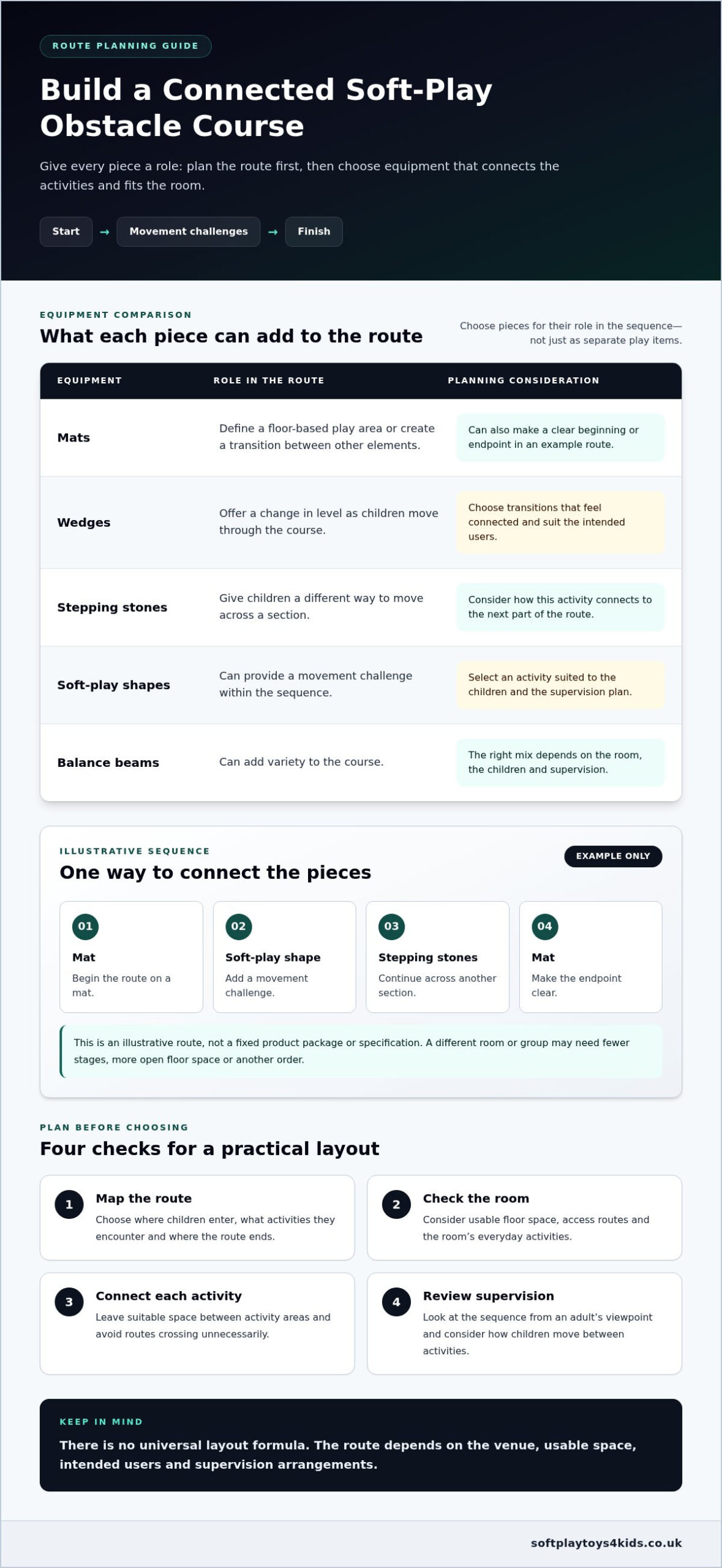
A course takes shape when each piece has a role in a clear route. Decide where children enter, which movement activities they’ll encounter, how one activity leads to the next and where the route ends. This sequence helps you choose equipment for a purpose instead of collecting separate items that don’t work well together.
Choosing soft-play pieces for different movement challenges
Start with the activity each piece invites. Mats can define a floor-based play area or create a transition between other elements. Wedges offer a change in level, while stepping stones give children a different way to move across a section. Soft-play shapes and balance beams can add variety, depending on the room, the children and the supervision plan.
Varying activities can make a route more engaging, but variety doesn’t mean making every section more challenging. A simple course might alternate floor-level movement with a low-level balance activity, then return to a mat. Choose transitions that feel connected and keep the route easy to follow. The Association of Play Industries (API) offers wider UK play-sector context that can inform your thinking about play spaces and equipment.
Planning a route that feels connected
Before choosing pieces, sketch the route in order. Think about where children will approach each activity and how they’ll move on to the next one. Leave suitable space between activity areas, and avoid arranging pieces so that routes cross unnecessarily. The right layout depends on the venue and its users, rather than on a universal formula.
For example, an illustrative route might begin on a mat, continue to a soft-play shape for a movement challenge, lead across stepping stones, then finish at another mat as a clear endpoint. This shows one way to sequence activities, not a fixed product package or specification. A different room or user group may need fewer stages, more open floor space or a different order.
Use this practical planning checklist:
- Start: Choose a visible place to enter the route.
- Challenge: Select an activity suited to the intended users.
- Transition: Connect that activity to the next without cluttering the path.
- Finish: Make the endpoint clear, with room for children to leave the route.
Review the sequence from an adult’s viewpoint. Can the route be supervised as children move between activities? Does it fit the room’s everyday use? Buyers comparing soft play obstacle course equipment uk can use this route-first approach to assess how each piece contributes to the overall layout. Explore soft-play equipment for your project to see options for different settings.
How to compare UK soft play obstacle course equipment
The right setup depends on the venue, the users and the activities you have in mind. A home play area, a nursery room and a dedicated commercial play space have different requirements, so compare complete plans rather than choosing equipment on appearance alone. For soft play obstacle course equipment uk buyers, start with practical questions: how much floor area is usable, who will play, what route do you want and what project support would help?
| Setting | Compare | Planning focus |
|---|---|---|
| Home | Available play area and intended users | A manageable mix that fits around the room’s other uses |
| Nursery or preschool | Usable floor space, children and activity plans | How the play area fits into a flexible indoor room |
| School or playgroup | Room layout, access and planned activities | A route that works within the space available |
| Commercial play space | Overall area, activity mix and project scope | Whether design and installation support would be useful |
Match the equipment plan to your venue
A nursery room may need to accommodate storage, clear circulation and other activities alongside active play. A dedicated commercial play area can be planned around a broader play-space layout. In both cases, consider the usable area, routes into and around the play zone, and where equipment will go when it isn’t in use. For a commercial project, consider the whole indoor play environment, not just the obstacle route.
Look beyond the play footprint: note storage needs, access routes and the space adults need to supervise. These practical details help you decide whether a compact setup or a larger project is the better fit, without assuming that every venue needs the same equipment mix.
Assess customisation, manufacture and project support
Standard equipment can suit a straightforward plan, while custom sizes or colours can help tailor pieces to a particular room or layout. SoftplayToys4kids makes handmade soft-play equipment at its Bradford, West Yorkshire factory, with size and colour customisation available on order. Consider these options alongside the design support your project needs.
Product supply may be enough for a smaller setup with a clear plan. For larger projects, SoftplayToys4kids offers a soft-play area design service and experienced installation teams. Use the same checklist to compare what each project needs:
- Venue and area: What space can the course use while leaving access and circulation in mind?
- Users and activities: Who will use the equipment, and what kinds of movement will the route invite?
- Equipment and support: Will standard choices suit the plan, or would custom sizing, colours, design or installation support be useful?
How to plan a safe, practical obstacle-course layout in the UK
A practical layout starts with the room, not the equipment list. Measure the usable floor area and note entrances, fixed features and circulation routes before deciding where the play route should go. Then consider who will use it and how adults will supervise. This gives you a clearer basis for choosing equipment that fits the setting and its everyday activities.
Use this sequence to organise your planning:
- Assess the room. Record the usable play area, entrances, fixed features and routes people need to move through.
- Define the users. Consider the children who will use the space and the activities appropriate to them.
- Map movement. Sketch how children enter, move between activity areas and leave the route.
- Select pieces. Choose equipment that fits the space and the intended play, rather than filling every available area.
- Plan supervision. Consider where adults will be and how they’ll observe children using the layout.
Measure the space and map how children will move
Measure the actual usable area, not just the room’s overall dimensions. Mark doors, access routes and fixed features on a simple sketch, then draw a route that children can follow and adults can see. Allow suitable space around activity areas for movement and supervision. Treat any sample layout as a planning aid, not a certified safety plan.
SoftplayToys4kids states that its products comply with BS Safety Standards. Keep this reference at that general level unless the exact applicable standard has been verified. A standards statement doesn’t replace the venue’s own assessment of its room, equipment and intended use. This section offers practical planning considerations, not a guarantee against injury or a substitute for applicable guidance.
Plan supervision and ongoing equipment checks
Supervision should reflect the children, activities and organisation’s setting. Consider sightlines from the places adults are likely to stand, and whether the route remains easy to observe when the room is in use. Before play, include a visual check for visible wear or damage, and follow the organisation’s procedures for responding to any concerns.
Include upkeep in the plan, too. Clear arrangements for cleaning and care help staff understand how equipment is looked after between sessions. For fuller care guidance, use the site’s soft-play cleaning and maintenance article alongside your own procedures.
For larger projects, SoftplayToys4kids’ design service and experienced installation teams can support the planning process. See soft-play project options when considering your room, users and supervision needs.
Plan your UK soft play obstacle course with SoftplayToys4kids
A venue-specific course begins with understanding the project, not choosing a ready-made package. SoftplayToys4kids manufactures handmade soft-play equipment at its factory in Bradford, West Yorkshire, for home and organisational customers. For UK nurseries, schools and commercial venues, the equipment plan can be shaped around the setting and the people who’ll use it.
When comparing soft play obstacle course equipment uk options, look at the full process, from planning to fitting the equipment into your space. A smaller project may call for product choices that work with an existing room layout. Larger projects can benefit from a design service and experienced installation teams to connect the proposed soft-play area with the venue.
From venue brief to tailored equipment plan
For a larger soft-play area, SoftplayToys4kids’ creative team can help plan the space. Start your project brief with the venue, intended users and available area. Include the activities you want the play environment to support and any practical priorities for the room.
This information helps shape a plan around your setting rather than a generic selection of pieces. Product sizes and colours can be customised on order, helping tailor an order to the layout and look of the venue. The right choices depend on the project, so there’s no need to force every room into the same arrangement.
UK-made equipment and next steps for organisations
Bradford manufacture is a distinctive part of the offer: equipment is handmade at the company’s West Yorkshire factory. Organisations can buy products for their project, while larger schemes can use the company’s design service and experienced installation teams. Installation support is available for larger projects, but it isn’t required for every order.
Before discussing a project, gather a few useful details: the venue type, intended users, usable space and the play experience you’re planning. This gives the conversation a clear starting point, whether you’re considering soft-play mats, ball pits or a broader area plan.
For product orders, choose individual items through the website. If you need a custom size or colour, leave a note at checkout. Larger organisational projects can use the design and installation services to plan the wider space.
Turn your play-space plans into a clear next step
A successful project starts with a brief that captures how the space needs to work, not just how you want it to look. Before choosing soft play obstacle course equipment uk, note your venue’s priorities: the kind of play you want to encourage, how the room is used throughout the day and what may need to change as your plans develop. This gives each decision a practical purpose and helps keep the project focused.
For organisational buyers, bring together the people who know the room best. Staff observations about everyday movement, supervision and storage can reveal details a floor plan alone may miss. Use those insights to shape a space that feels inviting for children and workable for the adults supporting play.
Ready to develop your ideas? Arrange a free consultation for your soft play project and take the next step towards a play area shaped around your venue.
Frequently Asked Questions
What is soft play obstacle course equipment?
Soft play obstacle course equipment is a collection of soft items arranged to create a route for active play. For example, a venue might set out mats and shapes in a sequence for children to explore under adult supervision. Rather than choosing a single toy for standalone play, you select pieces based on how they work together in the setting.
What equipment can be used in a soft play obstacle course?
A course may include soft-play mats, shapes, wedges, stepping stones and balance beams. There’s no required set: choose items according to the activities you have in mind and the room available. A playgroup planning floor-based movement might prioritise mats, while a venue looking for more varied activities could add different shapes. Treat sample combinations as ideas, not a fixed package.
Can soft play obstacle course equipment be customised?
Yes. SoftplayToys4kids offers custom sizes and colours on order, which can help match equipment to a room’s layout or visual scheme. For a useful project brief, include the venue type, intended users, available space and colour preferences. Larger projects can also use the company’s design service and experienced installation teams, bringing the wider play area into the planning process.
Is soft play obstacle course equipment suitable for nurseries and schools?
Yes, soft-play equipment can be used in nurseries, preschools, schools and playgroups. Suitability depends on the children, the room and the activities planned. A room used for several purposes may need an arrangement that leaves space for other routines, while a dedicated play area can be planned around its regular activities. Organisations should include their own supervision approach in equipment selection.
What safety standards does soft play equipment need to meet in the UK?
The relevant standards depend on the equipment and how the play area is used. SoftplayToys4kids states that its products comply with BS Safety Standards, but this general wording doesn’t identify a specific standard. Don’t assume a named standard applies based on that phrase alone. Keep applicable safety information clear in project records and follow the organisation’s procedures for equipment use and supervision.
Can I buy individual pieces instead of a complete obstacle course?
Yes. You can choose individual soft-play items, such as mats or activity equipment, to suit your plans. A pre-set course isn’t the only option: you might add a piece to an existing play area or replace an item that no longer suits its use. For a larger project, the design service can help you consider how individual choices fit into the wider space.
Leave a Reply