
Soft Play Equipment Safety Standards UK: The Ultimate 2026 Guide
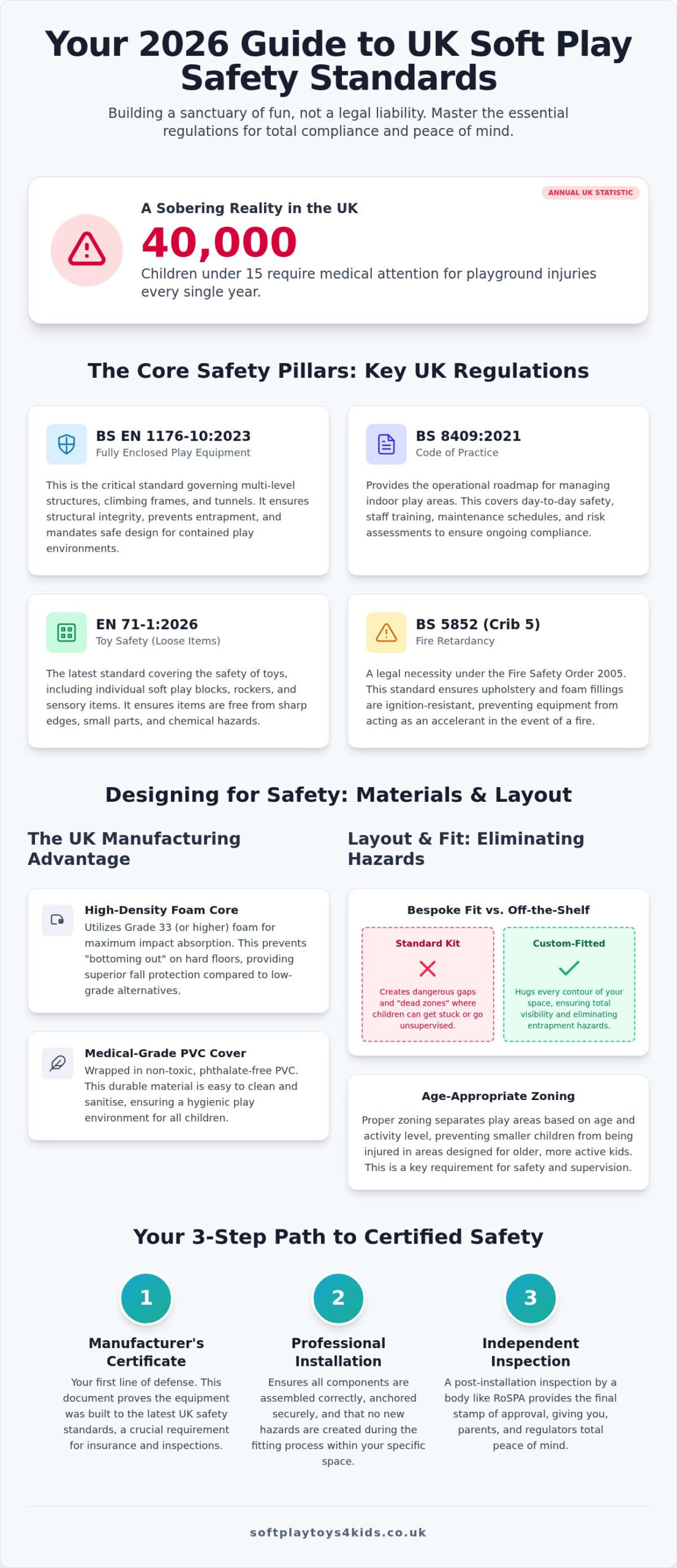
Did you know that approximately 40,000 children under the age of 15 require medical attention for playground injuries in the UK every single year? It’s a sobering statistic that keeps many nursery managers and school heads awake at night. You want to create a world of joy and adventure for your little ones, but the fear of litigation or a failed inspection is always looming in the background. Understanding the latest soft play equipment safety standards UK shouldn’t feel like deciphering a foreign language. You deserve total confidence that your play area is a sanctuary of fun, not a legal liability.
We understand the pressure of trying to balance exciting designs with rigid compliance. You might feel overwhelmed by conflicting technical codes or worried about whether bespoke equipment can truly stand up to years of enthusiastic play. This ultimate 2026 guide is here to clear the fog. You’ll master the essential British regulations, from the updated EN 71-1:2026 toy safety rules to the critical BS EN 1176-10:2023 standards for enclosed equipment. We’ll show you exactly how choosing high-quality, West Yorkshire-made equipment ensures your space is fully compliant, durable, and ready for Ofsted or insurance certification. Let’s build a play space that looks incredible and protects what matters most.
Key Takeaways
- Navigate the complex world of BS EN 1176 and BS 8409 with ease to ensure your facility is fully compliant for 2026 inspections.
- Discover how following the latest soft play equipment safety standards UK eliminates the risk of litigation and provides total peace of mind for parents and staff.
- Master the art of zoning and fall protection, ensuring your play mats and equipment layout meet the strictest safety requirements for every age group.
- See why “Handmade in West Yorkshire” isn’t just a label; it’s your guarantee of premium foam density, non-toxic materials, and British craftsmanship.
- Learn the 4-step bespoke design process that transforms your awkward space into a safe, durable, and Ofsted-ready play environment.
Understanding Soft Play Equipment Safety Standards in the UK
Creating a play space is about more than just bright colours and soft foam; it’s about building a fortress of safety for the children in your care. In the United Kingdom, the primary regulatory framework consists of BS EN 1176 and BS 8409. These aren’t just technical documents. They are the gold standard for protecting little explorers from hazards like finger entrapment, dangerous falls, and exposure to toxic chemicals. Adhering to soft play equipment safety standards UK ensures that every ball pit and play mat meets rigorous benchmarks for fire retardancy (such as BS 5852 Crib 5) and structural integrity.
The Health and Safety Executive (HSE) views these standards as the definitive guide for “reasonable” safety. If you’re running a commercial nursery or a school, your Ofsted rating and your insurance coverage depend entirely on your ability to prove your equipment is safe. Without a clear paper trail of compliance, you’re leaving your business vulnerable to litigation and your children at risk. It’s about demonstrating that you’ve taken every possible step to prevent harm.
Bespoke vs. Standard: Why Custom Design Needs Extra Care
Many providers are tempted by cheap, off-the-shelf kits. The problem? These generic sets rarely fit your room perfectly, creating “dead zones” where children can disappear from view or get wedged between a wall and a mat. Custom-fitted equipment from our West Yorkshire factory eliminates these dangerous gaps. We design every piece to hug the contours of your space, ensuring total visibility for supervisors. When every corner is filled with high-density foam, there’s nowhere for hazards to hide. For a deeper dive into making the right choice, check out our ultimate guide to buying soft play equipment.
The Legal Responsibility of Play Providers
As a play provider, you have a legal “Duty of Care” to ensure your environment is safe. This isn’t something you can delegate away. Your first line of defence is always a manufacturer’s certificate of conformity, which proves the equipment was built to soft play equipment safety standards UK. This document is essential for your insurance provider and serves as proof that your equipment meets the latest 2026 requirements.
Professional installation is the next critical step. Once your new ball pool or sensory zone is in place, we recommend a post-installation inspection by an independent body like RoSPA or the NLPI. This confirms that the equipment remains safe after being fitted into your specific environment. It’s the final stamp of approval that gives you, your staff, and your parents total peace of mind that the fun will never be interrupted by a safety failure.
Key Regulations Explained: EN 1176-10, BS 8409, and EN71
Understanding the alphabet soup of safety codes is the first step toward a worry-free play environment. In the UK, three main pillars support the safety of your facility. BS EN 1176-10:2023 is the heavy hitter; it specifically governs fully enclosed play structures. If your design includes multi-level climbing frames or tunnels, this is your bible. BS 8409:2021 acts as the “Code of Practice,” providing the operational roadmap for managing indoor play areas safely. Finally, EN 71-1:2026, the latest version published in February 2026, covers loose items like sensory toys or individual soft play blocks. Adhering to these soft play equipment safety standards UK ensures your business is protected from the start.
Fire safety isn’t just a recommendation; it’s a legal necessity. Under the Regulatory Reform (Fire Safety) Order 2005, your upholstery must meet BS 5852, often called Crib 5. This ensures that if a fire starts, your equipment won’t act as an accelerant. Every piece we make in our West Yorkshire factory adheres to these life-saving standards. You can explore our range of bespoke soft play solutions designed right here in Britain to see this quality in action.
Material Safety: What Is Inside Your Soft Play?
What’s actually inside your equipment? Safety starts at the core. We use high-density foam, specifically Grade 33 or higher, to ensure maximum impact absorption. Low-grade foam bottoms out quickly, leaving children vulnerable to hard floors. To keep things hygienic, we wrap that foam in medical-grade, phthalate-free PVC. This material is non-toxic and easy to wipe down, which is essential for meeting 2026 hygiene trends. For UK nurseries, fire-retardant materials are non-negotiable for insurance and Ofsted compliance. We take pride in sourcing materials that exceed these requirements, giving you a product that’s as safe as it is durable.
Entrapment Hazards: Head, Finger, and Limb Safety
Protecting little fingers and heads requires precision engineering. Designers use the “Probe Test” to simulate a child’s body parts, ensuring no gap in the structure is between 8mm and 25mm for finger traps or 110mm and 230mm for head traps. For multi-level bespoke designs, we specify safety netting with a mesh size small enough to prevent climbing but strong enough to catch a fall. We are deeply committed to meeting EN71 standards in every handmade piece we produce, ensuring your loose-fill play items are as safe as they are fun. By eliminating these hidden risks during the design phase, we help you create a space where the only thing parents have to worry about is how to get their children to leave.
Designing for Safety: Fall Zones and Age-Appropriate Zoning
How do you turn a technical safety manual into a vibrant, safe play area? It starts with a layout that respects the physics of play. In the UK, calculating fall zones is a critical part of compliance. If a child slips from a climbing block, the impact must be absorbed by a surface that exceeds the “splash zone” of the equipment. This is why high-quality crash mats must extend well beyond the base of any raised item. We don’t just guess these distances; we use precise measurements to ensure every landing is a soft one.
Zoning is another essential pillar of soft play equipment safety standards UK. Mixing adventurous ten-year-olds with wobbly toddlers is a recipe for accidents. A smart design creates a dedicated “Toddler Zone” where little ones can explore sensory textures without being overwhelmed by high-energy older children. This separation isn’t just about comfort; it’s about risk mitigation. We also prioritise 100% visibility. By eliminating blind spots and hidden tunnels, we ensure that parents and staff can supervise every second of the fun. Integrating safety pads into your custom room layout ensures every hard edge is neutralised before the first child enters.
Custom Shapes for Awkward Spaces
Does your room have structural pillars or tight corners? These aren’t obstacles; they’re opportunities for clever safety design. We use bespoke column padding to wrap structural elements, turning hard hazards into soft, interactive features. Whether it’s creating L-shaped ball pits that tuck into corners or ensuring exit routes remain wide and unobstructed, custom design means you never sacrifice safety for space. Handmade in our West Yorkshire factory, these pieces are tailored to fit your specific floor plan perfectly, leaving no dangerous gaps between the equipment and the walls.
The Role of Sensory and Imaginative Play
Safety isn’t just about padding; it’s about the stability of the items children handle. When sensory toys are integrated into larger sets, they must be secured or positioned to prevent tripping. Our soft play blocks are engineered with specific foam densities to ensure stability during building, so towers won’t collapse dangerously. This careful approach allows us to balance “Playground Therapy” challenges with the strict risk mitigation required by soft play equipment safety standards UK. You get a space that encourages development while maintaining a fortress of protection for every child.
The UK Manufacturing Advantage: Quality Control in West Yorkshire
Why settle for a “maybe” when it comes to your children’s safety? In a market flooded with mass-produced imports, “Handmade in Britain” is more than just a label; it’s a gold-standard trust marker for schools and nurseries across the country. Our West Yorkshire factory operates with a level of direct oversight that international competitors simply can’t match. Every single zip, seam, and stitch is inspected by hand before it leaves our doors. This hands-on approach is the only way to guarantee that your facility meets the most stringent soft play equipment safety standards UK.
Cheap imports often hide a dark side. To cut costs, many manufacturers use low-density foam that sags within months, or worse, PVC containing hidden toxins and lead-based inks. By choosing local manufacturing, you aren’t just protecting children from physical injury; you’re protecting them from chemical exposure. Plus, keeping production in West Yorkshire significantly reduces the carbon footprint of your project and eliminates the risk of equipment being crushed or damaged during long-distance shipping.
Our Factory Process: From Foam to Finished Product
Precision is our obsession. We use advanced cutting techniques for our high-density foam, ensuring every piece provides consistent impact protection across its entire surface. There are no “soft spots” here. To withstand the high-energy environment of a commercial play area, we use reinforced stitching that prevents seams from bursting under pressure. Our West Yorkshire factory serves as the beating heart of our safety commitment, where traditional craftsmanship meets modern safety engineering. Explore our full range of bespoke soft play equipment to see the West Yorkshire difference for yourself.
Maintenance: Keeping Your Equipment Safe for Years
Safety doesn’t end at installation. To keep your play area in peak condition, hygiene is paramount. We use medical-grade, antimicrobial PVC that stands up to rigorous daily cleaning without cracking or fading. Adhering to soft play equipment safety standards UK involves more than just a one-off purchase; it requires a commitment to ongoing care. We recommend all operators follow a daily safety checklist:
- Check all seams for signs of separation or wear.
- Ensure ball pits are free of debris and lost items.
- Verify that all safety pads and column protectors are securely fastened.
- Inspect foam for any areas that feel “bottomed out” or soft.
If a bespoke piece does get damaged, our local presence means we can provide custom repairs or replacements much faster than an overseas supplier. Don’t let a small tear become a major liability. Having a direct line to the manufacturer ensures your equipment stays safe, compliant, and ready for action for years to come.
From Concept to Installation: A Safe 4-Step Journey
Bringing your vision to life is an exciting process, but it requires a structured approach to ensure every centimetre meets soft play equipment safety standards UK. We’ve refined a 4-step journey that takes you from an empty room to a thriving, compliant play environment without the stress of guesswork. It’s about more than just picking colours; it’s about engineering a space that protects your investment and the children who use it. We handle the technical details so you can focus on the joy of the children.
- Step 1: Consultation & Measurements – We start by factoring in the “fixed” elements of your room. This includes ceiling heights, which dictate the maximum height of climbing structures, and the clear paths required for fire exits.
- Step 2: Bespoke Design – Our team creates detailed CAD plans that prioritise safety zones. We ensure that every ball pool and play mat is positioned to prevent collisions and maintain clear sightlines for staff.
- Step 3: UK Manufacturing – Once the design is approved, your set is handcrafted in our West Yorkshire factory using the premium, fire-retardant materials we’ve discussed.
- Step 4: Professional Installation – Our team arrives to fit the equipment, ensuring every pad is secure and every gap is closed to prevent entrapment.
Why Professional Installation is Vital
Can you really afford to leave safety to chance? DIY mistakes are the leading cause of “hidden” hazards in new play areas. A loose mat or a poorly secured column protector might seem like a small issue, but it can quickly become a trip hazard or an entrapment risk. Our installation teams are seasoned experts who have transformed schools, nurseries, and private homes across the country. We don’t just “drop and go.” During the final handover, we train your staff on essential daily safety checks, ensuring you have the knowledge to maintain soft play equipment safety standards UK long after we leave. This hands-on training is your final line of defence in maintaining a safe environment.
Get Your Custom Quote
Are you ready to create a world-class play space that parents trust and children love? To get started, all we need are your room dimensions and a brief idea of your theme or colour requirements. Whether you’re looking for a vibrant sensory zone or a high-energy ball pit area, we’ll design a solution that fits your space and your budget perfectly. Don’t settle for risky imports when you can have British-made quality that stands the test of time. Contact SoftplayToys4kids for a custom safety-first quote!
Secure Your Play Space for 2026 and Beyond
Safety isn’t just about ticking boxes on a checklist; it’s about the smiles and laughter of children who are free to explore without risk. You’ve seen how the latest soft play equipment safety standards UK provide a roadmap for excellence, from the precision of BS EN 1176 to the hygiene of medical-grade PVC. By focusing on bespoke designs that eliminate “dead zones” and choosing materials that exceed fire safety codes, you’re building more than a play area. You’re building a reputation for care and quality that parents will trust for years to come.
Why take a gamble with generic imports when you can have the West Yorkshire advantage? Our products are handmade in our local factory, ensuring every ball pit and play mat is fully compliant with EN71 and EN1176 standards. Our professional design and installation team is ready to turn your awkward room into a safety-first masterpiece. It’s time to stop worrying about litigation and start focusing on the joy of play. Get Your Free Custom Soft Play Quote Today and let’s create something extraordinary together. Your vision, backed by our British craftsmanship, is the perfect recipe for a successful, safe, and vibrant sanctuary for every child.
Frequently Asked Questions
What are the main soft play equipment safety standards in the UK?
The primary benchmarks for safety are BS EN 1176-10 for enclosed structures and BS 8409 for facility management. These regulations ensure your equipment is designed to prevent falls and entrapment. Adhering to soft play equipment safety standards UK is essential for insurance and Ofsted compliance. Look for the UKCA mark on all products to confirm they meet these rigorous national requirements for public use.
Is custom soft play equipment safe for commercial nurseries?
Absolutely, provided it’s built by a specialist manufacturer. Custom pieces are often safer because they’re designed to fit your room’s specific dimensions, which eliminates dangerous gaps between walls and mats. We design every bespoke item in our West Yorkshire factory to meet strict safety zones. This ensures total visibility for staff and a secure environment that generic, off-the-shelf kits simply cannot provide.
How do I know if soft play equipment is fire retardant?
You should always request a certificate of conformity from the manufacturer. In the UK, soft play upholstery must meet BS 5852 standards, often referred to as Crib 5. This ensures the foam and PVC fabrics are resistant to ignition sources. We use only high-quality, fire-retardant materials in every handmade piece, giving you total peace of mind for your nursery or school environment.
Do I need a professional to install my soft play area?
While home setups might be simpler, commercial facilities definitely require professional installation. Our experienced teams ensure every safety pad and column protector is securely fastened to prevent shifting during play. Professional fitting also guarantees that fall zones are correctly calculated and that the layout meets all soft play equipment safety standards UK. It’s the best way to protect your business from future liability.
How often should soft play equipment be inspected for safety?
You should conduct daily visual checks for loose seams or debris. Beyond that, a more detailed operational inspection is recommended every one to three months. Most importantly, commercial operators must arrange an annual independent inspection by a qualified body like RoSPA or the NLPI. Keeping a documented log of these checks is vital for maintaining your insurance coverage and proving your commitment to child safety.
What is the difference between EN71 and EN 1176 standards?
EN71 is the standard for toy safety, covering loose items like sensory blocks or small handheld play pieces. In contrast, BS EN 1176 applies specifically to playground equipment intended for public or commercial use, such as ball pools and climbing structures. We ensure our products meet the relevant standard for their intended use, whether they are loose sensory toys or large-scale bespoke play installations.
Are your soft play materials non-toxic and phthalate-free?
Yes, we prioritise child health in every material choice. We use medical-grade PVC that is completely phthalate-free and non-toxic, along with lead-free inks for all our designs. This prevents any risk from chemical exposure if children come into close contact with the surfaces. Our West Yorkshire factory maintains strict quality control over every component, ensuring your play area is as healthy as it is fun.
Can I get a safety certificate for my bespoke soft play area?
Yes, we provide certificates of conformity for the materials used in your bespoke project. These documents prove that your equipment meets the necessary UK fire and safety regulations. After a professional installation, you can also obtain a post-installation inspection report from an independent body. This provides the final stamp of approval you need for Ofsted, insurance providers, and your own peace of mind.
Leave a Reply