
Padded Mats for Learning to Walk: A Parent’s Buying Guide

What if the best mat for those first wobbly steps isn’t the softest one? When your little one is pulling up, cruising and finding their balance, a surface that feels too squishy or shifts underfoot may be less practical than a stable, well-sized space. Choosing padded mats for learning to walk is about more than cushioning alone.
It’s natural to want a comfortable place for practice and the occasional tumble, while also considering whether a mat suits your child, your floor and the room you have. A soft play mat can differ from a general play mat in its construction and intended use, so compare the product details rather than judging by appearance.
This guide covers what to look at, including firmness, thickness, surface grip, size, storage and cleaning, and how to balance cushioning with a steady feel. You’ll also find practical checks to make before buying and using a mat. SoftplayToys4kids manufactures handmade soft play mats in West Yorkshire, with designs for family and organisational settings.
Key Takeaways
- Understand how padded mats for learning to walk provide a designated surface for supervised play and early movement, without treating a mat as fall or injury prevention.
- Compare cushioning, firmness and surface feel using the product details, and consider whether the mat seems even and predictable for practice.
- See how padded mats, general play mats and household rugs can differ in intended use, coverage, portability and care.
- Measure your available floor space, consider how the mat will be used, and leave clear space around it for supervised movement.
- Explore handmade soft play mats from UK-based manufacturer SoftplayToys4kids in West Yorkshire.
What padded mats for learning to walk are designed to do
A padded mat is a cushioned surface for supervised floor play and early movement. It gives a child a defined place to sit, crawl, practise getting up or explore toys, with a different feel from the bare floor. Cushioning, firmness and grip vary between mats, so the category alone doesn’t tell you how a particular product will feel or perform.
Walking practice is just one possible use. A mat can also provide a familiar spot for reaching for toys or moving between sitting and crawling. Think of it as part of the play environment, not equipment that teaches a child to walk. A padded mat can mark out a cushioned area for supervised play, but it can’t prevent falls, guarantee safety or replace an attentive adult.
When might a mat be useful during early walking?
A defined floor area can help organise play as your child moves between positions and tries new movements. Place a few suitable toys within reach, then let your child explore while you stay close. Keep the surrounding floor clear, and check that the mat lies as intended, without curled edges or anything underneath that could shift it.
There’s no single timetable that every child follows. Physical skills develop at different rates, and a mat isn’t a way to hurry that process. For general context, the overview of child development milestones describes how development includes a range of physical changes. Watch your child’s cues, offer space to move and pause when they seem tired or unsettled.
What a padded mat cannot guarantee
Cushioning doesn’t remove the need to make the whole play area appropriate for your child. Before play, check the mat and nearby floor: move sharp or breakable objects, secure loose cables, and make sure furniture or other obstacles aren’t crowding the space. Follow the mat’s product instructions for set-up and care, and stop using it if you notice damage that could affect its use.
Stay within close reach during movement practice. A mat can’t stop a child from tipping, reaching beyond its edges or encountering a hazard elsewhere in the room. Its features also can’t provide a diagnosis or developmental advice. If you have concerns about your child’s movement or development, speak with a qualified health professional rather than relying on a play product for answers.
When choosing a mat, consider where it will go, what your child will do there and whether you can supervise comfortably. Soft play mats can provide a dedicated surface at home or in an organisational setting. Check the specific mat’s dimensions, materials, firmness, surface and care instructions, then assess how it will work in your room and routine.
Which mat features matter most for a baby’s first steps?
The most useful mat isn’t necessarily the one that feels softest to your hand. Compare how its cushioning and surface are described, and consider whether it offers an even, predictable area for standing, shifting weight and taking tentative steps. Mats can differ in construction, so a feature that works for one room or family may not suit another.
For padded mats for learning to walk, use product listings to compare like with like. Look for stated thickness and materials, then check any available information about firmness, surface texture, seams and edges. Don’t guess from a photograph or from the word “padded” if a detail isn’t provided.
Cushioning, firmness and surface feel
Thickness alone doesn’t tell you how a mat will feel underfoot. Compare it with the stated material and any description of firmness or surface finish. More give may feel comfortable for floor play, but an excessively soft or uneven surface may feel less steady for a child practising balance. There’s no single thickness or material that’s best for every child, so consider the full specification and intended use.
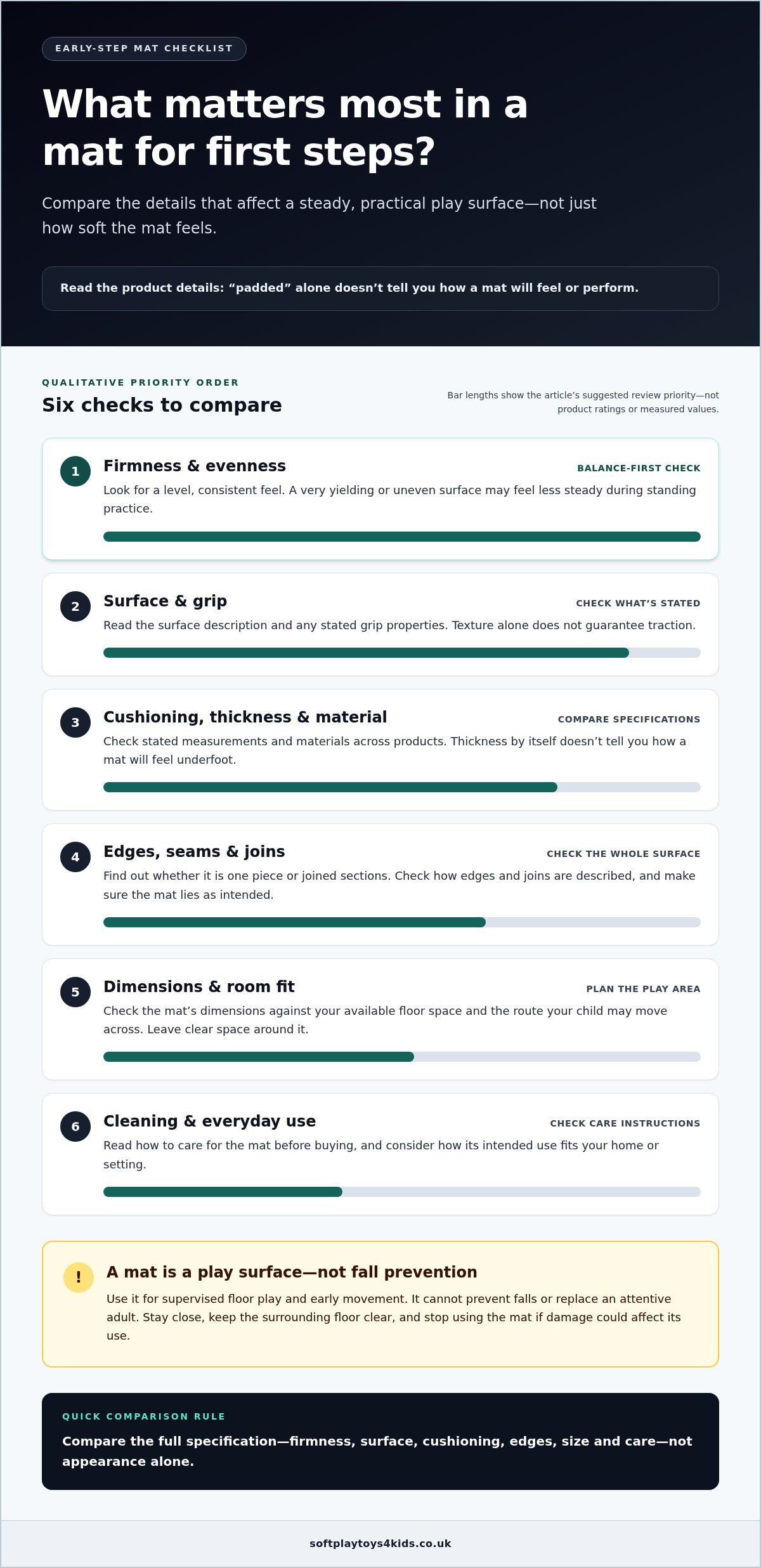
Compare cushioning, stated thickness, material, firmness, surface feel, grip, seams, edges, dimensions and care instructions.
- Cushioning and thickness: Check the stated measurements and compare them across products rather than judging by appearance.
- Surface and grip: Look for a clear description of the top surface and any grip properties. Don’t assume texture guarantees traction.
- Firmness: Note whether the product information describes how the mat responds to pressure. A level, consistent feel may be more practical for standing practice than a surface that feels very yielding.
A padded mat is a floor-play surface, not a walking aid or substitute for adult support. The American Academy of Pediatrics explains the risks of baby walkers; a mat is a different product, intended to define a play area rather than hold or propel a child.
Edges, joins and everyday usability
Shape and dimensions determine how much continuous floor space a mat covers. Check whether it’s one piece or made of joined sections, and read how the product description explains its joins and edges. Consider the route your child may take across the surface, not just the space where they first sit or stand.
Care matters, too. Read the cleaning instructions before buying so you know how to maintain the mat. For wider context on choosing and using a mat, see this UK baby play mat guide. SoftplayToys4kids makes handmade soft play mats in West Yorkshire for families and organisations. Browse its soft play mats and compare the details that matter for your home.
Padded walking mats compared with rugs and general play mats
Do you need a dedicated mat for early steps, or could an existing floor covering work? It depends on the surface, the room and how your child uses the space. A padded mat is designed as a cushioned play surface, while “general play mat” can describe products with very different constructions. A household rug is made as a floor covering, not necessarily for floor play, so check how it sits and feels rather than assuming it offers the same qualities.
| Surface | Intended use | Cushioning and coverage | Portability and care |
|---|---|---|---|
| Padded mat | May provide a defined area for supervised play and movement; check the specific product description. | Cushioning and dimensions vary by product. Compare its stated measurements with the space you have. | Storage and cleaning depend on its design and care instructions. |
| General play mat | May be intended for floor play, but purpose and construction differ between products. | Don’t assume it is padded or has a particular feel. Check materials, thickness and size. | Some may be easy to move or store; use the individual product details to assess this. |
| Household rug | Primarily a floor covering, though a clear, suitable area may also be used for supervised play. | Feel and cushioning depend on its construction. Size and placement determine how much floor it covers. | Care varies by rug. Check whether it stays in place and whether its surface or edges create a trip risk. |
When a dedicated padded mat may suit the space
A dedicated mat may be practical if you want to set aside an area for supervised floor play, separate from the room’s usual foot traffic. Check that it covers the space you intend to use without crowding furniture or walkways, and decide where it will go when play is over. It isn’t essential for every child or household; choose according to your room and routine.
When a general play mat or rug may be enough
An existing play mat or rug might suit your needs if it’s in good condition and provides a usable, even area for the way your child plays. Check for curled edges, loose joins, slipping or changes in floor level around it. A rug’s stability depends on its backing, construction and placement, so don’t assume it will stay put on every floor. Keep nearby routes clear, too.
For a broader look at features beyond walking practice, the baby play mat buying guide can help you compare options. When comparing padded mats for learning to walk, focus on the area your child will actually use, then weigh cushioning against a steady, practical surface. The best fit is the one that works for supervised play and your available space, not simply the one with the most padding.
How to choose the right padded mat for your child and room
A mat can look suitable online but feel awkward once it’s in the room. Choose based on the space your child can actually use, how you’ll supervise play and whether the mat will stay out or be put away. This process helps you compare padded mats for learning to walk with your household’s needs, without treating a larger or softer mat as automatically better.
- Measure the usable floor area. Measure the space you can dedicate to play, then note nearby furniture, doors and walkways. Leave clear surrounding floor space for supervised movement, and make sure the mat won’t obstruct everyday routes or prevent doors from opening freely.
- Decide how the area will be used. Consider whether your child will mostly sit and play, crawl, pull up or practise moving across the surface. Think about the room’s layout and where you can stay close by. Your intended use helps you judge whether a compact play spot or a broader area makes more sense.
- Compare product details with your measurements. Check each mat’s stated dimensions, shape, materials and available information about thickness, firmness and surface. Match the measurements to your planned play zone, rather than choosing by size alone. The mat should fit while leaving room around it for movement and supervision.
- Review care and storage needs. Read the product’s care instructions before buying, and consider how much effort its cleaning routine will take at home. If you’ll move it after play, think about where it can be stored and whether that suits your routine. A mat that stays laid out has different space demands from one you plan to put away.
Measure the play area before comparing products
Take measurements with the room set up as it’s normally used, including furniture that won’t be moved for play. Check the floor around the mat as well as its footprint: a surface that fits tightly between a sofa and table may leave little room to move. Plan for storage early, especially if the mat needs to be cleared away between play sessions.
Check suitability and care details before buying
Use the product description to confirm its stated materials, dimensions and care guidance. Consider whether it’s intended for the indoor setting where you plan to use it, and whether its features suit your child’s supervised play. If a key detail isn’t given, don’t infer it from a photo; base your decision on the information provided for that specific mat.
Once you know your available space and the details you want to compare, browse soft play mats from SoftplayToys4kids, a UK manufacturer based in West Yorkshire. Handmade mats are available for family and organisational settings, so compare room fit, everyday use and care against your needs.
Choosing a SoftplayToys4kids mat for everyday early-step play
The right mat is the one that suits your home and the way your child uses the floor, not one that promises a particular developmental result. SoftplayToys4kids is a UK-based soft play manufacturer and supplier in West Yorkshire, making handmade soft play mats for families and organisations. As you explore the range, use each mat’s product details to decide whether it fits your intended play area and household routine.
For padded mats for learning to walk, focus on practical fit. A mat is one part of a supervised play space. It doesn’t teach a child to walk or replace an adult nearby, and choosing one shouldn’t add pressure to reach a milestone. Look for a surface and format that suit your child’s everyday floor play.
What to consider in a soft play mat for home
Start with where the mat will go and how your child will use that area. A play spot in a shared living room may need to work around furniture and daily foot traffic, while a dedicated play area may allow a different footprint. Decide whether the mat will stay out or need to be moved, then compare its stated dimensions and product information with those practical needs.
Review the product description for details that affect day-to-day use. Don’t assume that two mats in the same broad category have identical construction or care requirements. Check the information for the specific mat you’re considering, and make sure its size, materials and cleaning guidance suit your space and routine.
- Room fit: Consider the usable floor area and keep surrounding space clear for supervised movement.
- Intended use: Decide whether the mat will be used for everyday floor play, early movement practice or both.
- Practical upkeep: Read the care instructions and consider how the mat will fit into your normal cleaning and storage routine.
These checks help you choose based on what the product is described to offer, rather than expecting it to deliver a developmental or safety outcome. Stay close while your child plays, and keep the wider play area appropriate for their movement.
A UK manufacturer for family and organisational settings
SoftplayToys4kids is based in West Yorkshire and manufactures soft play products in the UK. Its handmade soft play mats are offered to families as well as organisations, including schools, nurseries and playgroups. Use the product information for the specific mat to understand the details that matter for your setting.
Ready to compare options for your home or organisation? Browse soft play mats and consider your intended space, everyday use and the mat’s stated details.
Make room for the next little adventure
Your child’s first steps don’t need a perfect set-up. A thoughtful choice fits your home, supports the supervised play you have in mind and feels manageable in your everyday routine. As you compare padded mats for learning to walk, let the individual mat’s details and the space around it guide you, rather than expecting any surface to shape your child’s progress.
Picture where play will happen. Is there enough room to move? Will the mat stay in place in your routine, or need storing away? These questions can turn a long list of features into a practical choice for your family.
SoftplayToys4kids makes handmade soft play mats for family and organisational settings. Explore the range and choose an option that suits your intended space: explore soft play mats for your family.
Choose a space that works for your child, stay close as they explore and enjoy each new moment at their own pace.
Frequently Asked Questions
Do babies need a padded mat to learn to walk?
No, babies don’t need a padded mat to learn to walk. A mat is an optional surface for play, not a developmental requirement or walking aid. If your baby practises moving on the floor, focus on a clear space and stay close. You might use an area of your usual flooring if it’s in good condition and free from objects your child could trip over.
Is a padded mat suitable for a baby who is pulling up to stand?
It may be suitable if the product information supports your planned use and it sits steadily in the space. As babies pull up, they may reach for nearby furniture, so check that furniture is stable and that the mat doesn’t place them beside sharp corners or other hazards. Stay within reach, and don’t use the mat as a substitute for a secure environment or supervision.
Can a padded mat be used on carpet?
It depends on both the mat and the carpet. Thick or deep-pile carpet may make some mats feel less even or allow them to shift, while flatter carpet may behave differently. Check the mat’s instructions for suitable floor types, then see how it lies before your child plays on it. Don’t add another rug underneath unless the product guidance allows it.
How do I stop a play mat from moving on the floor?
Start with the product instructions and the floor itself. Make sure the floor is clean and dry, then lay the mat out as directed and check whether its edges stay flat during ordinary handling. Use an anti-slip layer only if the mat’s guidance says it’s suitable. Avoid improvised fixes such as loose tape or extra fabric that could create folds, raised edges or another slipping point.
Can padded mats for learning to walk be used outdoors?
Only use one outdoors if the product information specifically allows outdoor use. An indoor mat may not be designed for damp ground, rough surfaces or changing weather, and exposure could affect its condition. If outdoor use is permitted, follow the instructions for placement and cleaning, and inspect the mat afterwards. Keep your child supervised and choose a level area clear of stones, garden tools and other hazards.
When should a padded play mat be replaced?
Replace a mat if it has damage that could affect its use, such as a split surface, loose seam, exposed filling or a persistent change in shape. Also stop using it if it can’t be cleaned according to its care instructions. There’s no universal replacement timetable for every mat, so follow the product guidance and check its condition regularly, particularly after moving or storing it.
Leave a Reply