
Creating a Sensory Corner: A Practical Guide for 2026

Creating a sensory corner in a classroom starts with understanding what pupils need from the space, not simply adding equipment. When room is limited and every area has several uses, it’s natural to wonder what belongs in a sensory corner, where it should go and how pupils will use it as intended.
A successful corner doesn’t need to be large or packed with resources. A clear purpose, a welcoming layout and simple routines can make it a practical part of the school day. Pupils may respond differently to the same space or activity, so plan around what staff observe rather than a one-size-fits-all formula.
This guide will help you plan a compact corner around your pupils, available space and everyday routines. You’ll learn how to choose and arrange resources, including sensory toys and play mats, and how to introduce, maintain and review the space. Soft-play products handmade in Bradford can be part of your plan, and SoftplayToys4kids offers design and installation support for larger projects.
Key Takeaways
- Start creating a sensory corner in a classroom by defining pupils’ needs and the space’s purpose, not by buying lots of equipment.
- Map classroom movement, visibility and nearby activities to find a welcoming spot that doesn’t block access or disrupt learning.
- Choose resources for their intended use, considering space, storage and supervision as well as the experience they offer.
- Set clear routines for choosing resources, tidying up and transitioning, then observe how pupils use the area and make adjustments.
- Once you’ve planned the layout and routines, consider handmade UK soft-play equipment, sensory toys and play mats.
Creating a sensory corner in a classroom: start with its purpose
You don’t need to give up a whole room to create a useful sensory space. Start by deciding what the area is for, then fit that purpose into the space and routines you already have.
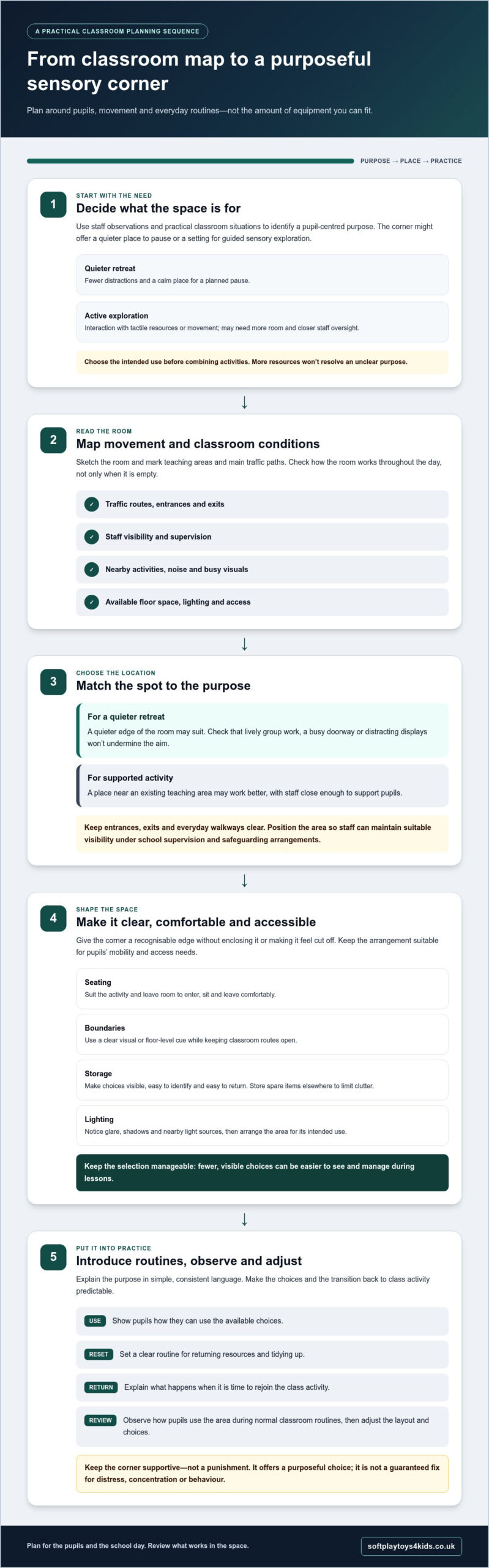
A classroom sensory corner is a designated area where pupils can access a considered environment or resources for a specific, pupil-centred purpose. That purpose might be a quieter place to pause or an area for guided sensory exploration. Let staff observations and the practical needs of the school day guide the setup, rather than assuming one formula will suit every pupil.
A retreat and an exploration area aren’t interchangeable. A quieter retreat may offer fewer distractions and a calm place for a planned pause. An active exploration area may invite interaction with tactile resources or movement, so it can need more room and closer staff oversight. Decide which need you’re planning for before combining different activities in one corner. A general overview of a sensory room can provide background, but shape a classroom corner around its own purpose and setting.
What should a classroom sensory corner help pupils do?
Begin with a practical question: what would you like pupils to be able to do here? Look at classroom situations, not labels or assumptions. For example, staff might notice that a pupil benefits from a quieter option during a busy transition, or enjoys exploring different textures during a planned activity. These observations can guide the space without diagnosing a child or presuming every pupil will respond in the same way.
Keep expectations realistic. The corner is one part of classroom practice, not a guaranteed fix for distress, concentration or behaviour. Its value is in offering a purposeful choice that staff can introduce and review. If its intended use isn’t clear, pause before selecting equipment. More resources won’t resolve an unclear purpose.
Who will use the space, and when?
Consider the ages, preferences and access needs of pupils who may use the area. Think, too, about when it could fit naturally into the day, such as during transitions, a planned quiet activity or a supported moment chosen by the pupil and staff. These details help determine whether the space should be mainly calm, active or available for a specific activity.
Introduce it in simple, consistent language that pupils understand. Explain what the corner is for, how they can use the available choices and what happens when it’s time to return to the class activity. A clear explanation can make the space feel welcoming and predictable. Avoid presenting it as a punishment or a place pupils are sent for being disruptive. Keep its purpose supportive and connected to everyday classroom routines.
Plan a classroom sensory corner around space, comfort and access
Once you’ve identified the purpose of creating a sensory corner in a classroom, look at how the room is used throughout the day. A spot that seems quiet during one lesson may be beside a busy doorway, a frequently used resource area or a route pupils need to move through. Sketch the room and mark the main traffic paths and teaching areas. Then find a location that won’t compete with them.
Before choosing a spot, check traffic routes, staff visibility, nearby activities, available floor space, lighting and access. This checklist helps turn a spare patch of floor into a considered part of the classroom, rather than an obstacle or an afterthought.
Where should the sensory corner go?
A quieter edge of the room may suit a retreat, while a place near an existing teaching area may work better for a supported activity. Neither is automatically the right choice. Listen for nearby noise, notice how pupils move past the space and consider whether colourful displays or busy classroom visuals could distract from the intended experience.
Walk the route pupils and staff will take. Keep entrances, exits and everyday walkways clear, and position the area where staff can maintain suitable visibility in line with the school’s supervision and safeguarding arrangements. If the corner is intended for quiet use, placing it beside lively group work may undermine that aim. If it’s for guided exploration, staff may need to remain close enough to support pupils.
How can a small corner feel organised?
Give the area a clear edge without enclosing it or making it feel cut off. A mat, a low shelf or a consistent floor layout can help pupils recognise where the corner begins. Keep storage simple and accessible, with resources easy to identify and return. Make sure the arrangement works for the pupils who use it, including their mobility and access needs.
- Seating: Choose an arrangement that suits the activity and leaves room to enter, sit and leave comfortably.
- Boundaries: Use a clear visual or floor-level cue while keeping routes through the classroom open.
- Storage: Make choices visible and store spare items elsewhere to limit clutter.
- Lighting: Notice glare, shadows and nearby light sources, then arrange the area to suit its intended use.
Resist the urge to fill every surface. A smaller selection can make choices easier to see and keep the corner manageable during lessons. Before settling the layout, consider how furniture, resources and pupils will move around one another, and whether staff can supervise the area without disrupting teaching. Review the arrangement during normal classroom use, not just when the room is empty.
If your plan includes soft-play mats or sensory toys, consider their size and placement against the space you’ve mapped. SoftplayToys4kids makes handmade soft-play equipment in Bradford, including soft-play options for classroom plans.
Choose sensory corner resources by purpose, not by quantity
Once the intended activity is clear, choose resources that fit it. A calm retreat with a few quiet interaction options calls for a different selection from an active exploration area with larger soft-play shapes. Consider the floor area available, where items can be stored between uses and how much staff support the activity needs. Starting with a small, considered selection makes it easier to see what pupils choose and what works in the classroom routine.
Which resource categories could suit different purposes?
Use the categories below as planning prompts, not a fixed programme. The same resource won’t suit every pupil or classroom, so match your choice to the planned activity and the space available. For broader context on possible resource types, see this sensory toys guide.
| Category | Could suit | Space, storage and supervision |
|---|---|---|
| Quiet interaction | A planned, low-key activity with a small number of easy-to-handle resources. | Usually simpler to store in a labelled container; staff can present a limited choice. |
| Tactile exploration | Hands-on exploration using selected sensory toys. | Plan a clear surface or floor space and a straightforward way to put items away; consider how the activity will be supported. |
| Movement | A planned opportunity for pupils to move within the area. | Needs more open floor space than a seated activity, with staff attention to movement and nearby classroom traffic. |
| Soft-play options | Activities using play mats or larger soft-play shapes. | Check the footprint, storage arrangements and how staff will oversee use before adding items. |
Use the table as a comparison tool, not a shopping list. If the purpose is quiet interaction, several large items may crowd the corner without helping pupils understand the choices. If the activity involves movement, a tiny collection of hand-held objects may not match the plan. Start with a few suitable categories, then observe how pupils engage and adjust the selection rather than buying many items at once.
How can soft-play resources fit into a classroom?
Soft-play mats can help define the area for a floor-based activity, while sensory toys offer a different, hands-on resource category. Neither is a prescribed solution. Consider the planned activity, available floor space and how the resource will be stored when it isn’t in use. A baby play mat guide offers additional context on mats and surfaces, though classroom needs should guide your selection.
SoftplayToys4kids makes handmade soft-play equipment in Bradford, West Yorkshire. You can customise product sizes and colours on order, which can help when planning around a particular classroom footprint or visual scheme. Keep the decision pupil-centred: select only what supports the intended activity and can be managed within the space and staff routines.
Introduce the sensory corner with clear routines and review its use
A carefully planned corner is useful when pupils know what it’s for and staff share an approach to using it. Build routines into ordinary classroom practice from the start. Introduce the area positively, make choices clear and explain how pupils move into and out of it. This helps the space feel predictable without suggesting that every pupil must use it in the same way.
Use a simple sequence to get everyone started:
- Introduce the purpose. Show pupils the corner and explain its role in clear, age-appropriate words, such as, “This is a place to choose a quiet activity.”
- Show the choices. Demonstrate what pupils can use and how to access the resources. Offer a manageable choice rather than presenting everything at once.
- Agree the routines. Explain how pupils can use the space, where items go afterwards and what signal or reminder marks the transition back to class.
- Observe and adjust. Notice how the routine works in real classroom conditions, then discuss practical changes with relevant staff.
How should staff introduce the corner?
Give pupils time to see and practise the routine before expecting them to use the area independently. Keep the language consistent between adults: explain how pupils access the space, what they can choose and how they’ll know it’s time to move on. A simple picture cue or short verbal reminder may help pupils remember the steps. Adapt the explanation to pupils’ ages and communication needs, and revisit it when routines change.
Be clear that the corner is an option within classroom practice, not a punishment or a substitute for individual support. Staff should follow relevant school arrangements for supervision and respond to a pupil’s needs as they arise. Consistent expectations can make the space easier to use, but flexibility matters too. A pupil may need adult support or a different response on a particular day.
How can staff tell whether the setup is working?
Keep observations brief and neutral. Note practical details such as when the area is used, which choices pupils select, whether they can access and leave it comfortably, and how tidying or transitions go. Describe what happened rather than assigning a medical or therapeutic explanation. For example, record that a pupil chose a book during a changeover, not an assumption about why they chose it.
Review these notes with relevant staff, including those who see pupils at different points in the day. Look for practical adjustments: perhaps a resource is hard to reach, the transition reminder needs to be clearer or the area becomes difficult to supervise during a particular activity. Change one feature at a time, then observe again. This makes it easier to see whether the adjustment made the space more manageable and accessible.
Creating a sensory corner in a classroom is an ongoing process, not a one-off arrangement. Keep routines under review, and involve the appropriate staff when a pupil needs individual support or professional advice. For larger soft-play projects, explore classroom soft-play options alongside SoftplayToys4kids’ design and installation support.
Create a classroom sensory corner with UK-made soft-play options
Choose products after planning. Once staff have agreed the corner’s purpose, mapped the available space and settled on routines, they can consider which resources fit. This keeps the focus on pupils and the intended activity, rather than filling the area with equipment. Sensory toys, play mats and other soft-play equipment are possible categories to explore, not a prescribed combination or a promise of particular outcomes.
What can a UK soft-play manufacturer contribute?
SoftplayToys4kids is a Bradford-based UK manufacturer of handmade soft-play equipment, sensory toys and play mats. For a classroom, the practical question is how a resource fits the planned footprint and activity. You can customise product sizes and colours on order, which can help when working with a defined space or an existing classroom scheme. For broader selection considerations, the soft-play equipment buying guide offers additional context.
For larger soft-play projects, SoftplayToys4kids offers design and installation support. This can help schools planning beyond a single compact corner and considering the layout and equipment together. For a smaller classroom area, keep the decision straightforward: match the product category to the activity, make sure it fits the available space, and plan how it will be used and stored during the school day.
What are sensible next steps for schools?
Before browsing, bring the plan together. Write down the intended purpose, measure the area, identify the resource categories that fit and agree how pupils and staff will use the corner. Then compare options against those decisions. A mat may suit a floor-based activity, while a smaller sensory toy may be easier to store and offer as a choice. The right fit depends on your classroom plan and the pupils who will use the space.
Keep the selection focused. A resource that looks appealing may not suit the corner if it takes up space needed for access, complicates storage or doesn’t support the planned activity. Consider size and colour as practical planning details alongside classroom routines. Revisit the choice after the corner is in use, so future adjustments respond to what staff observe rather than assumptions about what pupils need.
Creating a sensory corner in a classroom involves a series of thoughtful decisions: define the purpose, measure the space, choose relevant categories and agree routines. Browse options with that plan in mind, whether you’re considering handmade sensory toys, play mats or other soft-play equipment. Explore handmade soft-play options for your classroom.
Take the next step towards a classroom space that grows with pupils
A sensory corner doesn’t have to be finished in one go. Treat it as a living part of the classroom: give pupils time to become familiar with it, notice what they choose and listen to their feedback in ways that suit their age and communication style. Small, thoughtful changes can help the space stay relevant as classroom needs and routines shift.
As you continue creating a sensory corner in a classroom, keep curiosity at the centre of your decisions. Is the area still serving its purpose? Do pupils understand how to use it? These questions can guide your next adjustment without turning the corner into a fixed formula. The best plan is one your staff can maintain and adapt with care.
When you’re ready to explore resources that fit your classroom plan, browse handmade soft-play options for your classroom. A welcoming space can begin with one considered choice, then grow thoughtfully around the pupils who use it.
Frequently Asked Questions
What is a sensory corner in a classroom?
A sensory corner is a defined classroom area planned for a particular use, such as a quiet activity or hands-on exploration. It doesn’t need to be a separate room or contain lots of equipment. For example, staff might set aside a small area for a pupil to look at a book or explore a chosen object during a planned activity. Keep the purpose clear and adapt the setup to the class.
How do you create a sensory corner in a small classroom?
Start by identifying a spot that keeps classroom routes and access clear. Measure the available floor area, including the space pupils need to enter and use it, then choose only a few resources that fit. A mat or storage box can help define the area without adding bulky furniture. As you begin creating a sensory corner in a classroom, check that staff can supervise it and that everyday lessons can continue around it.
What should you put in a classroom sensory corner?
Choose items to match the activity, the pupils and the space. Sensory toys might suit a hands-on choice, while a mat or soft-play shapes may fit a floor-based activity. Think about how pupils will access each item and where it will go when not in use. A useful test is whether each resource has a clear role. If an item has no obvious purpose in the plan, leave it out for now.
Can a sensory corner help pupils calm down?
A sensory corner may offer a pupil a place for a quieter activity, but its effect can differ between pupils and situations. Don’t assume that one toy, layout or routine will calm every child. Staff can explain the space as an available classroom choice and observe how it’s used. If a pupil needs individual support, consider the corner alongside the school’s existing support approach rather than treating it as a replacement.
How do you introduce a sensory corner to pupils?
Show pupils the area and explain its purpose in language they can understand. Demonstrate how to select an item, where it belongs afterwards and what will signal the end of the activity. For younger pupils, a simple picture cue may help make the steps visible. Use the same key phrases across staff where possible, so pupils hear a familiar explanation even when a different adult is guiding the routine.
How often should a classroom sensory corner be reviewed?
Review the setup after staff and pupils have used it during ordinary classroom activities, then revisit it whenever the arrangement or routine changes. Consider whether pupils can reach and use the resources, whether transitions are manageable and whether the area remains practical during lessons. Staff can share brief observations, then adjust one feature at a time. This makes it easier to notice how a change affects everyday use.
Does a classroom sensory corner need specialist equipment?
No, specialist equipment isn’t essential for every classroom sensory corner. A clearly defined purpose and a few suitable resources can be a practical starting point. For example, a class might begin with one quiet activity and a small selection of items pupils can access easily. If the plan later calls for sensory toys, mats or soft-play options, choose them to fit the intended use and available classroom space.
Leave a Reply