
Understanding BS EN 71 Toy Safety: Tests and Reports

A test report isn’t a blanket pass for every toy. BS EN 71 is the UK-adopted series of toy safety standards, and testing assesses a toy against the parts that apply to its design and materials. Understanding BS EN 71 toy safety means looking beyond the standard’s name to see which hazards were tested and exactly which product the report covers.
It’s natural to want clear evidence that a toy has been assessed for the risks children may encounter during play. This article explains what EN 71 testing covers, when to identify the applicable parts, how chemical migration and mechanical checks work, and what to look for in a test report.
From EN 71-1 checks for physical hazards to EN 71-3 chemical migration testing, the details depend on the toy and its materials. We’ll also explain why a supplier report may not apply to a different product, so you can read the evidence with confidence.
Key Takeaways
- Match testing to the toy’s materials, design and intended age group to identify the relevant EN 71 parts.
- Learn how chemical migration assessments evaluate materials, including the significance of chromium testing.
- See how physical and mechanical tests look for hazards such as detachable parts, sharp edges and trapping risks.
- Assess a test report by checking whether it covers the specific product and material specification, rather than assuming it applies to an entire range.
Chemical migration and chromium testing under EN 71-3/A2
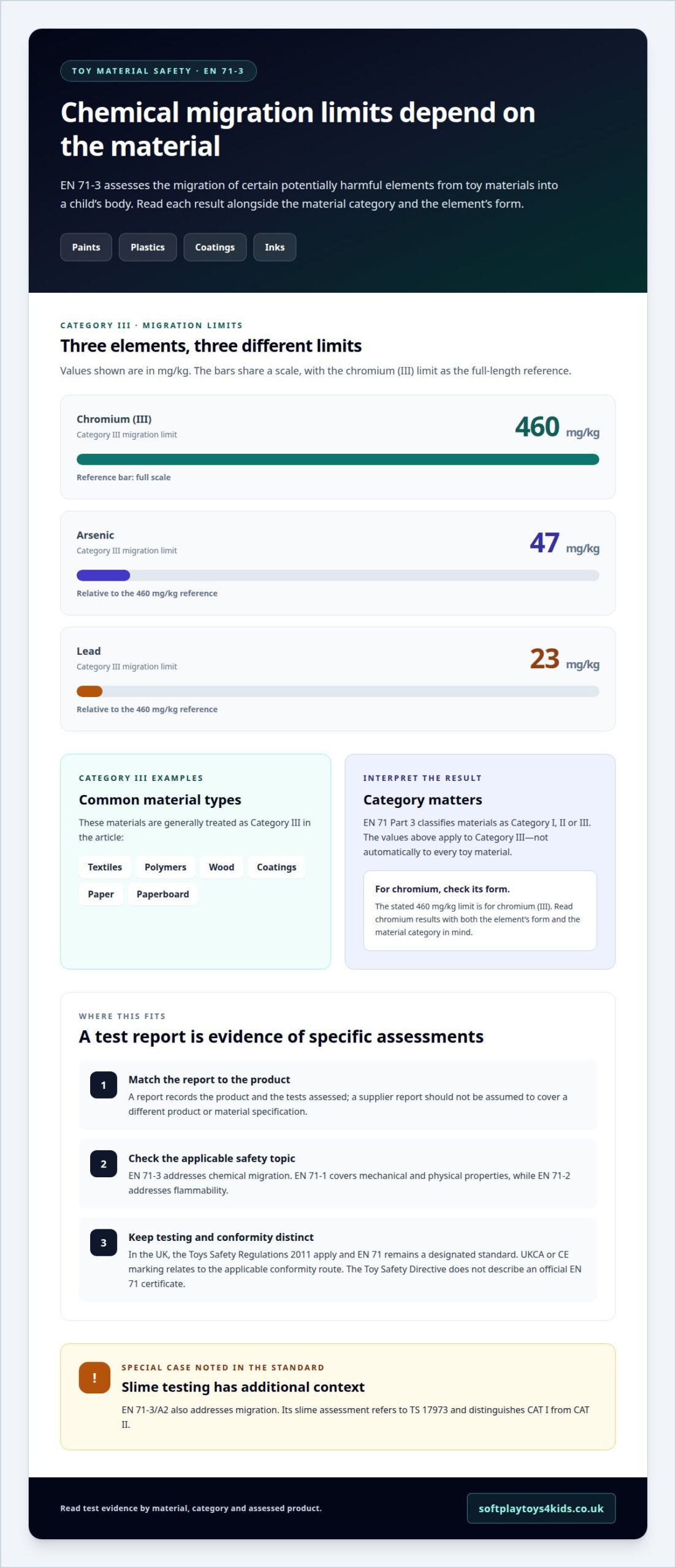
EN 71-3 limits the migration of certain potentially harmful elements from toy materials into a child’s body. Testing examines materials such as paints, plastics, coatings and inks. EN 71-3/A2 also addresses migration, while its slime assessment refers to TS 17973 and distinguishes CAT I from CAT II.
Material category matters. EN 71 Part 3 classifies materials as Category I, II or III, with limits expressed in mg/kg. Textiles, polymers, wood, coatings, paper and paperboard are examples generally treated as Category III. For that category, the migration limit is 460 mg/kg for chromium (III), 23 mg/kg for lead and 47 mg/kg for arsenic. Chromium results should therefore be read with the element’s form and the material category in mind.
In the UK, the Toys Safety Regulations 2011 apply, and EN 71 remains a designated standard. BS EN 71 testing provides evidence for assessing the safety requirements; UKCA or CE marking relates to the applicable conformity route. EN 71 testing is mandatory for products covered by the Toy Safety Directive. The responsible manufacturer must ensure conformity, with importers also responsible for the products they place on the market.
Flammability is addressed by EN 71-2, while chemical safety includes migration limits under EN 71-3. Physical testing under EN 71-1 can include torque, tension and drop tests, which assess whether parts detach or hazards form. Testing costs depend on the toy, materials and applicable test scope, so there is no single UK fee. The Toy Safety Directive does not describe an official EN 71 certificate; a test report records the product and tests assessed.
Microbiological methods are covered by BS EN 71 Part 20 for toys containing accessible aqueous media. EN 71-20:2025 requires additional testing when total aerobic microbial count exceeds 1,000 CFU/ml or CFU/g for toys intended for children under 36 months, or 10,000 CFU/ml or CFU/g for other toys. Non-compliant toys may expose children to physical or chemical hazards and fail applicable safety requirements, creating regulatory and market-access risks.
At what stage should I confirm applicable EN 71 parts?
Identify the relevant parts during product design by considering the toy’s function, materials and intended age group. Which parts apply depends on these features, not just the product’s name.
Age groups and small-parts hazards
Age grading affects safety assessment because children’s abilities and likely use differ as they grow. EN 71-1 covers toys intended for children under 3 years and over 3 years. For under-threes, it prohibits sharp points, sharp edges and small parts that could present choking risks. A small parts cylinder, often called a choking hazard tube, helps determine whether a component counts as a small part. Examine detachable pieces and items children may mouth, not just the assembled toy.
Choosing applicable EN 71 parts
Match each toy feature to the safety topic it raises to identify the relevant parts. This helps manufacturers plan testing around the design and gives consumers a clearer picture of what was assessed.
- EN 71-1 covers mechanical and physical properties, including small-parts hazards.
- EN 71-2 addresses flammability; EN 71-3 assesses migration of certain elements from materials.
- EN 71-4 covers experimental chemistry sets. EN 71-5 applies to other chemical toys, including slime kits.
- EN 71-8 covers swings, slides and similar activity toys for family domestic use; EN 71-14 covers domestic trampolines.
- EN 71-12 addresses N-nitrosamines and N-nitrosatable substances. Consider material and intended use, including for mouth-actuated toys.
- EN 71-13 covers olfactory board games, cosmetic kits and gustative games.
Confirm the product’s intended age, parts, materials and play activity before selecting tests. For example, a chemistry set calls for a different assessment from a domestic slide. Check applicable restrictions and age-warning needs too: EN 71-6 covers graphical symbols for age-warning labelling. The Toy Safety Directive’s scope and the toy’s characteristics inform the overall assessment; no single part covers every hazard.
EN 71-1:2026 mechanical and physical safety updates
EN 71-1 covers toys’ mechanical and physical properties. The updated EN 71-1:2026 was published on 28 January 2026, bringing the standard’s requirements into focus for product assessment and conformity.
Mechanical safety requirements
Mechanical requirements assess how a toy behaves during use and after foreseeable handling. Abuse tests can include torque, tension and drops, helping reveal whether components loosen, break or become hazardous. For the specified drop test, a toy or relevant component is dropped five times from 850 ± 50 mm onto a 4 mm thick steel plate. These checks help manufacturers assess the finished construction, not just its appearance.
Physical hazards in toys
Physical hazards include sharp edges or points, detachable parts and moving mechanisms that could trap fingers or hair. Testing checks whether sharp edges form after light damage and whether accessible gaps pose trapping risks. The intended age group matters because children interact with toys differently: a feature that seems harmless during an adult inspection may be hazardous during play.
Test equipment and dimensions matter. The specified EN 71-1 mandrel has a diameter of 9,53 ± 0,12 mm, and its surface must have a Rockwell C hardness of at least 40. The drop-test surface also has a 2 mm coating with Shore A hardness of 75 ± 5. These details help make test conditions consistent.
Other requirements address cords and loops. EN 71-1 uses 380 mm as the maximum perimeter of a noose. For toys with moving parts, assess the spaces where fingers or hair could become caught, alongside the parts’ strength after impact or pulling. Mechanical and physical conformity therefore depends on the toy’s construction, use and intended child, not simply on whether it remains intact in ordinary handling.
Toy test reports and supplier reports
Manufacturers and importers can assess compliance by matching test evidence to the exact toy, materials and applicable EN 71 parts. Arrange testing at two stages: on pre-production samples or prototypes, then on pre-shipment batch samples. A practical guide to understanding BS EN 71 toy safety starts by linking each report to the product version it actually assesses. This helps reveal design issues early and assess whether production samples match the tested specification.
A report is evidence of tests performed, not universal approval. The Toy Safety Directive does not describe an official EN 71 certificate. An EN 71 report applies to a specific product and material specification, not every toy made by the same factory or sold under the same brand. Changes to coatings, plastics, components or construction can affect whether earlier results remain relevant.
Read the report alongside the product itself. Compare the model description, tested materials, EN 71 parts assessed, test methods and results. Check that physical properties and chemical substances were considered against relevant requirements and limits. For example, an EN 71-3 result for one coating should not be treated as evidence for a different coating simply because both toys look alike.
Supplier reports can support a manufacturer’s conformity assessment, but they need to match the supplied item. Review warnings and age grading alongside the test scope, because these describe intended use and can affect which hazards need assessment. Understanding BS EN 71 toy safety also means treating a report as one part of the evidence, not the whole compliance process. Toy makers can use documents and test reports as part of preparing for market approval.
Keep records tied to the tested specification and production batch, so changes can be assessed rather than obscured by an old report. If you’re improving protection around a play space, explore safety pads as a separate practical consideration. The takeaway is simple: judge a supplier report by its exact product scope, not its title or general claims.
SoftplayToys4kids: Soft Play Ball Pits
SoftplayToys4kids offers sensory toys and lamp post protectors for different play-space needs. Sensory toys can add tactile and engaging play experiences, while lamp post protectors are designed to cushion exposed posts in play areas. Choose based on the environment and the role you want each item to serve.
BS EN 71 testing applies to toys according to their design, materials and intended use. A product’s presence in a play space does not replace checking the relevant safety information for that product. Keep the distinction clear: toy testing assesses toy-specific hazards, while protective padding addresses impacts against a post or column.
If you’re planning a play space, explore whether sensory toys or lamp post protectors suit your needs. Visit softplaytoys4kids.co.uk to find out more.
Put safer play choices into practice
Make product safety part of each design and purchasing decision, not a document review saved for the end. A clear understanding of BS EN 71 toy safety helps you keep test evidence connected to the specific item and its intended use as products or materials change.
For the play environment itself, consider which equipment best supports the space and children’s play. SoftplayToys4kids offers Soft Play Ball Pits, Soft Play Mats and Sensory Toys. These products serve different play needs, so choose according to how you want the area to be used, while treating toy testing and product selection as distinct considerations.
Ready to explore options for a play space? Browse SoftplayToys4kids products and take the next step towards creating a welcoming place for play.
Frequently Asked Questions
What is EN 71 testing?
EN 71 testing assesses a toy against safety requirements relevant to its design and use. A test programme may examine a representative sample, apply physical or chemical methods, then record results against the selected requirements. For example, a test report should identify the tested product and materials clearly enough to distinguish them from another model or later product revision.
What is EN 71 certification?
There is no official EN 71 certificate described by the Toy Safety Directive. The evidence is usually a test report for a defined product and material specification, alongside the manufacturer’s wider compliance documentation. Treat a document labelled “certificate” carefully: its title alone doesn’t show which tests were completed, what sample was assessed, or whether its findings cover the item being sold.
How do I know if EN 71 applies to my product?
Start by assessing whether the product is intended for children’s play, rather than judging by its appearance alone. For example, a decorative object shaped like a toy may have a different purpose from an item designed for play. The EU Toy Safety Directive applies to toys targeted at children aged 14 years or younger; intended use and product design are central to classification.
How do I know which specific EN 71 parts apply?
Map the product’s features to the hazards each standard part addresses. A battery-operated toy, for instance, may require consideration beyond physical properties because toys with electrical components may also be subject to EN 62115. Record each material, mechanism and play function in the product specification, then compare that profile with the scope of relevant EN 71 parts.
What are the EN 71 standards?
EN 71 is a series of European toy safety standards adopted in the UK as BS EN 71. Its parts address different topics, rather than one test covering every toy. Examples include requirements for finger paints under EN 71-7 and organic chemical compounds across EN 71-9, EN 71-10 and EN 71-11. The applicable parts depend on the toy’s features and materials.
What is classified as a toy?
A toy is generally a product designed or intended for children to use in play. Classification depends on its purpose and presentation, not simply whether children might handle it. For instance, a play item marketed for children differs from equipment intended solely for adult use. For the EU Toy Safety Directive, toys targeted at children aged 14 years or younger fall within its stated scope.
Leave a Reply