
How to Encourage Independent Play: The Ultimate Guide to Creating a ‘Yes Space’
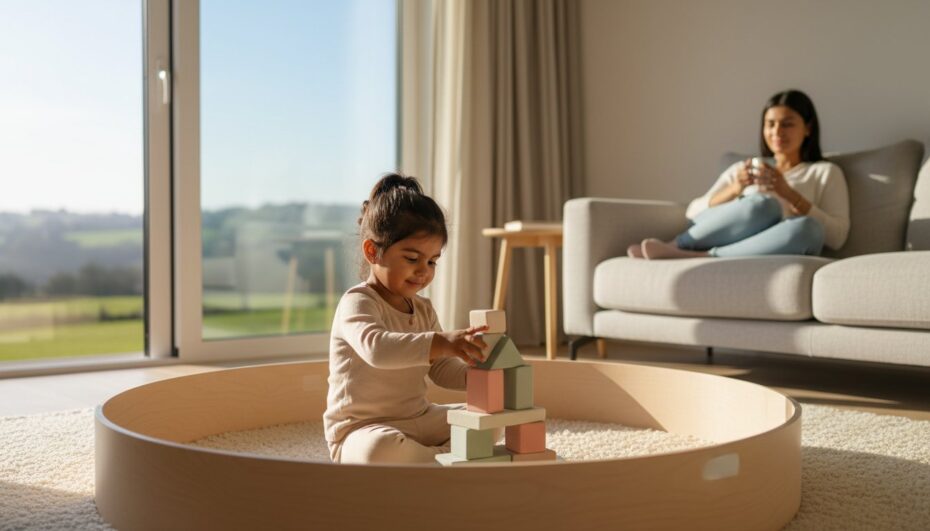
What if the best thing you could do for your child’s brain today is actually to step back and do nothing at all? We know the heavy weight of guilt that creeps in when you just need ten minutes for a hot tea, especially when you’re met with constant clinging or those dreaded “I’m bored” sighs. It’s natural to worry they aren’t learning if you aren’t actively teaching them, but the truth is quite the opposite. Mastering how to encourage independent play is the greatest gift you can give to their development and your own daily sanity.
You deserve to reclaim your time while your bundle of joy explores their world with total confidence. This guide reveals the practical strategies and physical environment secrets to help your child get lost in deep “flow” play. We’ll show you how to create a safe, self-contained “Yes Space” using premium equipment lovingly handmade in our West Yorkshire factory. You’re about to discover how a few simple layout changes lead to a child who plays happily on their own, giving you the freedom to breathe while they build essential life skills.
Key Takeaways
- Learn how to design a 100% safe “Yes Space” that eliminates constant corrections and lets your little one’s imagination run wild.
- Understand the vital link between solo play and your child’s ability to build problem-solving skills and emotional self-regulation.
- Discover why “passive” open-ended toys are superior to electronic sets for turning your child into a focused, active learner.
- Master how to encourage independent play through practical strategies like the “Staircase Method” to build your child’s confidence and reclaim your time.
- See how our lovingly handmade equipment from West Yorkshire offers premium UK quality and safety, all protected by our unbeatable Price-Beater Guarantee.
The Secret to Independent Play: Creating a ‘Yes Space’ for Your Child
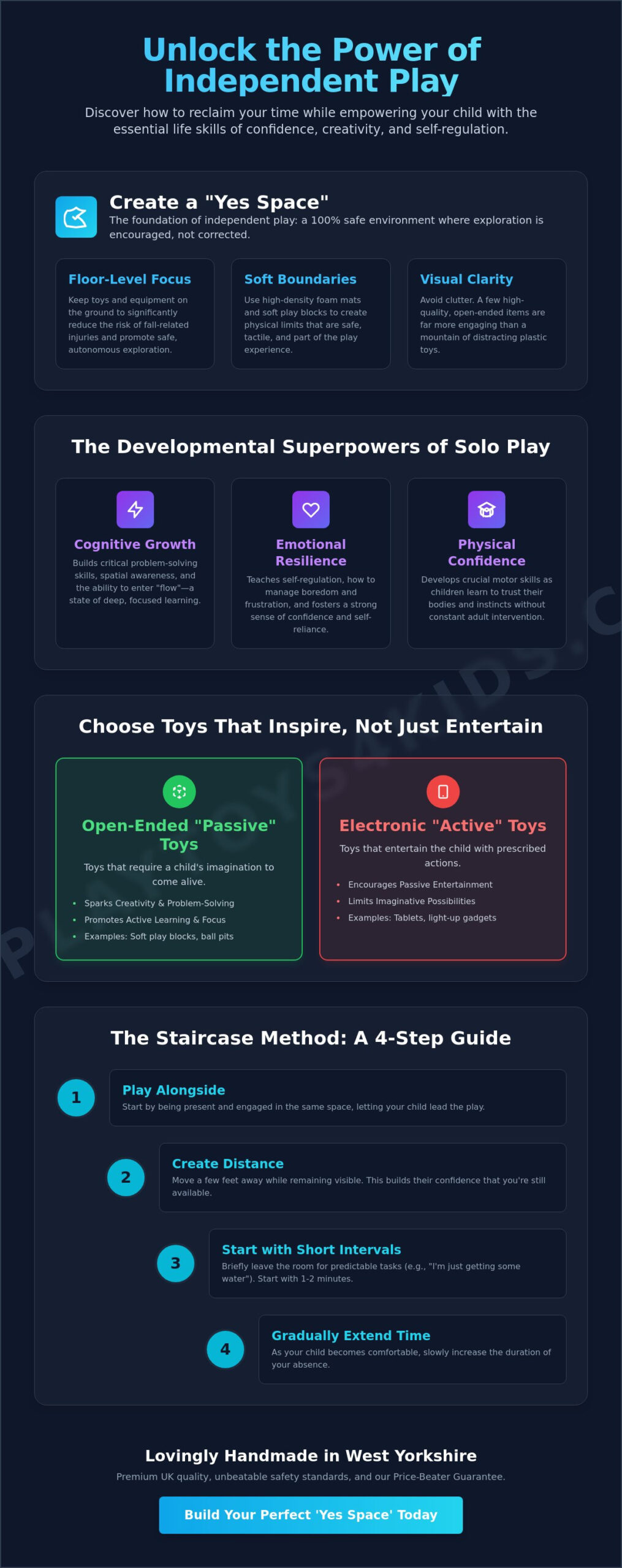
Every parent wants their child to be happy and engaged, but hovering constantly is exhausting for you and stifling for them. If you’re wondering how to encourage independent play, the answer starts with a “Yes Space.” This is a 100% child-proofed environment where your little one can explore every single inch without hearing “no,” “don’t touch,” or “be careful.” When a child is constantly interrupted by adult corrections, it shatters their “flow,” that vital state of deep concentration where the most significant cognitive leaps happen.
Making the psychological shift from being an “entertainer” to an “observer” is a game-changer for your sanity. It allows your child to naturally progress through Parten’s stages of play, specifically mastering solitary play. In this stage, children learn to engage with their surroundings and solve problems without needing your constant input. By stepping back, you’re actually giving them the confidence to trust their own abilities. At Softplay Toys4Kids, we know that the right equipment is the foundation of this freedom. Our UK-made, high-quality gear is designed to turn any corner of your home into a secure adventure zone where your child is the boss.
Moving from ‘No’ to ‘Go’: The Psychology of a Safe Space
Constant “no’s” act like a mental brake pedal for a developing brain. Frequent interruptions can hinder a child’s ability to focus and develop executive function. A Yes Space removes these barriers entirely. You’ll feel an immediate sense of relief when you don’t have to hover within six inches of your toddler. If you’re just starting out, it helps to understand what is soft play and how it supports this transition. It’s about using cushioned, impact-absorbing materials to create a “fail-safe” environment where tumbles are just part of the learning process rather than a cause for panic.
Essential Components of a Home ‘Yes Space’
Building this space requires a few strategic choices to ensure total peace of mind. Start by securing heavy furniture to the wall and removing any objects smaller than 3cm to eliminate choking hazards. Focus on these core elements:
- Floor-Level Focus: Keep toys and equipment on the ground. When play happens at floor level, the risk of serious fall injuries is significantly reduced.
- Soft Boundaries: Use high-density foam mats or soft play blocks instead of hard metal gates. These provide a physical limit while encouraging tactile exploration.
- Visual Clarity: Don’t clutter the space. A few high-quality items are better than a mountain of plastic.
Check Us Out Before You Checkout to see how our West Yorkshire-made equipment provides that “Price-Beater Guarantee” on safety and durability. Using 5cm thick, UK-manufactured foam mats ensures that even the most energetic toddlers stay safe while they learn how to encourage independent play through self-led discovery. Our products are lovingly handmade to ensure they meet the highest safety standards, giving you the freedom to sit back and watch your child thrive.
Why Independent Play is the Foundation of Child Development
Do you ever wonder what is happening in your toddler’s mind when they are quietly stacking blocks? It is far more than just “keeping busy.” It is a massive brain workout. Mastering how to encourage independent play is about more than just finding five minutes for a cuppa; it is about building a resilient brain. When a child plays alone, they enter a state of “flow.” This is a deep, immersive concentration where they lose track of time and become fully focused on the task at hand. Experts agree that this state is vital for high-level cognitive learning and focus.
Physical independence directly fuels cognitive confidence. When a child moves their body without being “managed” by an adult, they learn to trust their own instincts. This self-reliance is the secret sauce for emotional regulation. If they aren’t constantly looking to you for the next instruction, they learn to manage their own boredom and frustration. It is about letting them be the boss of their own tiny world. Are you ready to see your child’s confidence soar?
Cognitive Benefits of Solo Exploration
When a child explores a “Yes Space” on their own, they develop essential spatial awareness. Navigating around ball pits or moving foam blocks helps them understand distance, gravity, and volume through direct experience. This trial and error process is most effective when it is uninterrupted. Using sensory toys can further spark this curiosity, letting them follow their own interests at their own pace. Studies in 2023 suggest that self-directed discovery can be significantly more effective for long-term retention than adult-led instruction.
Building Resilience Through Playful Mistakes
Mistakes are brilliant teachers when the environment is safe. Falling onto a high-quality soft mat isn’t a crisis; it is a “safe mistake” that teaches a toddler about balance. They learn to “try again” without immediately looking to a parent for a solution. This builds a sense of agency that stays with them for life. Citing the developmental benefits of independent play, we see that children who play alone regularly show higher levels of self-esteem by age five. They know they can solve problems. They know they are capable. We proudly manufacture our products in West Yorkshire to ensure every mat and block supports these vital moments of growth. If you want to start building this empowering environment today, check out our range of handmade UK soft play equipment to create your own “Yes Space.”
Soft Play vs. Traditional Toys: Which Better Supports Solo Play?
Why does a child often ignore a flashy, battery-operated toy in favour of the cardboard box it came in? The answer is simple. Plastic sets with buttons and pre-programmed sounds are “active” toys that leave the child in a “passive” role. To truly master how to encourage independent play, you need the opposite: passive toys that demand an active mind. High-quality soft play equipment, like our lovingly handmade foam blocks and ball pits, provides a blank canvas for imagination. While a plastic robot only does one thing, a foam wedge can be anything from a slide to a dragon’s tail.
Soft play equipment offers a level of longevity that traditional toys simply can’t match. A 12-month-old uses a foam step to practice crawling, while a four-year-old uses that same step as a throne in a make-believe castle. This adaptability ensures your investment keeps your little ones engaged for years, rather than weeks. Because these items don’t rely on batteries or “correct” ways to play, they never become obsolete as your child’s skills evolve.
The Safety Factor: Foam as a Parent’s Proxy
A “Yes Space” only works if you actually feel comfortable saying “yes” to solo exploration. Traditional wooden or plastic toys often have sharp corners or rigid edges that require you to hover nearby. Our high-density foam acts as a silent guardian. It absorbs impact, which means if your toddler decides to tumble, the foam catches them safely. This built-in safety net allows you to step further away, giving your child the physical space they need to build confidence.
When you are choosing pieces for your home, it is vital to look for professional-grade materials. Check out the ultimate guide to buying soft play equipment to understand the quality standards we maintain in our West Yorkshire factory. We use non-toxic, easy-clean PVC surfaces, so even the messiest independent play sessions can be wiped away in seconds. You get peace of mind, and they get the freedom to move.
Open-Ended Play with Soft Blocks and Shapes
Soft blocks and shapes are the gold standard for how to encourage independent play because they remove the fear of failure. There is no “wrong” way to stack a foam cylinder or a square. This lack of rigid rules reduces the frustration that often leads to a child quitting and asking for help. Instead, they stay in the “flow” state longer, building their focus and resilience.
- Physical Development: Climbing, lifting, and dragging large shapes builds essential gross motor skills and muscle strength.
- Problem Solving: Figuring out how to balance a triangular prism on a cube keeps the brain engaged without needing adult intervention.
- Confidence: Successfully building a “mountain” and climbing it alone provides a massive boost to a child’s self-esteem.
Don’t settle for toys that do the thinking for your child. By choosing open-ended soft play, you are giving them the tools to become the architects of their own fun. Check us out before you checkout to see how our premium UK-made shapes can transform your playroom into a hub of creative energy.
5 Practical Ways to Encourage Your Child to Play Alone
Learning how to encourage independent play isn’t about leaving your child to fend for themselves. It’s a skill you build together through trust and environment. You want your bundle of joy to feel confident and safe while they explore their world. By using these five proven strategies, you can foster a sense of autonomy that benefits their development and gives you a much-needed breather. We proudly offer high-quality tools to help this process, but the real magic happens in how you step back.
The ‘Staircase’ Method of Stepping Back
This technique focuses on gradual transitions to build confidence. Start by sitting on the floor and playing alongside your child. Once they’re deeply engaged, move to a chair across the room. Eventually, you’ll be able to step into the next room while they continue their adventure. If they ask you to join in, don’t shut them down. Try a “sportscasting” approach instead. Say, “I see you’re building a massive tower with those blue blocks!” This acknowledges their effort without you taking over the play. Use 30-second check-ins to peek in and smile. It maintains their sense of security without breaking their flow.
Toy Rotation and Presentation
Too many choices often lead to “toy fatigue” and less focus. Studies from the University of Toledo show that toddlers engage in deeper, more creative play when fewer toys are available. Try rotating your selection every 10 to 14 days to keep the environment fresh. You can use large, engaging items like ball pits as a rotating ‘anchor’ for your play area. One week it’s a ball pool; the next, it’s a soft climbing wedge. Create an “invitation to play” by setting up a small scene for them to discover. A few toy animals placed near a wooden fence will spark immediate interest much faster than a bin full of random plastic.
Observation and Routine
Consistency helps children feel in control. Establish a predictable routine where independent play happens at the same time daily, such as after a morning snack. During this period, follow the “sit on your hands” rule. It’s tempting to jump in when a bridge collapses or a puzzle piece doesn’t fit, but don’t. Let them struggle slightly and find their own solution. This builds the resilience they’ll need as they grow. Your role is the silent observer, admiring their brilliance from the sidelines while they master new skills in their lovingly prepared space.
Ready to transform your home into a haven of fun and learning? Check Us Out Before You Checkout for premium, UK-made soft play equipment that’s built to last.
Building Your Home Playroom with UK-Made Soft Play Equipment
Creating the perfect environment is the most effective way to master how to encourage independent play. When your child has a dedicated area filled with tools designed for their size and ability, their confidence grows. At SoftplayToys4kids, we take pride in being a leading UK manufacturer based in West Yorkshire. Every single piece of equipment we sell is lovingly handmade in our local factory. We don’t believe that high-quality play should be a luxury reserved for a few. Our Price-Beater Guarantee ensures that families across the country can access premium gear without overstretching their budget. Whether you’re looking for a single sensory mat or a full room setup, we provide the durability and safety your “Yes Space” requires.
Why Handmade Quality Matters for Safety
Safety is the foundation of independent play. If you’re constantly worried about equipment collapsing or toxic materials, you won’t feel comfortable letting your child explore alone. Many cheap imports use low-density foam that loses its shape within weeks. Our UK-manufactured foam is different. It’s designed to be firm enough for stability but soft enough to cushion every tumble. Because we oversee the entire production process in West Yorkshire, we guarantee that every seam is reinforced and every fabric is non-toxic. This durability is essential because equipment that lasts encourages longer, more frequent play sessions. We invite every parent to Check Us Out Before You Checkout. You’ll find that our local manufacturing standards offer a level of peace of mind that mass-produced alternatives simply can’t match.
Customising Your ‘Yes Space’ with SoftplayToys4kids
Every home in the UK is different. You might be working with a small corner of a living room in a city flat or a sprawling dedicated playroom. We specialise in custom designs that fit your specific dimensions. You can mix and match our modular mats, wedge blocks, and vibrant ball pools to create a tailored sanctuary. If you’re unsure where to start, our team provides professional design advice to help you maximise your available square footage. Learning how to encourage independent play is much easier when the layout makes sense for your child’s current developmental stage. From soft steps that build motor skills to creative activity blocks, we help you build a space where “yes” is the only word they need to hear. Visit our shop today to start building a high-quality, safe, and fun sanctuary for your little one.
Start Building Your Child’s Dream Yes Space Today
Creating a dedicated “Yes Space” is the most effective way to foster confidence and curiosity in your little one. By removing physical hazards and replacing rigid, traditional toys with versatile soft play equipment, you’re setting the stage for hours of safe, solo exploration. You now have the tools and the strategy for how to encourage independent play by simply letting your child lead the way in a secure environment.
Softplay Toys4Kids is here to help you bring that vision to life with equipment that’s built to last. Every single piece is lovingly handmade in West Yorkshire and meets the rigorous standards required by the UK schools and nurseries we’ve supplied for years. We’re committed to being the best value on the market, which is why we stand by our famous Price-Beater Guarantee. You don’t have to compromise on safety or your budget to give your child a world of new fun at home.
Check Us Out Before You Checkout – Shop Our UK-Handmade Soft Play Collection
It’s time to watch your child’s imagination soar as they master the art of playing solo. We can’t wait to see the incredible play spaces you create!
Frequently Asked Questions
At what age should a child start playing independently?
Children can begin developing the skills for how to encourage independent play from birth. Even a newborn spending 2 minutes on a play mat while you stay nearby counts as the start. By 6 months old, most infants can safely explore their surroundings for 5 to 10 minutes at a time. As they grow, these windows expand naturally. Our UK-made floor mats provide the perfect cushioned base for these early milestones.
Is it okay if my child cries when I leave them to play alone?
It is normal for a child to protest briefly when you transition them to solo play. However, you shouldn’t leave them if they’re genuinely distressed or panicking. If they cry, try staying in the room but staying busy with your own task. This helps them feel secure while they learn how to encourage independent play. Gradually increase the distance as their confidence grows over several days.
How long should a toddler be able to play by themselves?
A typical 2-year-old can usually manage between 15 and 30 minutes of focused solo play. According to child development experts at the LEGO Foundation, play spans change significantly as children age. A 3-year-old might reach 45 minutes if the environment is engaging and safe. Don’t worry if your child starts with just 5 minutes. Consistency is the key to building their stamina for longer sessions every day.
What should I do if my child follows me out of the ‘Yes Space’?
Use a sturdy safety gate or a room divider to maintain the boundaries of your ‘Yes Space’ effectively. If they follow you out, calmly lead them back without making it a game or a confrontation. Explain that it’s their time to play and your time to work or rest. Clear physical limits help toddlers understand where it’s safe to be wild and where they need to stay for now.
Can I encourage independent play in a small flat without a playroom?
You don’t need a dedicated playroom to foster independence in a small UK flat. A single corner equipped with a soft play mat or a foldable ball pool works perfectly for this purpose. The goal is to create a zone where every item is safe for them to touch. Even a 2-metre square area can become a high-quality ‘Yes Space’ that keeps your bundle of joy happy and occupied.
What are the best toys to encourage solo play for a 1-year-old?
Open-ended toys like soft building blocks, activity tunnels, and sensory balls are ideal for 1-year-olds. These items don’t have a single right way to play, which keeps toddlers engaged for longer periods. Our West Yorkshire factory creates premium soft play shapes specifically designed to spark this kind of creative exploration. Check Us Out Before You Checkout to see our full range of British-made options for your home.
How do I stop feeling guilty for wanting my child to play alone?
Remember that solo play is a vital developmental skill, not a sign of neglect. Research from the University of Cambridge indicates that independent play fosters problem-solving and self-regulation in early childhood. You’re giving them the gift of confidence and creativity. When they’re giggling in their ball pool, they’re learning to be happy in their own company. It’s a win for their growth and your own mental health.
Is soft play equipment safe for unsupervised (but nearby) play?
High-quality soft play equipment is designed for safety, making it perfect for a ‘Yes Space’ environment. Our products are lovingly handmade in the UK and meet strict fire safety and durability standards for your peace of mind. While you should always be within earshot, these cushioned items remove the risks of sharp edges or hard falls. This allows your child to enjoy new wild fun while you stay productive nearby.
Leave a Reply