
Reducing Screen Time for Toddlers: The Ultimate Guide to Active Play in 2026
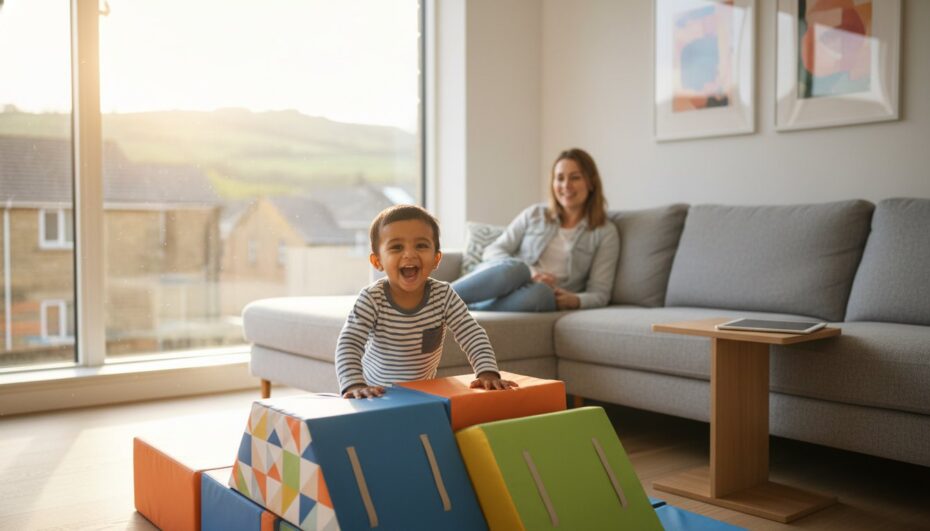
Last Tuesday, Sarah watched her two-year-old transform from a happy child into a whirlwind of “scream time” the second the tablet turned off. It’s a scene playing out in living rooms across the UK, where recent surveys indicate that 70% of parents feel guilty about using screens as a digital babysitter just to finish daily chores. You want your bundle of joy to be happy and safe, yet you worry that fast-paced videos are impacting their attention span. We agree that the struggle is real. Finding the balance while reducing screen time for toddlers feels like an uphill battle when you just need five minutes of peace to put the kettle on.
You deserve a home filled with the sound of giggling rather than digital noise. This guide provides practical, stress-free strategies to swap those glowing pixels for active, physical play that builds real-world skills. We will show you how to encourage independent play and follow the latest UK health guidelines with total confidence. You’ll discover how high-quality, UK-made play equipment can turn your lounge into a zone of “new wild fun” where your little one thrives. Check us out before you checkout, and let’s explore how to reclaim your living room and boost your child’s happiness today.
Key Takeaways
- Learn the latest 2026 UK guidance for under-5s, including why the “Zero Screen” recommendation is the new gold standard for your bundle of joy’s development.
- Discover the “PREP” method to handle “Bye Bye Elmo” meltdowns with confidence, ensuring you never fall into the “just this once” trap again.
- Master the art of reducing screen time for toddlers by swapping passive tablets for immersive, physical active play that keeps them giggling and moving.
- See how to transform your home into a screen-free sanctuary using an “invitation to play” layout that makes soft play equipment more tempting than a TV remote.
- Understand why high-quality, UK-made soft play provides the same “digital immersion” as a game but with unbeatable benefits for your child’s physical growth.
The Screen Time Struggle: Why Reducing It Matters in 2026
Do you feel like you’re fighting a losing battle against the tablet? It’s a common struggle. In 2026, screen time has evolved far beyond the living room television. It now includes smartphones, high-speed tablets, and even AI-integrated dolls or robots. For most families, the digital babysitter is a survival tool for household management. We get it. You’ve got chores, work, and a million other things to do. But there’s a better way. This guide is built on a core philosophy: shifting your toddler from passive watching to active doing. Reducing screen time for toddlers doesn’t have to be a chore for you; it can be a new wild fun for them.
Raising kids in 2026 is harder than ever. The pressure to be a perfect parent while managing a digital-first world is exhausting. You shouldn’t feel guilty for using technology, but you should feel empowered to swap it for something better. Our goal is to help you reclaim your living room and get those little legs moving again. Check Us Out Before You Checkout elsewhere, because we understand that your child’s happiness and safety are your top priorities.
The Impact of Sedentary Behavior on Toddler Development
When toddlers stay glued to a screen, they lose out on gross motor skill practice. These early years are critical. Physical movement is what actually wires a child’s brain for future learning. Recent research on screen time shows that a screen provides zero tactile feedback. Compare that to the sensory experience of physical play. Our lovingly handmade equipment provides the bumps, climbs, and crawls that digital pixels simply can’t match. Reducing screen time for toddlers ensures they develop the balance and coordination they need for a healthy life.
The 2026 UK Parental Landscape
Data from early 2026 indicates that 98% of UK 2-year-olds are already digital natives. This has sparked a massive shift in places like West Yorkshire, where parents are pushing back against digital overstimulation. They want safer, more traditional play. That’s why high-quality UK manufacturing is seeing a resurgence. Parents want products they can trust, built to premium safety standards right here at home. We proudly offer durable, British-made solutions that help families break the screen habit. Our price-beater guarantee ensures you get the best value while investing in your child’s physical future.
- Define the goal: Move from passive screens to active play.
- Support local: Trust West Yorkshire craftsmanship for safety.
- Focus on growth: Prioritise gross motor skills over digital points.
New 2026 UK Guidance: How Much Screen Time is Too Much?
Are you worried your little one is spending too much time glued to a tablet? You aren’t alone. Reducing screen time for toddlers is a top priority for parents in 2026, and the latest UK health recommendations are clearer than ever. To ensure your child hits their developmental milestones, follow these core guidelines:
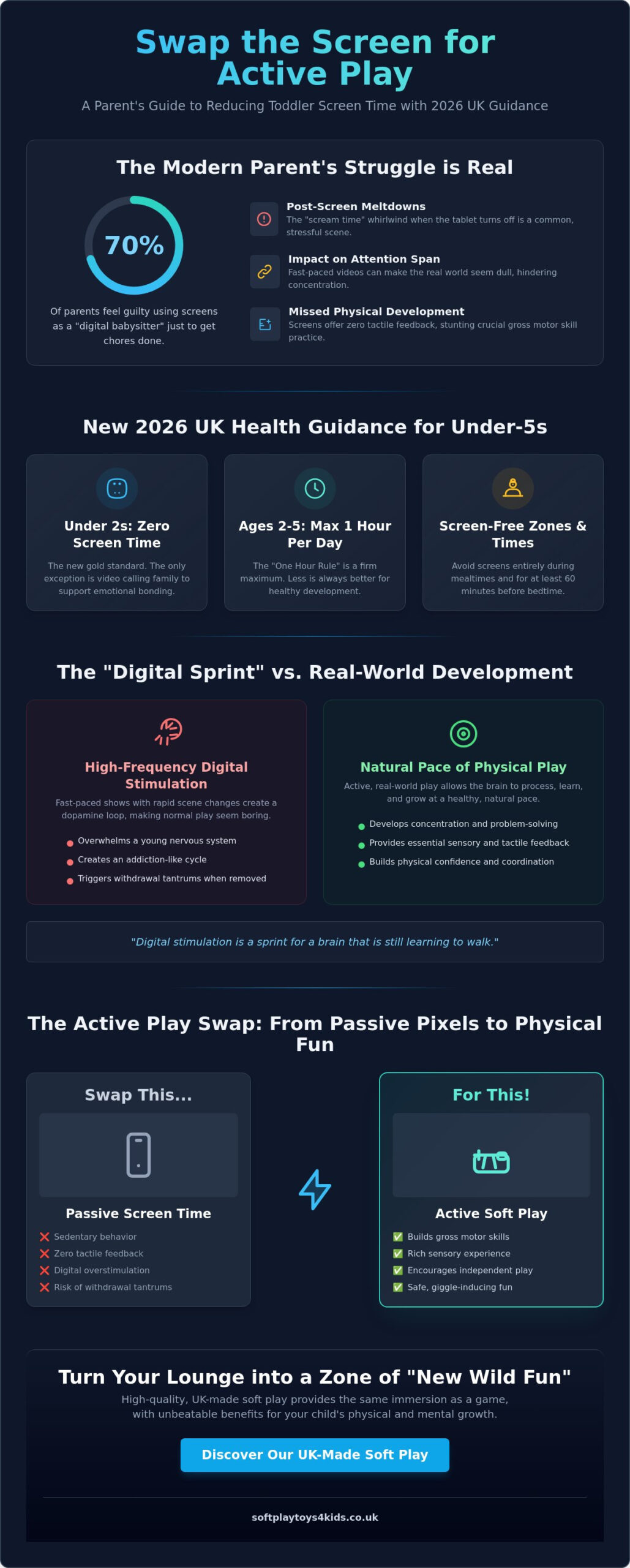
- Under 2s: The goal is zero screen time. The only exception is video calling family, which helps with emotional bonding and language recognition.
- Ages 2 to 5: A maximum of one hour per day is the “One Hour Rule,” but health professionals agree that less is always better.
- Timing: Screens must be avoided during mealtimes and at least 60 minutes before sleep to prevent blue-light disruption.
Content quality is just as vital as the clock. Experts providing guidance on screen time suggest opting for slow-paced educational programmes. These are far safer for developing minds than the high-intensity, rapid-fire scene changes found in social media clips or “fast-paced” gaming apps that can overstimulate a young nervous system.
The Dangers of High-Frequency Digital Stimulation
Fast-paced shows with scene changes every three seconds are overwhelming for a child. This rapid delivery creates a dopamine loop that makes real-world play seem dull by comparison. When the screen finally goes off, the sudden drop in stimulation often triggers those intense withdrawal tantrums. “Digital stimulation is a sprint for a brain that is still learning to walk.” By reducing screen time for toddlers, you give their concentration levels the space they need to grow naturally.
Co-Viewing: Making Screen Time a Shared Activity
Don’t just hand over the phone and walk away. Sit with them. Ask questions about the characters to boost their vocabulary and use digital photo albums to look at pictures of family trips. This bridges the gap between technology and real-world memories. When it’s time to switch off, transition to hands-on fun with sensory toys that engage their touch and sight in the physical world.
We proudly offer high-quality play equipment lovingly handmade in the UK to make this transition easier for your family. Check Us Out Before You Checkout and explore our latest range of UK-made soft play sets to keep those little hands busy and happy.
The Active Play Swap: Replacing Digital Stimuli with Physical Engagement
Are you struggling to pry the iPad away from your little one? You aren’t alone. High-definition screens offer a constant stream of dopamine that’s hard for a developing brain to resist. However, active play serves as the natural antidote. It provides the same level of total immersion as a video game but swaps sedentary habits for physical growth. While Mayo Clinic’s guide to children’s screen time highlights the importance of setting firm limits, we focus on the practical “how.” We don’t just take the screen away; we replace it with something better.
Think about the sensory “hit” of a bright screen. It’s purely visual and auditory. Now, imagine the sensory “hit” of a child diving into a ball pit. It’s a full-body experience. They feel the pressure of the balls, the cool texture of the PVC, and the thrill of weightless movement. This physical engagement is what makes reducing screen time for toddlers actually sustainable. At SoftplayToys4kids, we’re your partner in building these high-energy zones right in your living room. Surely, you want your child to be active rather than passive?
Physical Alternatives for Every Screen Scenario
Changing habits is easier when you have a direct replacement ready. Consider these swaps to keep your toddler moving:
- Instead of a morning cartoon: Use a soft play ball pit for “wake-up” movement. It gets the blood pumping and the giggles flowing before breakfast.
- Instead of a tablet at the doctors: Pack hand-held sensory fidget toys. These tactile tools keep little fingers busy and minds focused without the need for a glowing display.
- Instead of a show while cooking dinner: Create a safe baby play mat zone with soft blocks. Your child can build and tumble while you prep, keeping them close but safely occupied.
Building Motor Skills Through Soft Play
Active play isn’t just about burning off steam; it’s about essential development. When your child is climbing, sliding, and crawling through our equipment, they’re building spatial awareness and physical confidence. These are skills a screen simply cannot teach. We’re proud to be a leading UK manufacturer, crafting every piece in our West Yorkshire factory. Our equipment is lovingly handmade to ensure it stands up to vigorous, daily use by even the most energetic toddlers.
Quality shouldn’t be out of reach for families. That’s why we offer our famous Price-Beater Guarantee. If you find a comparable UK-made product for less, we’ll beat it. Check us out before you checkout. You deserve premium equipment that lasts for years, and your toddler deserves a childhood filled with real-world movement. Let’s make reducing screen time for toddlers a fun adventure rather than a daily battle. Come join us in creating a safer, more active home environment today.
Managing the “BYE BYE ELMO” Meltdown: Practical Strategies
Every parent knows the sound. It’s the high-pitched protest that erupts the moment the iPad goes dark. While reducing screen time for toddlers is essential for healthy development, the immediate transition is often the hardest part of the day. To handle this without losing your mind, use the “PREP” Method: Predictability, Reach, Empower, and Plan.
Predictability means giving warnings at 10, 5, and 2 minutes. Reach involves getting down on their level and making eye contact before the screen goes off. Empower your child by letting them press the “off” button themselves. Finally, always have a Plan for what happens next. If you give in and grant “just five more minutes” after a scream, you’ve fallen into a “just this once” trap. This teaches your toddler that volume controls the remote. Research from child development experts indicates that intermittent reinforcement actually makes the unwanted behavior three times harder to stop in the long run.
Visual timers are your secret weapon here. Toddlers don’t have a firm grasp of linear time, but they can see a red dial disappearing. When the red is gone, the fun moves elsewhere. This simple tool shifts the “blame” from you to the timer, which reduces friction and helps them process the transition visually.
Step-by-Step Meltdown Management
When the tears start, don’t ignore them, but don’t buckle either. Start by acknowledging the feeling: “I know it’s hard to stop watching, you really liked that show.” This validates their emotion without changing the rule. Hold the boundary firmly; the screen stays off regardless of the noise level. Immediately use “The Pivot” to redirect their energy. You might say, “Let’s see how many blue balls we can find in your Ball pits!” Moving from a passive screen to a physical, sensory environment helps their brain reset and focus on active play.
Creating Consistent Routines
Consistency is the enemy of the tantrum. Establishing “Screen-Free Zones” in bedrooms and dining areas ensures your child knows exactly where technology is off-limits. For families in West Yorkshire, we offer a “Call and Collect” option at our local factory. This lets you get your hands on new active play gear fast to keep those routines exciting. Reducing screen time for toddlers becomes much easier when the alternative is a high-quality, handmade soft play set waiting in the lounge. Over a period of 14 to 21 days, these consistent boundaries will naturally lower the frequency and intensity of power struggles.
Designing a Screen-Free Play Sanctuary with Soft Play
The physical layout of your home acts as a silent architect for your child’s habits. If the sofa faces a 50-inch screen, that’s where the focus stays. Success in reducing screen time for toddlers requires a deliberate shift in your environment. You want to create an “invitation to play” that is visually louder than the remote control. By placing vibrant, tactile soft play equipment in their direct line of sight, you trigger their natural urge to climb, crawl, and explore.
Setting up these zones doesn’t require a mansion. Many UK families maximise limited square footage by using modular mats and corner ball pools. These clever designs turn awkward 90-degree angles into high-energy hubs. It’s about making the active choice the easiest choice. When a toddler sees a soft, inviting mountain of foam, the tablet suddenly loses its lustre. You’re not just buying a toy; you’re engineering a lifestyle change that prioritises movement over passive watching.
Durability is non-negotiable for daily use. You need premium materials that stand up to “wild fun” without losing their shape. We use high-density foam and reinforced PVC that wipes clean in seconds. This ensures your investment lasts through the toddler years and beyond, providing a consistent safe haven for physical development. Quality gear doesn’t just look better; it stays safe and supportive even after years of jumping and tumbling.
Essential Equipment for a Screen-Free Home
Foam play mats serve as the anchor for a “Safe Play Zone.” They provide a clear physical boundary where toddlers know they can push their limits safely. For moments when you’re on the move, sensory toys are the ultimate distraction. They keep little hands busy during travel or quiet time without needing a digital interface. Our creative team specialises in designing these areas to fit your specific room dimensions, ensuring every inch promotes reducing screen time for toddlers through active engagement.
The SoftplayToys4kids Difference
We are a proud UK manufacturer based in West Yorkshire. Being handmade in the UK means we don’t cut corners on safety or quality. We know you want the best for your bundle of joy, which is why we offer a Price-Beater Guarantee. Premium play should be accessible to every family. Check us out before you checkout; browse our full range of active play solutions today and see why we’re the UK’s fastest-growing retailer in the industry.
Transform Your Living Room into a Hub for Active Growth
Navigating the digital landscape in 2026 doesn’t have to be a constant battle. By following the latest UK health guidelines and swapping tablets for physical engagement, you’re setting the stage for better sleep and faster motor skill development. You’ll find that reducing screen time for toddlers becomes much easier when they have a dedicated, safe space to climb, tumble, and explore. It’s about replacing passive scrolling with active, giggling fun that builds confidence and coordination.
Our soft play equipment is lovingly handmade in West Yorkshire using premium, durable materials that stand up to the most energetic play sessions. We take pride in our craftsmanship and offer a Price-Beater Guarantee to ensure you get the best value in the UK market. Every piece is designed to create a secure sanctuary where your child can thrive without a screen in sight. Don’t let your little one miss out on the physical milestones that define these early years. We provide the high-quality tools you need to make active play the highlight of their day.
Check Us Out Before You Checkout – Browse Our UK-Made Soft Play Collection
Your child’s next big adventure starts right at home, so let’s get them moving today.
Frequently Asked Questions
How much screen time should a 2-year-old have according to UK guidelines?
The World Health Organisation and UK health experts recommend that 2-year-olds should have no more than 60 minutes of sedentary screen time per day. The NHS emphasizes that reducing screen time for toddlers is vital for healthy sleep and physical development. Instead of digital devices, the 2019 UK Chief Medical Officers’ guidelines recommend at least 180 minutes of physical activity daily. We believe active play is the best way to hit these targets while keeping your bundle of joy smiling.
What are the best alternatives to screens for toddlers when I need to get chores done?
Safe, independent play zones like a soft play corner or a ball pool are the most effective alternatives. You can set up a “busy bag” with sensory toys or a pop-up tunnel to keep them engaged for 20 to 30 minutes while you finish the laundry. These tactile activities stimulate their brains much better than a passive video. Check us out before you checkout to find the perfect UK-made foam sets that keep them safe and busy.
How do I stop my toddler from having a meltdown when I take the tablet away?
Use a visual timer and provide a five-minute warning to help your child transition without a tantrum. Research shows that 70% of toddler meltdowns during transitions occur because they feel a lack of control. Give them a choice between two active options immediately after, like “Do you want to jump in the ball pool or play with your blocks?” This shifts their focus from what they’ve lost to a new, wild fun activity.
Is all screen time bad for toddlers, or are some apps okay?
Not all screen time is equal, but high-quality educational content should still be limited to one hour daily. The 2023 National Literacy Trust report suggests that interactive, co-viewed content can support vocabulary, but it can’t replace physical movement. While some apps claim to be educational, they often lack the sensory feedback found in real-world play. For the best developmental results, prioritize “active” digital use where you talk about what’s happening on screen together.
Can soft play really help reduce my child’s interest in screens?
Yes, providing a stimulating physical environment directly competes with the dopamine hit of a tablet. When you introduce vibrant, high-quality soft play equipment, you’re offering a sensory-rich experience that tablets simply can’t match. Children are naturally wired to move; by creating a dedicated “fun zone” in your home, you’ll find they choose climbing and sliding over sitting still. It’s a proven way to make reducing screen time for toddlers a natural part of your day.
What should I do if my child is already “addicted” to fast-paced videos?
You should implement a “digital detox” by gradually replacing high-stimulation videos with slower-paced activities over a 14-day period. Fast-paced content can shorten attention spans, so transition them toward open-ended toys like foam building blocks or sensory mats. These UK-manufactured toys encourage “deep play,” which helps recalibrate their brain’s reward system. Start with 15-minute sessions of physical play to rebuild their focus and burn off that restless energy.
How do I set up a screen-free play area in a small UK home?
You can create a functional play zone in as little as 2 square metres by using multi-functional, foldable soft play mats. Many UK terraced houses have limited space, so we design our premium equipment to be easily stored or rearranged. Use vertical space with wall-mounted sensory boards or a corner ball pool to maximize the footprint. A dedicated rug or foam mat clearly defines the “no-tablet zone,” making it a safe haven for giggling and growth.
Why is physical play more important than educational apps for development?
Physical play builds gross motor skills and neural pathways that apps simply cannot reach. A 2022 study found that toddlers who engage in daily active play have 25% better spatial awareness than those who rely on digital learning. When your child climbs, jumps, or balances on our UK-made soft play sets, they’re learning physics and problem-solving in real-time. It’s about building a healthy body and a sharp mind through movement, not just memorising shapes on a flat glass screen.
Leave a Reply