
Sensory Room Design Ideas: Using Stepping Stones for Active Play (2026)

Imagine your little one’s face lighting up as they prepare to leap across a “lava” pit, only for your heart to sink as you picture them slipping on a hard plastic block or a slick floor. It’s a worry every caregiver knows well. You want to encourage that high-energy movement, yet the fear of bumps and bruises often holds you back. When you are looking for effective sensory room design ideas, you’re not just looking for decor; you’re looking for a promise of safety and a spark of joy for your child.
We completely understand that you need a space where your children can thrive without the risks associated with cheap imports. We’ve helped countless families and SEN providers across the UK create environments that are both thrilling and incredibly secure. Discover how to transform any space into a developmental powerhouse with creative sensory room design ideas centred on balance and active play. We’ll show you how our handmade West Yorkshire stepping stones can build confidence, improve coordination, and meet the latest 2026 EYFS milestones. From “floor is lava” setups to structured balance circuits, we’re previewing the best ways to use commercial-grade, UKCA-compliant soft play to turn your room into a safe haven for growth.
Key Takeaways
- Transform any space into a developmental powerhouse with innovative sensory room design ideas that bridge the gap between calming environments and active physical play.
- Improve a child’s coordination and body awareness by mastering the science of proprioception through structured balance challenges and varied heights.
- Ensure maximum safety and longevity by choosing handmade, UK-manufactured soft play materials that meet rigorous EN71 standards over hard plastic alternatives.
- Create engaging “floor is lava” layouts that combine high-energy movement with foundational skills like counting and colour recognition for a holistic learning experience.
- Discover the financial and quality benefits of buying factory-direct from West Yorkshire, providing commercial-grade durability for both home and professional SEN settings.
Stepping Stones: Essential for Sensory Room Design
While many people imagine a Sensory room as a quiet space filled with glowing lights and soft music, modern developmental science tells a different story. Active play is the heartbeat of a truly effective space. Integrating movement is one of the most impactful sensory room design ideas you can implement, and that’s where stepping stones come in. These aren’t just decorative items; they’re foundational tools for building “physical literacy” in toddlers and preschoolers. By encouraging children to move from one point to another, you’re helping them master their own bodies long before they reach the playground.
We’ve seen a massive shift away from the idea that stepping stones belong only in a garden. Today, these tools have moved indoors to become essential parts of living rooms and professional SEN centres. Why the change? Because caregivers now recognise that children need year-round access to high-energy activities that don’t depend on the British weather. Our handmade stones provide a structured way for kids to burn energy while developing the coordination skills needed for 2026 EYFS milestones.
The Difference Between Garden Stones and Play Stones
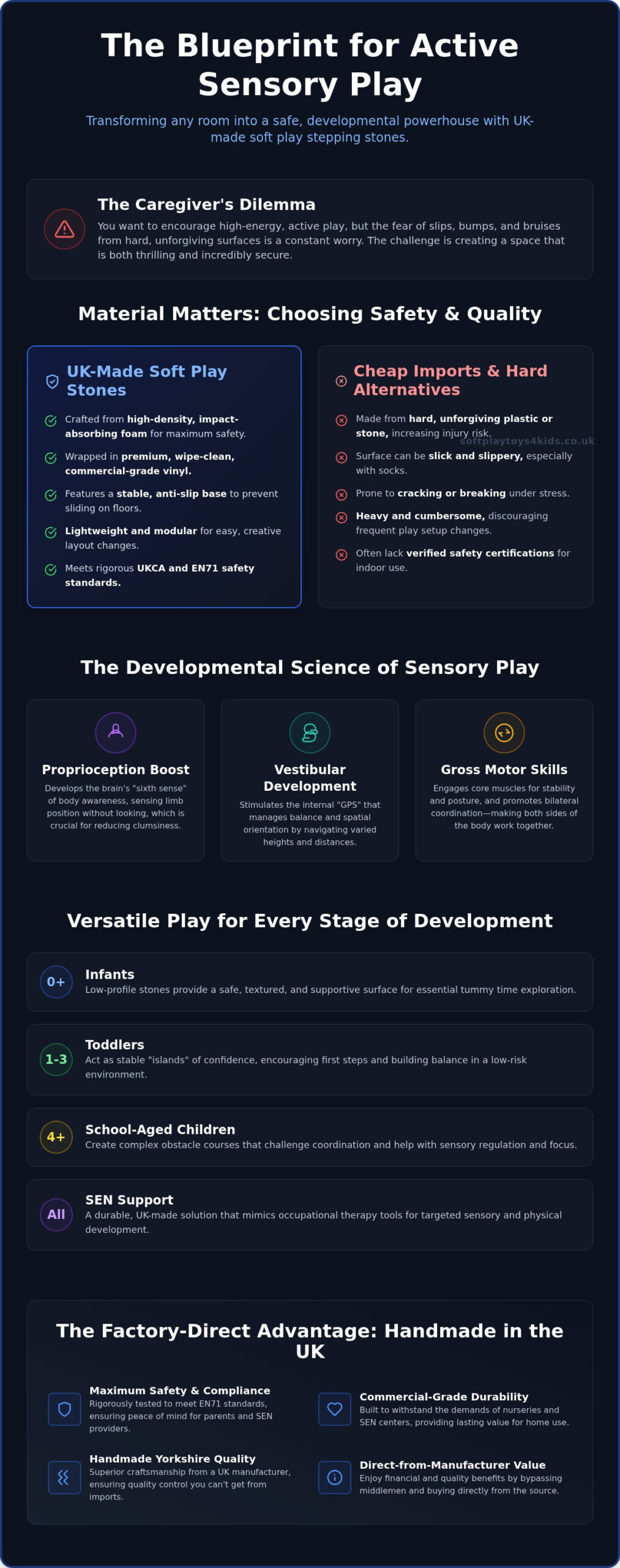
If you’ve ever worried about a child slipping on a hard surface, you’ll understand why material choice is everything. Traditional garden stones are cold, heavy, and unforgiving. In contrast, our soft play stones are crafted from high-density, impact-absorbing foam. We wrap each piece in premium, wipe-clean vinyl that’s tough enough for commercial nurseries but soft enough for a home bedroom. Unlike cheap plastic imports that can crack or slide, these stones feature anti-slip bases to keep your little ones upright. Because they’re lightweight, you can easily change your sensory room design ideas every day, moving the stones into new, exciting patterns without breaking a sweat.
Who Are These For? From Early Years to SEN Support
The beauty of these tools lies in their versatility across different age groups and needs. For infants, low-profile stones offer excellent tummy time support, providing a safe, textured surface to explore. As toddlers begin finding their first steps, these stones act as “islands” of confidence in a sea of carpet. For older school-aged children, the challenge increases. You can create complex obstacle courses that mimic occupational therapy sessions, helping with sensory regulation and focus. Whether you’re supporting a child with specific SEN requirements or simply want to give your preschooler a head start on balance, these stones are a durable, UK-made solution that grows with your family.
The Science of Sensory Play: Boosting Proprioception and Balance
Did you know that a child’s ability to sit still and focus in a classroom often starts with their ability to balance on one foot? It’s a surprising connection. When you’re researching sensory room design ideas, it is easy to get caught up in the visual elements, but the physical input a child receives is just as vital. Stepping stones are exceptional tools for developing the vestibular system, the internal GPS that manages balance and spatial orientation. By challenging a child to navigate different heights and distances, you’re giving their brain the high-quality data it needs to master movement.
This process is deeply linked to proprioception, which is the brain’s ability to sense limb position without looking. Without a well-developed sense of body awareness, children can appear clumsy or struggle with fine motor tasks later in life. Our handmade, high-density foam stones provide the stable yet forgiving resistance required to sharpen this “sixth sense”. When a child jumps from one stone to another, they are mapping their body in space. This physical mastery leads to improved cognitive focus; if the brain isn’t working overtime just to keep the body upright, it has more “bandwidth” available for learning and communication.
Gross Motor Skills and Coordination
Building core strength is about more than just muscles; it’s about providing a stable base for all physical activity. Balancing on our commercial-grade soft play stones engages the deep core and back muscles, which are essential for good posture. This type of active play also promotes bilateral coordination, forcing both sides of the body to work together in a synchronised way. It’s a brilliant, low-risk method to help your little ones meet 2026 EYFS milestones for physical literacy while they’re simply having a blast.
Sensory Integration and Playground Therapy
For children living with Sensory Processing Disorder (SPD), the world can often feel like it’s “too much” or “not enough”. The premium textured vinyl on our stones provides essential tactile feedback that helps ground a child’s nervous system. Integrating movement into sensory toys and development programmes acts as a natural “reset” button for overstimulated minds. This “heavy work” of jumping and balancing provides the calming input many children crave to regulate their emotions. If you want to build a truly supportive environment, our range of handmade sensory equipment is designed to withstand the rigours of both home and professional therapy settings.
Choosing the Right Materials for Your Sensory Room Design
When you are scrolling through sensory room design ideas, it’s easy to get distracted by bright colours and flashing lights. But have you stopped to think about what those products are actually made of? In a high-energy play environment, the material is the difference between a safe afternoon and a trip to the GP. While some traditional landscaping guides might suggest real stone or concrete for durability, these have no place in a child’s sanctuary. They are cold, dangerously heavy, and unforgiving on impact. You need materials that work with your child’s movement, not against it.
We believe that high-density foam is the gold standard for indoor play. It provides the necessary resistance for balance while remaining soft enough to absorb any accidental tumbles. There is also a major “noise factor” to consider. If you have hardwood or laminate flooring, hard plastic toys create a constant, distracting clatter that can be overwhelming for children with sensory sensitivities. Our foam-based stepping stones are the quiet choice, absorbing sound and creating a calmer, low-arousal environment where your child can focus on their physical goals without auditory overload.
Foam vs. Plastic Stepping Stones
Why do we champion foam over the moulded plastic alternatives you often see online? It comes down to three things: weight, grip, and longevity. Plastic stones are often slick, especially when used with socks, which leads to slips. Our premium vinyl covers provide a natural grip that builds confidence with every step. Because foam is lightweight, children can safely rearrange their own “lava” courses, promoting independence and creative play. Don’t worry about them losing their shape; our commercial-grade foam is designed to bounce back after years of heavy use in busy nurseries and home playrooms alike.
The Importance of UK-Made Quality and Safety
Safety shouldn’t be a guessing game. When you buy from our West Yorkshire factory, you aren’t just supporting local craftsmanship; you’re ensuring your equipment meets rigorous UK toy safety regulations (EN71). Many cheap imports bypass these standards, using inferior materials that can crack or peel. We use wipe-clean, medical-grade vinyl that stands up to industrial cleaners, making it perfect for high-traffic SEN centres and nurseries. For a deeper look at what to look for before you buy, check out our guide on buying soft play equipment to ensure you’re getting the quality your children deserve. We take immense pride in every stitch, ensuring our products are built to last a childhood.
Creative Sensory Room Layouts and Game Ideas
Ready to bring your sensory room design ideas to life? The magic happens when you move from planning to playing. You don’t need a massive hall to make a big impact. A few well-placed foam stones can turn a standard living room into a high-stakes adventure zone. Start with a simple straight line to build basic confidence. Once your child is comfortable, try “island” clusters that require diagonal leaps or wider stretches. This naturally scales the difficulty as their balance improves, ensuring they’re always challenged but never overwhelmed.
We love seeing parents and teachers get creative by combining these stones with other soft play equipment, such as wedge ramps or tunnel sets. This creates a multi-level environment that keeps children engaged for hours. By varying the layout, you’re not just changing the game; you’re constantly rewiring the brain to adapt to new physical challenges. It’s about turning a static room into a dynamic landscape for growth.
Classic Games: The Floor is Lava and Beyond
The “Floor is Lava” is a childhood staple for a reason. It’s thrilling, simple, and incredibly effective for building coordination. Set up your foam stones in a winding path across the room. The goal is to reach the “safe zone” without touching the carpet. To boost cognitive focus, introduce colour-coded jumping. Call out “Blue!” or “Yellow!” and watch them scan the room to find the right landing spot. For a physical challenge, try the “Animal Walk”. Can they hop like a frog on the green stone or balance like a flamingo on the red one? It’s fun, it’s fast, and it builds incredible core strength.
Quiet Time and Mindful Sensory Paths
While we love the energy of active play, these stones are equally brilliant for calming down. Use them as designated “sit spots” for reading corners or mindfulness exercises. In a busy classroom, having a specific stone can help a child define their personal space, which helps reduce anxiety during group activities. You can also create a sensory trail by alternating stones with different heights and textures. This encourages slow, deliberate movement and tactile exploration, helping to ground a child after a busy day at school. Ready to start building? Browse our full range of UK-made sensory stepping stones and transform your space today.
Why Buy Factory-Direct From a UK Manufacturer?
Why settle for flimsy, mass-produced imports when you can go straight to the source? Choosing to buy factory-direct from our West Yorkshire workshop means you’re getting premium British craftsmanship without the inflated price tags of middleman retailers. We’re proud to be a hands-on manufacturer, which gives us total control over the safety and quality of every stitch. Whether you’re a parent looking for home sensory room design ideas or a school manager planning a full-scale SEN suite, we provide the durability you need at a price that makes sense. By cutting out the middleman, we ensure that every penny you spend goes directly into the quality of the materials and the safety of your children.
SoftplayToys4kids has become a trusted partner for both individual families and commercial clients across the UK. We understand that every space is unique, which is why we offer bespoke design capabilities. If you have a specific vision for a nursery or a professional therapy centre, we have the expertise to make it happen. Our products don’t just meet the standard; they set it. We invite you to compare our handmade quality with any international alternative. You’ll find that our commitment to domestic manufacturing results in a superior product that’s built to last a childhood.
Built for Commercial and Home Use
Our equipment is designed to thrive in high-demand environments. In a bustling nursery or a professional therapy centre, play equipment faces a level of “enthusiasm” that would destroy cheaper alternatives. Our stepping stones are built with high-density foam that maintains its shape year after year, even with daily use by dozens of children. The premium vinyl covers aren’t just durable; they’re specifically chosen for their wipe-clean properties. This makes maintaining a hygienic space effortless for busy staff and parents. It’s this commercial-grade durability that makes our products a smart investment for your home as well.
Getting Started with Your Sensory Room
Ready to take the first step? Choosing your first set of stones depends largely on your child’s current mobility and the sensory room design ideas you want to explore. For infants and toddlers, low-profile stones provide a safe introduction to different textures and heights. For school-aged children, a mix of heights will keep their vestibular system challenged and their core strength growing. To create a truly developmental powerhouse, we recommend pairing your stones with one of our ball pits. This setup provides the perfect balance of active balance play and calming, deep-pressure sensory input. Explore our full range of sensory stepping stones today!
Ready to Build Your Child’s Dream Sensory Space?
Transforming your space with active sensory room design ideas is more than just a home improvement project; it’s an investment in your child’s physical literacy and emotional regulation. By choosing high-density foam stepping stones, you’re providing a safe, quiet, and incredibly durable foundation for years of adventurous play. We’ve seen how these simple tools bridge the gap between calming therapy and high-energy development, helping little ones across the UK hit those vital 2026 EYFS milestones with confidence.
Why settle for anything less than the best for your family or nursery? Our equipment is handmade in our West Yorkshire factory, ensuring it meets rigorous UK safety standards while offering commercial-grade durability that stands up to the most enthusiastic play. It’s time to turn those “floor is lava” dreams into a safe, developmental reality. You’re just one step away from a more engaged, coordinated, and happier child.
Shop Our Handmade UK Stepping Stones and start building a space where your child can truly thrive. We can’t wait to see what amazing courses you create!
Frequently Asked Questions
What age are stepping stones for kids suitable for?
Stepping stones are suitable for children from birth through to approximately seven years old. Infants use low-profile stones for tummy time and tactile exploration, while toddlers use them to find their balance. For older children, they remain a staple for complex obstacle courses and physical literacy challenges. Because our equipment is handmade in West Yorkshire to commercial standards, it’s robust enough to support various developmental stages as your child grows.
Are soft play stepping stones safe for hardwood floors?
Yes, soft play stepping stones are perfectly safe and actually recommended for hardwood or laminate floors. Unlike hard plastic alternatives that can scratch surfaces and create loud clattering noises, our high-density foam stones absorb sound and impact. Each stone features an anti-slip base to ensure it stays firmly in place during active play. This makes them a quiet, secure addition to your home or school environment.
How do stepping stones help with sensory processing disorder (SPD)?
Stepping stones provide essential “heavy work” that helps children with Sensory Processing Disorder (SPD) regulate their nervous systems. Navigating these stones forces the brain to process proprioceptive and vestibular input, which improves body awareness and balance. This physical engagement acts as a natural grounding mechanism, helping children feel more secure in their surroundings. Integrating these tools into your sensory room design ideas provides a structured way to manage overstimulation.
Can I use soft play stepping stones outdoors in the garden?
We recommend using our soft play stepping stones primarily indoors to maintain their longevity. While the premium vinyl covers are wipe-clean and durable, the internal high-density foam isn’t designed to be left in wet or damp garden conditions. If you do take them outside on a dry day, ensure they’re brought back inside immediately after play. This protects the West Yorkshire craftsmanship and ensures the materials remain compliant with safety standards.
How do I clean and maintain foam stepping stones?
Maintaining your foam stepping stones is incredibly simple thanks to our medical-grade, wipe-clean vinyl covers. You only need a soft cloth and a mild detergent or a non-bleach sanitising spray to keep them hygienic. This is a massive advantage for high-traffic nurseries and SEN centres where cleanliness is a top priority. Regular wiping ensures the stones remain bright and safe, standing up to years of enthusiastic daily use.
How many stepping stones do I need for a basic sensory room layout?
For a basic sensory room layout, a set of five to seven stepping stones is the ideal starting point. This number allows you to create a simple straight path or a small “island” cluster that challenges a child’s balance. If you’re planning more complex “floor is lava” games or larger obstacle courses, you might consider ten or more stones. This provides enough variety to keep the physical challenges fresh and engaging.
What is the weight limit for your handmade soft play stones?
Our handmade soft play stones are built to commercial-grade standards, meaning they’re incredibly durable. While designed primarily for children, they can comfortably support the weight of a typical primary school-aged child up to approximately 50kg without losing their shape. The high-density foam is specifically chosen to bounce back after every jump. This makes them a reliable choice for both busy nurseries and high-energy home playrooms.
Do stepping stones help with autism-related sensory needs?
Stepping stones are fantastic tools for children with autism as they provide predictable, structured movement. They help define personal space and spatial boundaries, which can often be a source of anxiety in open environments. The deep pressure and vestibular input gained from jumping and balancing can also have a significant calming effect. Using these tools within your sensory room design ideas helps create a safe haven for emotional regulation and physical growth.
Leave a Reply