
Group Play Activities for Preschoolers: Fun Ideas That Build Skills
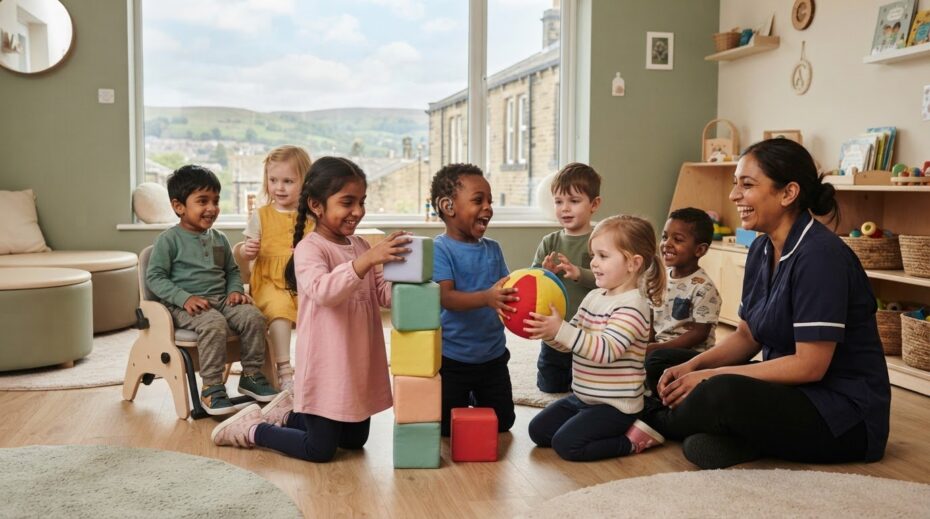
What if the best group game isn’t the one with the most equipment, but the one that gives every child a reason to join in? Finding group play activities for preschoolers that hold attention can be tricky when children have different confidence levels, abilities and ideas about sharing. A simple game with a clear shared goal can make listening, taking turns and cooperating part of the fun.
You don’t need an elaborate setup to create a purposeful play session. Choose an activity based on what children can practise together, then adapt the rules, space or materials to suit the group. You might slow down a movement game, offer a quieter child a choice of roles or let children use their imagination instead of equipment. These small adjustments can make it easier for more children to take part.
This guide shares group games for practising communication, cooperation, movement and creativity, plus practical ways to manage turn-taking and disagreements. Whether you’re playing indoors, outdoors or in a dedicated soft play area, you can prepare these ideas with minimal equipment and adapt them to your group.
Key Takeaways
- Choose group play activities for preschoolers by the social skill you want to practise, rather than by the equipment you have.
- Notice everyday learning moments, such as children listening to a partner, suggesting an idea or waiting for a turn.
- Match activities to the group’s energy and setting, with options for cooperation, movement, imagination and calm focus.
- Offer different ways to join the same game, then simplify or extend it to suit the children taking part.
- Use a simple planning routine: set a goal, check the space, prepare materials and reflect on how the activity went.
What makes group play activities for preschoolers work well?
Leading a group of young children can feel challenging. One child may be ready to race ahead, another may still be watching, and someone else may have a different idea for the game. Start by focusing on the shared experience, rather than expecting everyone to participate in exactly the same way.
Group play is an activity in which children interact around a common game or idea. They might pass a ball, add pieces to a shared construction or take roles in an imagined story. With thoughtful guidance, play gives children opportunities to practise communication, cooperation, movement and imagination. The goal is to offer a welcoming chance to join in, not to make every child respond in the same way.
Some children take part by talking or suggesting what happens next. Others may watch, copy an action, fetch materials or join for only part of the activity. When choosing a game, consider how children can participate, what the space allows and how much support the activity will need. The ideas below cover cooperation, movement, imagination and calmer focus.
How group play differs from playing alongside others
Children can play in the same space without playing together. For example, they might each build a separate tower with the same blocks. In shared play, their actions connect: they agree to build one structure, decide where pieces go and respond to one another’s ideas. Parten’s stages of play describes different forms of play, including cooperative play. These patterns aren’t a timetable. Children’s interactions can develop gradually and vary from one child or situation to another.
What to consider before choosing an activity
Choose a game that fits the children in front of you, not just one that sounds fun on paper. Think about their interests, how comfortable they are in a group, how they communicate and what kinds of movement suit them. Then check these practical details:
- Space: Is there room for the planned actions, with clear routes and no obvious obstacles?
- Group and time: Can everyone see and hear the instructions, and can the activity fit the time available?
- Materials: Do you have what you need, or can the game work without equipment?
- Ways to join: Can children watch first, take a smaller role or participate through a simple action?
Keep instructions short and show what to do where possible. A quick demonstration can make the first step clear, while flexible roles let children join at their own pace. Give the group one shared idea to focus on, then leave room for children to contribute.
What skills can preschoolers practise through group play?
Play gives children a reason to communicate and move without turning the moment into a test. The same activity may give one child a chance to suggest an idea, another a reason to listen, and someone else a comfortable way to watch before joining. These are opportunities to practise, not outcomes that will look the same for every child.
Shared play turns everyday moments into chances to practise social skills. The National Association for the Education of Young Children explains how playful learning can combine children’s own ideas with thoughtful adult guidance in The Power of Playful Learning. Set a simple purpose, then give children room to shape what happens.
Cooperation, communication, and taking turns
A shared goal gives children reasons to ask, listen, suggest and respond. For example, children building one pretend bridge can decide where pieces go, notice when a friend needs a turn and negotiate what to add next. A passing game offers another clear prompt: watch for the object, pass it on and wait for it to come around again.
Model useful language without making every decision for the children. Try prompts such as, “Who could have a turn next?” or “What do you think we should add?” Then pause to give them space to answer, make choices and work through small differences with your support nearby.
Imagination, movement, and sensory exploration
Imaginative play invites children to create a shared story. Offer a starting point, such as a journey through a forest or a visit to a make-believe café, and let the group decide who or what appears. Children can practise expressing ideas, listening to others and building on a story together.
Movement games make communication physical and playful. Invite children to copy an animal’s walk, invent an action for everyone to try or take turns leading a follow-the-movement game. Children can join by copying, creating, leading or watching first. Choose movements that suit the space and the group.
Sensory materials can offer another way to explore, but they’re optional. Children might describe how a material feels, sort objects by texture or take turns choosing what to investigate. If you’re considering equipment for a defined play area, soft play mats and equipment may support active group sessions. Choose options that suit your setting and intended use. Group play activities for preschoolers can work just as well with imagination, movement and everyday materials.
Which group play activities suit different preschool groups?
The best activity depends on what you want children to do together: cooperate, move, imagine or focus on a quieter task. Group play activities for preschoolers don’t need specialist equipment. Everyday materials may be enough, while soft play mats are an optional way to mark out a movement area when suitable.
Use age ranges only as a rough guide. Children’s interests, familiarity with a game and the support they need can matter just as much. Watch how the group responds, then adjust the activity as you go.
Choose an activity that fits your space, with clear room for the actions children will make.
| Activity | Materials | Group arrangement | Easy adaptation |
|---|---|---|---|
| Group mural | Large paper and crayons | Children add to one shared picture | Offer a choice of colours or let a child dictate an idea |
| Action-copying game | None; optional soft play mat to mark an area | Stand or sit in a circle | Use smaller movements or invite a child to lead |
| Shared story circle | None; optional familiar object as a story prompt | Take turns adding a sentence or idea | Let children contribute a sound, gesture or picture instead |
| Picture puzzle together | A suitable puzzle | Work around one shared puzzle | Use fewer pieces or invite children to take turns finding pieces |
| Passing rhythm | A soft, easy-to-hold object | Pass the object around the group to a steady beat | Slow the beat, pass to a neighbour or participate by making the rhythm |
Cooperative and imaginative group games
For a group mural, place the paper where everyone can reach and invite children to add something to a shared scene. Begin with an open prompt such as, “What could be happening here?” In a shared story circle, each child can add an idea, sound or gesture. The group can decide when the story is finished. Let children shape the result instead of steering them towards one answer.
A team-built structure can use everyday blocks or boxes. Invite children to decide what to make, then contribute pieces or ideas. When they’re done, look at the creation together or choose a name for it.
Movement and calm-focus activities
In an action-copying game, one child invents a movement for the others to copy, then another child leads. For a quieter change of pace, try collaborative drawing or the shared picture puzzle in the table. Match movement to the available room, keep routes clear and reduce waiting by letting children join, watch or take a helper role. Guidance on inclusive small-group activities also highlights adapting the environment, materials and support so children have different ways to take part.
How can you lead group activities when children have different needs?
A well-led activity doesn’t require every child to do the same thing at the same time. One child might speak up, another might point to a choice, and someone else may watch before joining. For group play activities for preschoolers, plan a shared goal and offer several comfortable ways to take part.
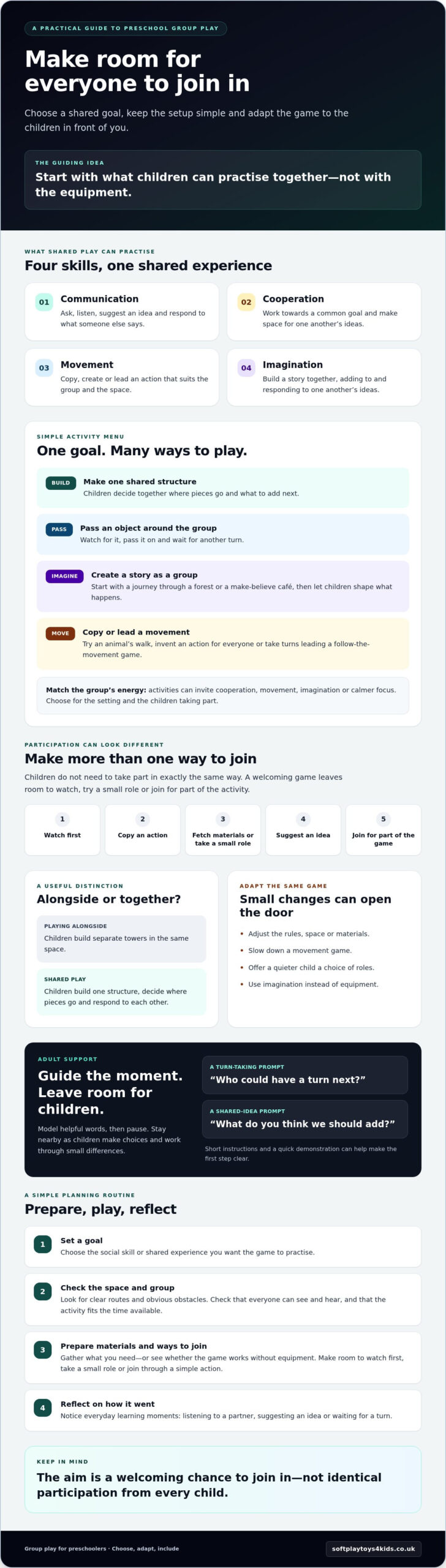
Try this simple sequence:
- Prepare the space: Clear obstacles, set out only the materials you need and make sure children can see and reach them.
- Explain simply: Give one or two short instructions, then show what the activity might look like.
- Invite participation: Offer a choice of roles rather than expecting everyone to join immediately.
- Adapt as you go: Change the pace, materials or arrangement if the group needs a different approach.
Stay close enough to supervise in a way that suits the activity, the children and your setting. Make boundaries clear, especially around movement, shared materials and where the game takes place. Follow your setting’s guidance for supervision and safe use of equipment.
Make activities accessible without singling children out
Build choice into the game for everyone. Children might sit or stand, speak or gesture, take a small role or observe before joining. Pair a short spoken explanation with a demonstration, such as showing how to pass an object or add a piece to a shared picture. Adjust the materials, pace or group arrangement to suit the children present without making one child feel singled out.
A child who prefers watching can still be included. You might say, “You can join when you’re ready,” then offer a simple role, such as choosing the next colour or pointing to whose turn comes next.
Help children share space and handle disagreements
Before starting, agree on a few simple expectations: take turns, use materials gently and stop when the leader signals the game has ended. If children disagree, acknowledge both ideas and model useful words: “Can I have a turn next?”, “Would you like to use this?” or “What could we try together?” Give them time to respond instead of deciding every detail for them.
If attention starts to fade, treat it as useful information. Shorten the game, change who leads or move to a quieter option. Keep your tone calm and make the next step clear. Small adjustments can help children stay engaged without turning play into a struggle.
For a nursery, school or playgroup planning a defined play area, soft play options for your setting can help you consider which mats or equipment suit the activities and space you have in mind.
How can you plan group play activities for preschoolers in your setting?
A simple routine helps you plan a purposeful session without overcomplicating it. Choose one focus, check the space, prepare what you need and reflect on how the group responded. Use the same steps at home, in a nursery or in a playgroup, and adapt the activity as children’s interests and needs change.
A simple plan for a group play session
Start with one goal linked to what the children enjoy. If they’re keen on animals, try a movement game where they take turns choosing an animal action for others to copy. Decide whether you want to encourage turn-taking, shared movement or imaginative ideas, but keep the play enjoyable rather than treating it as a test.
- Choose a focus: Pick one social or movement experience to shape the activity.
- Check the space: Make sure there’s room for the planned actions and that children can gather comfortably.
- Prepare: Set out accessible materials, explain how to begin and leave the ending flexible.
- Reflect: Notice what held children’s interest, who joined in and what you might change next time.
Adjust the challenge without changing the shared idea. For the animal-action game, children can start by copying one simple movement. A group familiar with the game might invent a sequence or take turns leading. If attention fades, finish with one last action rather than pushing through a fixed set of turns. Changing the pace, instructions or roles can help group play activities for preschoolers suit different groups.
When soft play equipment can support shared play
Equipment can provide a setting for imaginative or movement-based games, but it isn’t needed for every activity. A soft play mat might define a space for a sitting story circle or mark the starting area for a movement game, if it suits the room and intended use. Before adding equipment, consider the available space, how the activity will be supervised and who will use the area. Follow relevant guidance for your setting.
If you’re planning a larger play environment, the UK indoor playground equipment guide can help you explore considerations for that kind of project. SoftplayToys4kids offers design and installation support for larger soft play projects, with the setup planned around the needs of the setting. To explore suitable soft play options, review the available mats and equipment and consider what fits your space and planned activities.
Make your next group play session count
The best group play activities for preschoolers start with a simple goal, not a pile of equipment. Decide whether you want to invite cooperation, communication, movement or imagination, then adapt the game to the children, space and materials you have. A shared activity can offer different ways to join in, from leading or contributing an idea to watching before taking part.
Keep the plan flexible. Notice what captures the group’s interest, make room for children’s ideas and adjust the next session based on what you observe. Thoughtful choices can help play feel more welcoming and enjoyable for everyone.
SoftplayToys4kids is a UK manufacturer based in West Yorkshire, serving families, schools, nurseries and playgroups. For larger projects, the company offers design and installation support.
Start with one simple game, follow the children’s curiosity and enjoy seeing where their shared play takes them.
Frequently Asked Questions
What are some good group play activities for preschoolers?
Good group play activities for preschoolers include cooperative building, shared storytelling, action-copying, group drawing and simple passing games. Choose one that suits the children’s interests, the available space and the group’s energy. Show how to begin, keep the rules easy to follow and let children contribute in different ways. For a calmer alternative, offer drawing or another quiet shared task if the group needs a slower pace.
How do you encourage preschoolers to play together?
Give children a shared purpose, such as creating one large picture or building a structure together. Explain the idea simply, then model phrases such as “Can I have a turn?” or “Would you like to add this?” Avoid expecting everyone to participate in the same way. A child might watch first, contribute briefly or need support from an adult to feel comfortable joining the activity.
Can group play activities work for children with different abilities?
Yes, group activities can be adapted by offering flexible roles and different ways to join. A child might lead, pass materials, make a choice, observe or take part in the main action. Use clear instructions and adjust the pace, space and materials to suit the children present. Ask families or colleagues about relevant needs, and follow the guidance that applies in your setting.
How long should a group activity last for preschoolers?
There’s no single duration that suits every preschool group. Children’s interest, familiarity with the game, the time of day and the activity itself can all affect how long they want to continue. Plan a manageable activity, then watch how the group responds. If children become restless or lose interest, finish, shorten the game or change direction. There’s no need to stretch play after the group has moved on.
What happens if a preschooler doesn’t want to join a group game?
Offer a welcoming choice without pressuring the child. They could watch, help prepare materials, join with one friend or take a small role later. Explain what the group is doing and leave the invitation open. If a child often avoids a particular activity, consider whether its noise, movement, social demands or instructions could be adjusted. Discuss relevant observations with the child’s family or colleagues.
Do group play activities for preschoolers need special equipment?
No, many group play activities for preschoolers need only conversation, movement, imagination or everyday materials such as paper and blocks. Soft play equipment may suit some movement games or help define a play area, but it’s optional. Choose materials that fit the children, available space and supervision. If you’re planning a larger play area, first consider the setting’s needs and whether equipment would support the activities you want to offer.
Planning a soft play area for your home, school, nursery or playgroup? Explore SoftplayToys4kids’ soft play equipment, including mats and ball pits, and consider what suits your space and activities.
Leave a Reply