Affordable Gymnastics Mats for Home Practice
The cheapest gymnastics mat isn’t automatically the best value. A folding mat on the UK market has 6 cm of cushioning, but the right affordable choice depends on the space you have and the kind of practice it needs to support.
It makes sense to look for a mat that fits your budget, especially for home practice. But cushioning, dimensions and thickness all affect how a mat feels and where it can be used. Choosing gymnastics mats for home use means weighing these practical details, not judging value by price alone.
This guide explains how cushioning and size relate to different home practice needs, what to consider for safety, and how foam and cover materials affect comfort and care. You’ll have a clearer way to compare options and choose a mat that suits your space, routine and budget.
Key Takeaways
- Match cushioning to the movements and landings planned, rather than choosing a mat by price or thickness alone.
- Measure your practice space and consider how the mat’s dimensions affect storage and room to move.
- Make safety part of your choice by considering the practice area, mat placement and the type of activity.
- Compare foam and cover materials to find a balance of comfort, durability and ease of care.
Bounce and landing cushioning
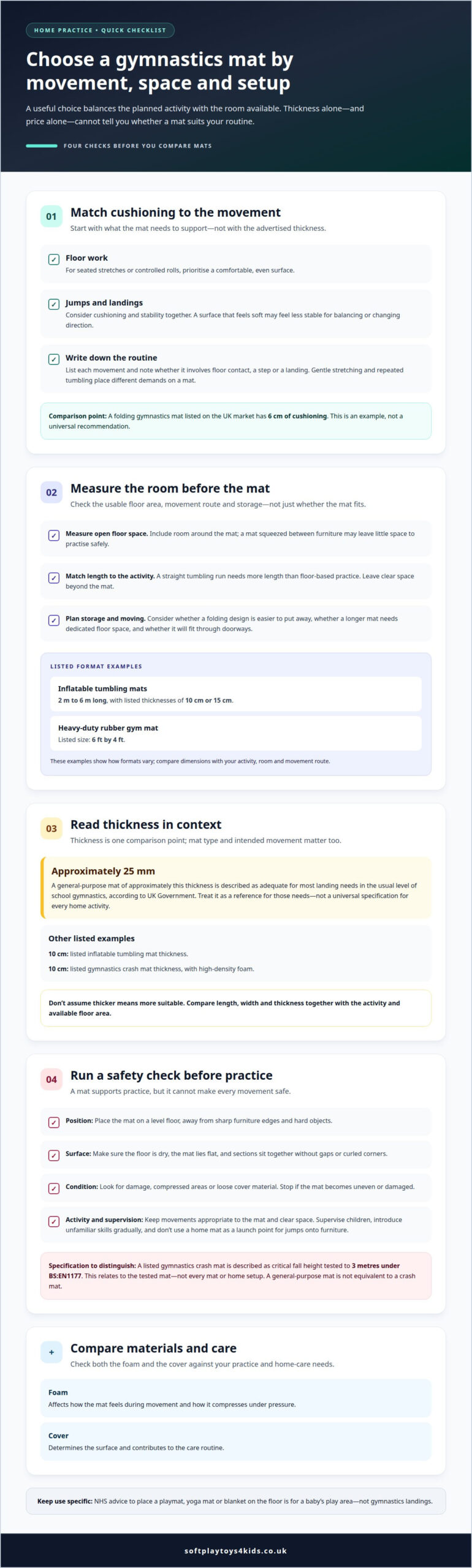
Think about the movement first: a controlled stretch, a seated roll and a landing place different demands on a mat. Cushioning compresses under the body, so its feel matters as much as its advertised thickness. A folding gymnastics mat listed on the UK market has 6 cm of cushioning. That gives you a concrete comparison point, not a universal recommendation for every home routine or gymnast.
For landings, consider how the surface responds under your weight. A mat that feels comfortable for floor-based movement may feel different during repeated jumps. Conversely, a softer surface can feel less stable when balancing or changing direction. Match the cushioning to the planned activity, and ensure the mat lies flat on a fully supporting floor before practice.
Use a simple activity check before choosing: list the movements the mat will support, then consider whether each involves floor contact, a step or a landing. Gentle stretching, for example, has different demands from repeated tumbling. This helps you focus on the cushioning you need instead of paying for thickness or bounce that doesn’t suit your routine.
- Floor work: For seated stretches or controlled rolls, prioritise a comfortable, even surface.
- Landing practice: Consider cushioning and stability together, rather than treating softness as the only measure.
- Shared family space: Decide whether the mat will be used for gymnastics or another activity; those needs may differ.
For a baby’s play space at home, the NHS advises placing a playmat, yoga mat or blanket on the floor. This guidance is for a baby’s play area, not for gymnastics landings. Keep the intended use clear when comparing surfaces. Start with the activity, then consider cushioning and how the mat fits your available floor space.
Home gymnastics mat dimensions and thickness
Measure your clear floor area first, then compare it with the movements you plan to practise. Choosing gymnastics mats for home use means balancing usable practice space with storage and thickness.
Mat Dimensions
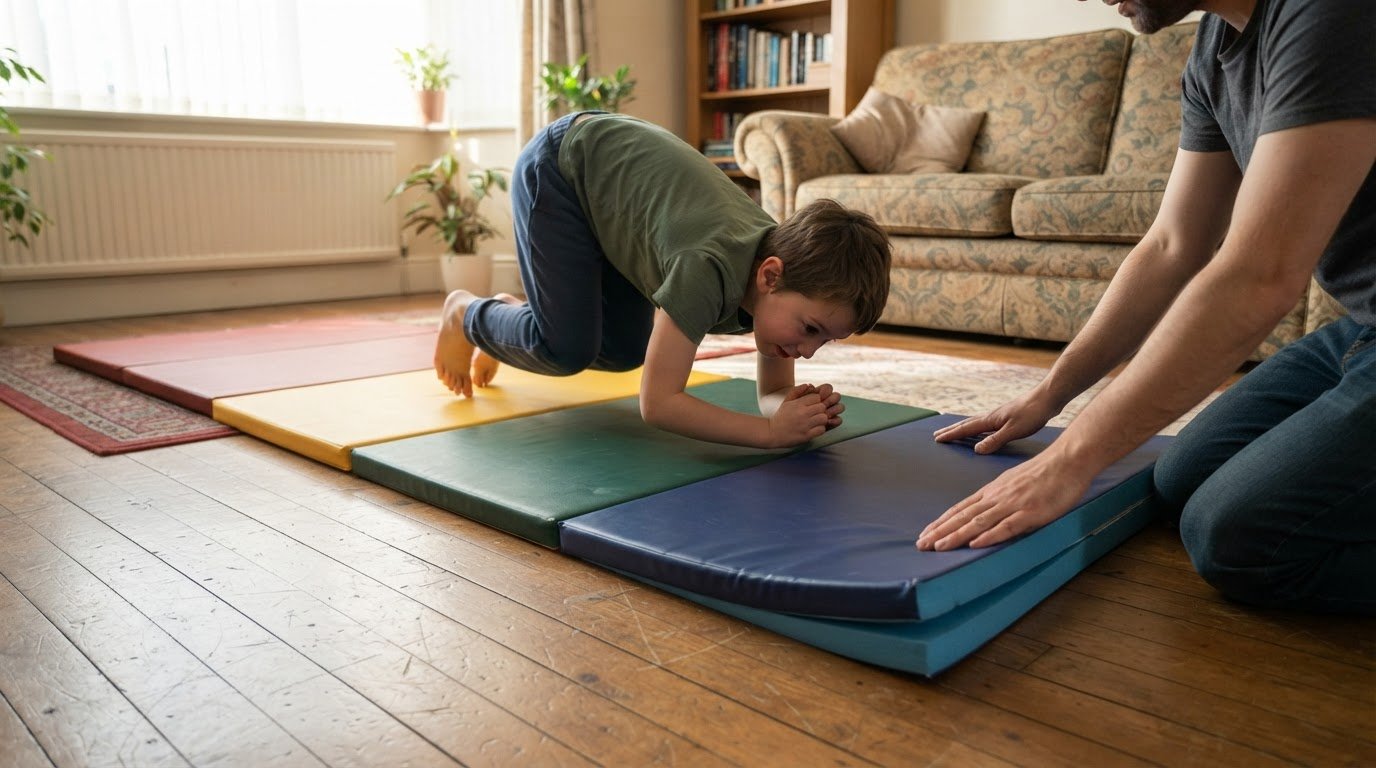
Measure the open floor, including space around the mat for movement. A mat squeezed between furniture may fit but leave little room to practise safely. Consider storage too: a folding design may be easier to put away, while a longer format may need dedicated floor space. Check doorways if you’ll move the mat between rooms.
Listed inflatable tumbling mats range from 2 m to 6 m long, with thicknesses of 10 cm or 15 cm. A listed heavy-duty rubber gym mat measures 6 ft by 4 ft. These examples show how formats can vary. Match the mat’s length and width to the activity, the room and the route needed for movement.
When choosing gymnastics mats for home use, assess the usable area rather than picking the largest option that fits. A straight tumbling run needs more length than floor-based practice. Leave clear space beyond the mat, and check whether its edges would be close to furniture or other obstacles.
Mat Thickness
Thickness describes depth, but not the whole feel or purpose of a mat. A general-purpose mat of approximately 25 mm thickness is adequate for most landing needs in the usual level of school gymnastics, according to UK Government. Use this as a reference for those general landing needs, not as a universal specification for every home activity.
Other listed formats differ. An inflatable tumbling mat is available at 10 cm thickness, while a listed gymnastics crash mat for home use has 10 cm-thick high-density foam. Those examples illustrate why thickness should be considered alongside mat type and intended movement. Don’t assume that thicker automatically means more suitable for every exercise.
Before choosing, note the planned movements, available floor area and storage needs. Then compare length, width and thickness together. A 6 ft by 4 ft rubber mat has a different footprint from a long inflatable mat, so the right fit depends on your home setup and practice routine.
Safety considerations for home practice
Clear the practice area before each session. Move furniture, toys and other hard objects away from the mat’s edges. Check that the floor is dry and the mat lies flat, without curled corners or gaps. A mat beside a table, for example, leaves a collision hazard even if its surface feels cushioned. Make sure the space suits the movement, not just the mat’s footprint.
Match the mat to the activity and the height of any potential fall. A listed gymnastics crash mat is described as critical fall height tested to 3 metres under BS:EN1177. That specification relates to the tested mat, not every mat or every home setup. Read product descriptions carefully, and don’t treat a general-purpose mat as equivalent to a crash mat.
Before practice, use this quick setup check:
- Position: Place the mat on a level floor, away from sharp furniture edges.
- Surface: Smooth out folds and check that sections sit together without gaps.
- Condition: Look for damage, compressed areas or loose cover material before use.
- Activity: Keep movements appropriate to the mat and the available clear space.
Supervision matters, especially when children are practising unfamiliar movements. Stay close enough to respond, and introduce skills gradually rather than encouraging attempts beyond their current ability. A mat can support practice, but it cannot replace suitable instruction or make every movement safe. For example, don’t use a home mat as a launch point for jumps onto furniture.
Recheck the setup if the mat shifts or the practice changes. A longer tumbling sequence needs a clear route, while a small floor exercise needs room around the body. Stop if the mat becomes uneven or damaged. These checks help keep the practice space organised and make it easier to spot when an activity no longer suits the setup.
Foam and cover materials
Foam affects how a mat feels during movement, while the cover determines its surface and care routine. Compare both materials with your planned practice and home cleaning needs.
Foam Materials
Foam construction affects how a mat compresses under pressure and recovers afterwards. Check the product description for the foam type and intended use instead of relying on thickness alone. For example, a listed gymnastics crash mat uses high-density foam. This describes its filling, but doesn’t establish that it suits every movement or home routine.
Consider how the mat will be used. A surface for floor exercises may feel different from one used for repeated landings. Compare the foam description with the mat’s format and intended activity. This helps you judge whether the material suits your practice without assuming that one foam type works best for every gymnast.
Cover Materials
The cover affects the surface you practise on and the effort needed to keep it clean. A listed Exercise Mat is 50 mm thick and has a PU leather cover. Use those details as a specific example, not a claim that every mat uses the same material. Check how the cover feels and whether its care instructions fit your household routine.
A listed Home Practice Mat cover can be machine washed on a gentle cycle and air dried. This gives households a clear care process when regular cleaning matters. Follow the cover’s own instructions, as washing methods can vary between materials. After cleaning, let the cover air dry as directed before using the mat again.
Compare material details in this order: foam type, cover material, then care instructions. For example, a mat with a PU leather cover has different stated surface details from one with a machine-washable cover. Prioritise the feature that matters most at home, whether that’s the feel underfoot or an easy cleaning routine.
- Foam: Read the filling description and consider the planned movements.
- Cover: Note the material and surface feel.
- Care: Follow stated washing and drying instructions.
For padding around exposed pillars near a practice area, explore column padding options.
SoftplayToys4kids
SoftplayToys4kids helps families create engaging play spaces with soft play equipment and sensory toys. After comparing mat cushioning, size, safety and materials, consider how the wider home play area will work too. Sensory toys can complement children’s play, while lamp post protectors address a separate padding need around exposed posts.
Think about the space, the activities and the equipment that will share it. This keeps your mat choice connected to a practical home setup, rather than treating it as an isolated purchase. SoftplayToys4kids supplies children’s play equipment for home use, so you can explore options that fit your family’s play environment.
Contact SoftplayToys4kids to discuss your home play needs.
Make room for confident home practice
Choosing gymnastics mats for home use gives you a chance to shape a play space around your family’s routines, not just one activity. Think about where practice will happen, how the area will be used between sessions, and what might make it inviting for children. A clear plan can help create a space that’s easy to return to, whether you bring out the mat for practice or store it away afterwards.
SoftplayToys4kids also offers Soft Play Ball Pits, Soft Play Mats and Sensory Toys, giving families options to consider for a broader play environment. Keep your priorities in view and choose what suits your home, rather than adding equipment without a purpose.
Ready to discuss what could work for your family? Contact SoftplayToys4kids for mat advice, and take the next step towards a home practice space that encourages happy movement.
Frequently Asked Questions
What are the best home gymnastics tumbling mats for cheap?
The best affordable choice is a mat that suits your practice, not simply the lowest-priced option. For gymnastics mats for home use, compare folding mats with longer tumbling formats and consider how much floor space each needs. A compact mat may suit floor exercises and easier storage, while a longer format may better suit travelling movements. Check the intended use before deciding.
What style of flooring is best for practising gymnastics at home?
A level, firm, uncluttered floor is the most practical base for home gymnastics. Place a suitable exercise mat on it rather than practising directly on hard flooring or soft, uneven carpet. Clear furniture and toys from the practice area. For example, a living-room setup should leave open floor beyond the mat, not end beside a coffee table or shelving.
What types of gymnastics mats are suitable for home use?
Folding mats, inflatable tumbling mats, rubber gym mats, crash mats and exercise mats serve different purposes. A folding mat can suit floor exercises and convenient storage; an inflatable mat provides a longer practice surface. Rubber gym mats offer another format, while crash mats are intended for a different landing purpose. Choose according to the movement, available room and storage plan.
How thick should a home gymnastics mat be for tumbling and floor exercises?
According to UK Government, a general-purpose mat of approximately 25 mm thickness is adequate for most landing needs in the usual level of school gymnastics. Tumbling and floor exercises can call for different surface characteristics, so consider the activity and mat type together. Thickness alone doesn’t explain how a mat feels or whether it suits your routine. Choose with the planned movements in mind.
What size gymnastics mat is best for a home gym?
The right size leaves room for the planned movement and a clear area around the mat. Measure the available floor along the direction of travel, including space beyond the mat’s edges. For gymnastics mats for home use, consider whether you’ll store the mat between sessions and move it through doorways. A compact rectangle may suit floor practice; tumbling needs more length.
How much do gymnastics mats cost in the UK?
On the UK market, folding gymnastics mats typically range from £45 to £117, with a median of about £92, based on a market snapshot collected on 18 November 2026. Compare similar formats and dimensions, since a folding mat differs from a tumbling or crash mat. Consider intended use and available space alongside the price to assess whether an option suits your home practice.