Soft Play Versus Bouncy Castles: Which Fits Best?
A bouncy castle can turn a birthday party into an instant event, but it is not always the best answer for everyday play. When comparing soft play versus bouncy castles, the right choice comes down to more than excitement. Age range, available space, supervision, weather, storage and the kind of play children need all matter.
For parents, nurseries and commercial venues, soft play often delivers more flexible, repeat-use value. Bouncy castles have their place, particularly for short celebrations and high-energy outdoor fun. The best option is the one that keeps children active, safe and engaged without creating a headache every time it is used.
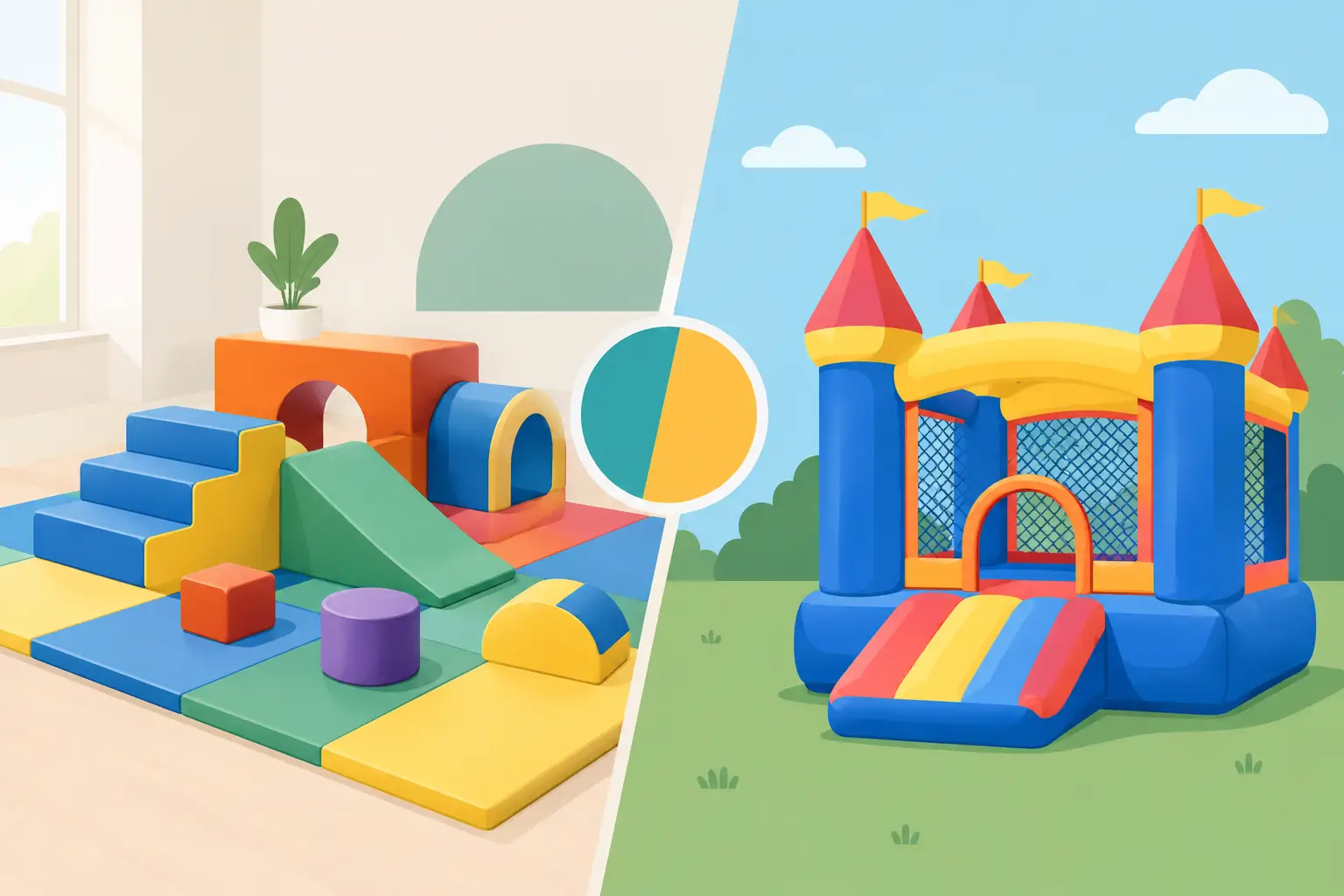
Soft Play Versus Bouncy Castles: The Main Difference
Soft play is designed for children to climb, crawl, balance, build and explore at their own pace. It can include foam shapes, ball pits, steps, ramps, tunnels, balance beams, activity sets and safety mats. Pieces can be arranged to suit a child’s age, a room’s layout or a nursery’s planned activity.
A bouncy castle is usually a single inflatable attraction. Children jump, bounce and tumble inside an enclosed area, powered by a continuous blower. It creates immediate excitement, especially at parties, but offers less variety in how children play.
That difference matters. Soft play encourages both energetic movement and imaginative play. A toddler may crawl through a tunnel, use foam blocks as a pretend shop, then practise stepping over a balance beam. Older children can make obstacle courses, dens or games with clear rules. A bouncy castle is all about bouncing – great fun, but more limited.
Which Is Better for Babies and Toddlers?
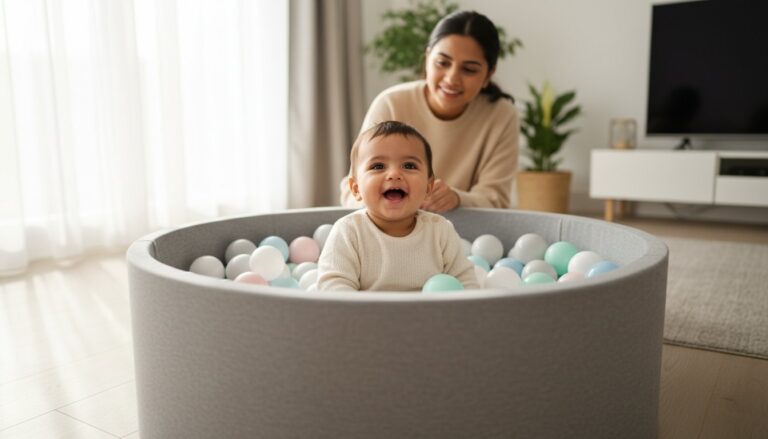
For babies and younger toddlers, soft play is normally the stronger choice. Purpose-made foam equipment gives little ones a padded environment for supervised movement, from early crawling to climbing and cruising. Low-level shapes, soft mats and ball pits let children build confidence without being overwhelmed by bigger, faster children.
Bouncy castles can be unsuitable for very young children when they are sharing with older or more boisterous jumpers. Even where age-separated sessions are offered, the bouncing surface can make balance difficult for children still finding their feet. The risk is not just falling over. Collisions are common when several children bounce at once.
That does not mean every inflatable is off limits. Smaller toddler inflatables with suitable supervision can work well for an occasional treat. However, if you are buying equipment for regular use at home, in a baby room or in a nursery, soft play gives younger children far more opportunities to learn through movement.
A Better Fit for Mixed Age Groups
Soft play also makes it easier to create zones. Babies can use a padded mat and simple sensory shapes while toddlers tackle a small step-and-slide unit nearby. In a nursery or playgroup, this makes supervision more manageable and helps prevent confident climbers from taking over the entire play area.
With a bouncy castle, children are generally using the same space in the same way. That can be difficult at a busy party or commercial venue where ages, sizes and confidence levels vary widely.
Space, Storage and Everyday Use
Before choosing either option, measure your space properly. A bouncy castle needs room not only for the inflatable itself but also for safe access, the blower, anchoring where required and clear space around it. Outdoor use depends heavily on weather, ground conditions and wind. It may look simple in a product photograph, but setup is not always practical in a typical garden.
Indoor use can be even more restrictive. Ceiling height is often the deciding factor, and a large inflatable may be too tall for a living room, community hall or nursery room. Noise from the blower is another consideration, especially for longer sessions.
Soft play is easier to tailor. A compact home setup might use a folding mat, a few climbing shapes and a small ball pit. A larger room can take modular blocks, a slide, steps and balancing equipment. When you need the floor for another activity, individual pieces can be stacked, moved or stored far more easily than a full inflatable.
For commercial buyers, bespoke sizing makes a real difference. An awkward corner, a narrow room or an unused section of a reception area can become a valuable activity zone with equipment made to fit. Softplay Toys4Kids manufactures in the UK and can help create practical soft play layouts rather than forcing a standard inflatable into a space that does not suit it.
Safety: It Is About Setup as Well as Equipment
Both soft play and bouncy castles need adult supervision. Neither should be treated as a way to leave children to play unsupervised. The key difference is the type of risk you are managing.
With soft play, safety comes from choosing age-appropriate equipment, placing it on a suitable surface, keeping play areas clean and arranging pieces securely. Padded foam, wipe-clean covers and well-designed shapes help create a controlled environment for climbing and active play. Safety mats and padded protection can be added around walls, posts or harder edges in commercial settings.
Bouncy castles require careful attention to capacity, user height, weather, anchoring and operation. Children should not be allowed to perform flips, pile on top of each other or mix dramatically different ages and sizes. Wind can quickly change an outdoor setup from acceptable to unsafe, so operators and parents need to follow the supplier’s guidance without compromise.
For nurseries, schools and venues, soft play is usually easier to build into a daily risk-assessed routine. Staff can change the layout, reduce the challenge level for younger children and remove individual pieces if needed. It is a more controlled form of active play.
Developmental Value Beyond Burning Off Energy
Children absolutely need opportunities to jump, run and let off steam. Bouncy castles deliver that in abundance. For a one-off celebration, the laughter and high-energy excitement can be worth every bit of effort.
Yet regular play should offer more than a big burst of energy. Soft play supports gross motor development through climbing, reaching, crawling, rolling, balancing and negotiating different levels. It also supports decision-making. Children work out how to get over a shape, where to place a foam block or how to create a route across the room.
The open-ended nature of soft play is a major advantage. The same equipment can become an obstacle course one day, a castle the next and a colour-sorting activity after that. For early years settings, this creates more value from the same purchase and gives practitioners plenty of ways to refresh the environment without buying a new attraction.
Cost: Buy for Frequency, Not Just the First Day
A bouncy castle can seem like the obvious value choice if the goal is a memorable birthday. For occasional use, hiring one may make more sense than buying, storing and maintaining it. Owners also need to consider electricity, cleaning, repairs, safe storage and whether the castle will realistically be used enough to justify its footprint.
Soft play can be built up gradually. Parents might start with a mat and a small set of shapes, then add a ball pit, slide or balance equipment as their child grows. Nurseries can begin with a core activity area and expand it over time. This makes budgeting much more manageable.
Durability matters too. Well-made, wipe-clean soft play equipment is intended for regular handling, climbing and cleaning. Cheap foam that loses its shape or covers that split quickly are false economies, particularly in busy childcare settings. Compare materials, stitching, foam quality, dimensions and the supplier’s support before making a decision.
When a Bouncy Castle Is the Right Choice
A bouncy castle is hard to beat for a larger birthday party, school fête or short outdoor event with enough room and suitable conditions. It creates a single focal point and gives children an obvious place to burn energy. If the guest list is mostly similar-aged children and there is capable supervision, it can be a brilliant addition.
Choose soft play when you need equipment that works indoors, suits a broader age range, supports everyday development or fits a specific space. It is especially practical for homes with toddlers, nurseries, preschools, playgroups, waiting areas and commercial soft play environments.
The strongest play spaces are not always the loudest ones. Give children safe, inviting equipment they can return to every day, change around and grow into, and the play value keeps building long after the party music has stopped.