
Soft Playground Equipment: The 2026 Guide to Safety, Design & Fun
Cheap imports might seem like a bargain, but when it comes to soft playground equipment, cutting corners on quality can mean cutting corners on safety. If you’ve ever stood in a play space wondering whether the foam is truly fire-retardant, whether the stitching will hold up to hundreds of excited children, or whether that budget ball pit actually meets UK safety standards, you’re not alone.
Finding equipment that genuinely ticks every box is a real challenge. Parents want a space where children can tumble, bounce, and explore without risk. Schools and nurseries need solutions that comply with UK regulations, survive daily use, and fit rooms that were never designed with play in mind. And everyone wants to avoid the frustration of cheap, poorly made products that look tired within months.
This guide has you covered. Whether you’re kitting out a family home, a nursery, or a commercial soft play centre, you’ll discover exactly how to choose, design, and maintain soft playground equipment that’s safe, durable, and built to last. From understanding UK safety standards to exploring bespoke design options for awkward spaces, here’s everything you need to make a confident, informed decision in 2026.
Key Takeaways
- Not all soft playground equipment is created equal — understanding the difference between residential and commercial grades could be the deciding factor between a safe, lasting investment and a costly mistake.
- UK safety standards like BS EN 1176 and BS EN 1177 set the benchmark for compliant play spaces in 2026, and knowing what to look for on a product specification sheet puts you in control.
- Smart space design — from ceiling height to toddler zoning — can transform even the most awkward room into an engaging, age-appropriate play environment.
- A simple daily, weekly, and monthly cleaning routine is all it takes to keep PVC soft play surfaces hygienic, vibrant, and safe for years of heavy use.
- Choosing a UK manufacturer with a bespoke design service means your equipment is built to fit your exact space, your budget, and the safety standards that matter most.
Understanding Soft Playground Equipment: More Than Just Soft Play
Ask most people to picture a soft play area and they’ll conjure up a chaotic ball pit in a leisure centre. The reality is far more sophisticated. Soft playground equipment is a category of engineered, foam-based apparatus specifically designed to support active, exploratory play in a controlled and cushioned environment. It’s not simply padding thrown over a frame. Every component, from the foam core to the outer cover, is selected to absorb impact, resist wear, and keep children safe during the kind of full-body play that genuinely supports their development.
The shift away from traditional hard-plastic outdoor playgrounds towards indoor soft environments has been significant. Nurseries, schools, and commercial play centres have increasingly recognised that soft play spaces can operate year-round, serve younger age groups, and dramatically reduce the severity of bumps and falls. For parents kitting out a playroom at home, the same logic applies: a purpose-built soft environment gives children the freedom to move energetically without the hard edges and unforgiving surfaces of conventional play equipment.
The Anatomy of Quality Soft Play Apparatus
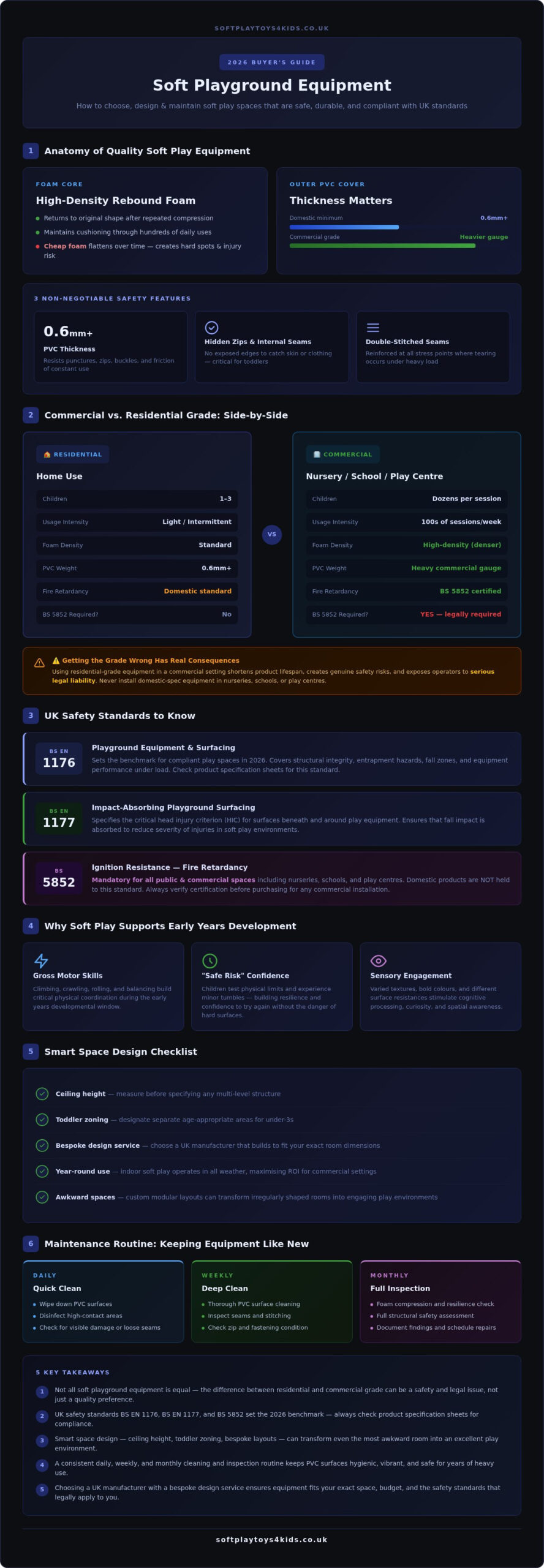
Not all foam is equal, and that distinction matters enormously over the lifetime of a product. Quality soft playground equipment uses high-density “rebound” foam that returns to its original shape after repeated compression. Cheaper alternatives flatten over time, losing their cushioning properties and creating hard spots that increase injury risk. The foam grade used in commercial settings is typically denser than domestic variants, engineered to withstand hundreds of uses daily without degrading.
The outer PVC cover is equally critical. Thicker PVC resists punctures from zips, buckles, and the sheer friction of constant use, and it’s far easier to disinfect thoroughly between sessions. Look for:
- PVC thickness of at least 0.6mm for domestic use, and heavier gauges for commercial environments
- Hidden zips and internal seams, which eliminate exposed edges that could catch skin or clothing
- Double-stitched reinforced seams at stress points, where tearing is most likely under heavy load
These aren’t cosmetic details. Hidden zips and recessed fastenings are a meaningful safety feature, particularly for toddlers who explore surfaces with their hands and mouths.
Why Soft Play is Essential for Early Years Development
There’s genuine developmental science behind the appeal of soft play. Climbing, crawling, rolling, and balancing all build gross motor skills during the critical early years window. A soft environment introduces what child development specialists call “safe risk”: children test their physical limits, experience minor tumbles, and build the confidence to try again, all without the consequences of a hard fall.
Sensory engagement matters too. Varied textures, bold colours, and different surface resistances stimulate cognitive processing in young children, encouraging curiosity and spatial awareness. It’s play, yes, but it’s also learning in its most natural form.
Commercial vs. Residential Soft Play: Choosing the Right Grade
Here’s a question worth asking before you spend a penny: how many children will actually use this equipment, and how often? That single consideration determines almost everything else, from the foam density you need to the fire retardancy standard that legally applies to your space. Getting the grade wrong doesn’t just shorten the lifespan of your investment; it can create genuine safety risks and, in commercial settings, expose you to serious liability.
The fundamental split is straightforward. Residential soft playground equipment is engineered for light, intermittent use, typically one to three children in a home environment. Commercial-grade equipment is built for relentless daily punishment, sometimes hundreds of sessions per week across dozens of children. The foam, the PVC weight, the seam construction, and the fire-retardancy certification all differ accordingly.
Fire retardancy is where the regulatory gap is most significant. Equipment installed in any public or commercial space in the UK, including nurseries, schools, and play centres, must meet BS 5852 ignition resistance standards. Domestic products aren’t held to the same requirement, which is why you should never repurpose home-use equipment in a commercial setting, regardless of how robust it looks.
A practical framework for choosing the right grade:
- 1-3 children, home use only: Residential grade, standard foam density, modular and foldable options are ideal
- 4-15 children, nursery or small school setting: Light commercial grade, BS 5852 compliant, reinforced seams at key stress points
- 15+ children, high-footfall commercial venue: Full commercial grade, heavy-gauge PVC, reinforced traffic areas, column padding and safety pads throughout
Residential Equipment: Creating the Perfect Home Playroom
For parents, the priority is usually space efficiency without sacrificing the fun factor. Modular soft play items like soft play ball pits are a brilliant starting point because they’re self-contained, easy to relocate, and genuinely loved by toddlers and young children alike. Foldable play mats and stackable foam blocks solve the storage problem neatly, folding away when the living room needs to serve its other purpose. For a deeper dive into choosing the right combination of items for your home, The Ultimate Guide to Buying Soft Play Equipment is an excellent resource that covers sizing, materials, and age-appropriate choices in detail.
Commercial Grade Solutions for Schools and Nurseries
Schools and nurseries face a different challenge entirely. The requirements for indoor playground equipment in public sector settings go well beyond basic padding. High-traffic zones need reinforced coverage, and that includes structural elements that are often overlooked: column padding and lamp post protectors are essential in any space where children run freely near fixed architectural features. A child at full sprint doesn’t register a pillar until it’s too late.
For play centre operators, bespoke design isn’t a luxury; it’s a revenue decision. A layout engineered around your specific floor plan maximises usable play space, supports efficient supervision, and creates the kind of immersive environment that drives repeat visits. Handmade in West Yorkshire and supplied direct from the factory, the team at SoftplayToys4kids works with commercial clients to design installations that fit the space precisely, rather than forcing a standard kit into a room it wasn’t built for. If you’re planning a commercial installation, speak to the design team early in the process to get the most from your budget.
UK Safety Standards and Manufacturing Excellence
Standards exist for a reason. When a child launches themselves off a foam climbing block or tumbles headfirst into a ball pit, the difference between a bruise and a serious injury often comes down to whether the equipment beneath them was built to a verified specification. In 2026, the benchmarks that matter most for soft playground equipment in the UK are BS EN 1176 and BS EN 1177.
BS EN 1176 sets the structural and mechanical requirements for playground equipment, covering everything from load-bearing capacity to entrapment hazards. BS EN 1177 specifically addresses impact-absorbing surfacing, defining the critical fall height thresholds that flooring and matting must accommodate. Together, they form the compliance backbone for any commercial play environment. If a supplier can’t point you to test certification against these standards, that’s your answer.
Regular safety inspections aren’t optional for commercial operators; they’re a risk management essential. A documented inspection regime, ideally combining weekly visual checks with an annual third-party assessment, creates a paper trail that protects your business and, far more importantly, keeps children safe. Look for equipment that’s designed with inspection in mind: accessible seams, clearly labelled foam grades, and covers that can be removed and replaced without specialist tools.
The Bradford Factory Advantage: Handmade Quality
There’s a meaningful difference between soft play equipment assembled in a UK factory and products shipped from overseas with a compliance sticker applied at the border. SoftplayToys4kids manufactures directly from their West Yorkshire facility, using premium British foam and high-grade PVC sourced to specification. That direct-from-factory model means every unit is inspected before it leaves the building, not after it arrives in a container six weeks later. Quality control isn’t an afterthought; it’s built into the process at every stage, from foam cutting to final seam inspection. When you’re buying factory direct, you’re also cutting out the middleman markup, which means better materials for the same budget.
Installation Safety: Why Professional Setup Matters
A well-made product installed badly is still a hazard. Complex commercial structures, particularly those involving column padding, safety pads, and multi-zone layouts, require correct anchoring and precise fall zone coverage that DIY installation simply can’t guarantee. Professional installation teams understand how individual components interact under real play conditions: where impact loads concentrate, which fixings need redundancy, and how to configure layouts so supervision lines remain clear. That expertise translates directly into safer spaces and, for commercial operators, far greater confidence during health and safety audits.
Designing Your Soft Play Space for Maximum Engagement
Great soft play design isn’t accidental. The spaces that children return to again and again, the ones that feel instinctively safe yet genuinely exciting, are the result of deliberate planning before a single piece of foam is ordered. Whether you’re converting a spare bedroom or fitting out a commercial venue, the same principles apply: measure carefully, plan for flow, and design with the child in mind.
Start with a proper site assessment. Before browsing equipment, work through this checklist:
- Floor dimensions: Measure length and width at floor level, noting any alcoves, recesses, or irregular walls
- Ceiling height: Critical for any climbing structures; a minimum of 2.4m is recommended for most commercial soft playground equipment configurations
- Fixed obstructions: Mark the position of columns, radiators, fire exits, and electrical sockets
- Natural light and ventilation: Window placement affects both supervision sightlines and temperature management during busy sessions
- Floor surface: Identify whether the existing floor is suitable as a base or whether additional matting is needed throughout
That last point matters more than people expect. Baby play mats aren’t simply a nice-to-have for the youngest visitors; they’re the foundational safety layer for any play area. Laid across the entire floor before any other equipment is positioned, quality play mats cushion the inevitable tumbles that happen during free movement and create a consistent, hygienic surface that’s far easier to maintain than bare flooring.
Once your base layer is sorted, think about how children will actually move through the space. Good flow separates energy levels, not just age groups. A toddler crawling towards a sensory corner shouldn’t be in the path of an older child sprinting between climbing zones. Routing active play away from quieter exploration areas reduces collision risk and creates a calmer experience for younger children who can easily become overwhelmed. Sensory toys work brilliantly as anchor points for quieter zones; positioned at the perimeter of a layout, they draw children away from high-traffic areas and provide focused, calming engagement that balances the physical intensity of climbing and bouncing elsewhere in the room.
Themed Environments and Custom Branding
Colour and theme do real work in a well-designed play space. For schools, matching equipment colours to existing branding creates a cohesive, professional environment that feels intentional rather than assembled from a catalogue. For commercial venues, a strong theme, whether that’s a jungle canopy, an underwater world, or a space station, builds the kind of immersive atmosphere that children talk about and parents remember. The team at SoftplayToys4kids produces bespoke foam structures and custom PVC colour combinations from their West Yorkshire factory, meaning your space can be genuinely unique rather than a copy of every other soft play installation in the region. Custom shapes aren’t a premium add-on; they’re how you turn an awkward room into a destination.
Zoning for Safety: Toddlers vs. Juniors
Physical separation between age groups isn’t overprotective; it’s essential. Toddlers and juniors play at entirely different speeds and with very different spatial awareness. Low foam barriers or dedicated play mat zones create a visible boundary that older children instinctively respect and that gives parents of younger ones genuine peace of mind. For junior zones, balance boards and more challenging climbing configurations support the proprioceptive development that older children actively seek. Throughout both areas, safety pads and column padding eliminate the hard architectural points that cause the most serious contact injuries. Every pillar, wall edge, and structural protrusion in a busy play space should be treated as a hazard until it’s covered.
Ready to design a space that genuinely works for your children and your room? Talk to the SoftplayToys4kids design team and get a bespoke layout built around your exact measurements and age range.
Maintenance and Longevity: Keeping Your Equipment Like New
Even the highest-quality soft playground equipment won’t stay that way without a consistent maintenance routine. The good news? Keeping PVC foam equipment clean, safe, and visually appealing doesn’t require specialist tools or hours of effort. It requires a structured schedule and the right products applied at the right frequency.
For PVC surfaces, the cleaning agent matters as much as the routine. Avoid solvent-based products, bleach at high concentrations, and anything abrasive that can degrade the PVC finish over time. A diluted solution of mild antibacterial detergent, rinsed thoroughly and allowed to dry completely before children return, is effective for daily surface cleaning. Alcohol-based wipes at around 70% concentration work well for spot disinfection between sessions without leaving residue that could irritate young skin.
A simple three-tier schedule keeps everything manageable:
- Daily: Wipe all contact surfaces with a mild antibacterial solution; remove visible debris; inspect high-traffic areas for surface damage
- Weekly: Check all seams and zips for early signs of stress or separation; clean under and behind modular pieces; inspect foam edges at cover openings for compression or flattening
- Monthly: Remove PVC covers where accessible and inspect the foam core directly; check fixings, anchor points, and any column padding or safety pads for secure attachment; document findings in a maintenance log
Seams and zips are where wear concentrates first. Run your hand firmly along every seam during weekly checks; any give, puckering, or thread exposure is an early warning sign. Caught early, a failing seam is a repair job. Left unchecked, it becomes a foam exposure hazard and a replacement cost. The same logic applies to foam: if a section no longer rebounds fully after compression, it’s lost its protective function and needs replacing, regardless of how intact the outer cover looks.
Hygiene Protocols for Commercial Play Centres
Ball pits demand their own protocol entirely. Balls should be removed and machine-washed regularly, with ball cleaning machines making this practical at volume. Anti-bacterial fogging of the pit structure itself, applied after hours and fully dissipated before opening, addresses the surface areas that manual cleaning can’t reach efficiently. A visible, documented hygiene schedule posted in your venue does double duty: it satisfies inspectors and it builds exactly the kind of parental trust that drives return visits. Parents notice. A clean, well-maintained space communicates professionalism before a single word is spoken.
Extending the Life of Your Soft Play Investment
Rotate modular pieces periodically so that the same sections aren’t absorbing the heaviest traffic week after week. Store unused components flat, away from direct sunlight and moisture, to prevent PVC discolouration and foam deformation. Simple habits like these can meaningfully extend the usable lifespan of your equipment, protecting the investment you’ve made and keeping the play space looking as good as the day it arrived from the factory.
Ready to upgrade your space with equipment built to last? Explore our range of soft playground equipment and discover what handmade, factory-direct quality really looks like.
Your Next Step Towards a Safer, More Exciting Play Space
Choosing the right soft playground equipment is one of the most impactful decisions you’ll make for the children in your care. Get it right and you’re creating a space that supports development, withstands years of enthusiastic play, and keeps every child genuinely safe. Get it wrong and you’re replacing tired, non-compliant equipment far sooner than your budget planned for.
The essentials are clear: match your equipment grade to your actual usage, insist on verified UK safety compliance, design your layout with flow and supervision in mind, and protect your investment with a consistent maintenance routine.
At SoftplayToys4kids, everything is handmade in our West Yorkshire factory, supplied direct to keep pricing competitive, and backed by a bespoke design and installation service that works around your exact space. We’re proud suppliers to schools and nurseries nationwide, and we’d love to help you build something brilliant.
Ready to see what factory-direct quality looks like? Shop our full range of handmade UK soft play equipment and let’s create a space children will absolutely love.
Frequently Asked Questions About Soft Playground Equipment
Is soft playground equipment suitable for outdoor use?
Most soft playground equipment is designed specifically for indoor use. PVC foam products are vulnerable to prolonged UV exposure, rain, and temperature extremes, all of which accelerate material degradation and compromise the foam’s protective properties. Using indoor-grade equipment outdoors, even temporarily, can void any manufacturer warranty and create safety risks as the foam and PVC deteriorate faster than intended.
If you need outdoor play solutions, always check the product specification before purchasing. For covered outdoor spaces like verandas or canopied areas, speak directly to a manufacturer about suitability for your specific conditions rather than assuming standard equipment will cope.
How much does it cost to install a commercial soft play area in the UK?
We don’t quote specific prices here because commercial installation costs vary enormously depending on floor area, the complexity of your layout, the number of zones, and the specific equipment selected. A small nursery setup requires a very different budget to a large commercial play centre. The most reliable approach is to get a bespoke quote based on your actual measurements and requirements.
What we can say is that buying factory direct from a UK manufacturer like SoftplayToys4kids removes the middleman markup, meaning your budget goes further on materials and design rather than distributor margins. Contact the design team with your floor plan to get an accurate, no-obligation figure.
What is the best way to clean soft play mats and ball pits?
For soft play mats, a diluted mild antibacterial detergent applied with a soft cloth, rinsed thoroughly and left to dry completely, is the safest and most effective daily method. Avoid bleach at high concentrations and any abrasive products that can degrade the PVC surface over time. Alcohol-based wipes at around 70% concentration work well for quick disinfection between sessions without leaving harmful residue.
Ball pits need their own dedicated protocol. Remove and machine-wash balls regularly, and treat the pit structure itself with anti-bacterial fogging after hours, ensuring the space is fully ventilated before children return. A documented cleaning schedule, visible to visitors, builds parental confidence and satisfies inspection requirements.
Does soft play equipment come with a warranty?
Warranty terms vary between manufacturers and product types, so always ask for written warranty details before committing to a purchase. Key things to confirm include what the warranty covers (seams, foam, PVC covers), whether it applies to commercial use as well as residential, and what the claims process looks like in practice.
For specific warranty information on SoftplayToys4kids products, contact the team directly. As a manufacturer supplying direct from their West Yorkshire factory, they can give you clear, straightforward answers about what’s covered rather than routing you through a distributor who may not have full visibility of the original product specification.
How do I know if the equipment meets UK safety standards?
Ask any supplier for documented test certification against BS EN 1176 and BS EN 1177 before purchasing soft playground equipment for any commercial or public setting. These are the primary UK benchmarks covering structural integrity, entrapment hazards, and impact-absorbing surface performance. A reputable manufacturer will provide this documentation without hesitation. If a supplier can’t produce it, that’s a clear signal to look elsewhere.
For fire retardancy in commercial environments, confirm compliance with BS 5852 separately. This applies to any equipment installed in nurseries, schools, play centres, or other public spaces. Don’t assume compliance based on appearance alone; always get it in writing as part of your purchase documentation.
Can I customise the colours and sizes of my soft play equipment?
Yes, and it’s genuinely worth doing. SoftplayToys4kids produces bespoke foam structures and custom PVC colour combinations from their West Yorkshire factory, so you’re not limited to whatever happens to be in a standard catalogue. Schools can match equipment to existing branding, and commercial venues can build a themed environment that creates a genuinely distinctive atmosphere.
Custom sizing is particularly valuable for rooms with awkward dimensions, alcoves, or structural features like columns that standard kits simply don’t accommodate well. Engaging the design team early with your floor plan measurements means the finished installation fits your space precisely rather than being forced into it.
What age range is soft playground equipment designed for?
Soft playground equipment typically spans from babies and non-mobile infants right through to children aged around 12, though specific products are designed with particular developmental stages in mind. Soft play mats and low sensory toys suit the youngest children, while climbing structures, balance boards, and more complex configurations are built for juniors with greater physical capability and spatial awareness.
Physical separation between age groups within a shared space is strongly recommended. Low foam barriers or dedicated mat zones keep toddlers and older children in appropriately matched environments, reducing collision risk and giving parents of younger children genuine peace of mind during busy sessions.
Do I need professional installers for my home soft play setup?
For straightforward residential setups using modular items like ball pits, play mats, and foam blocks, professional installation isn’t typically necessary. These products are designed for home assembly and can be repositioned easily as your child grows or your space changes. The priority at home is ensuring the base layer of matting covers the full play area and that no sharp edges or hard surfaces are left exposed nearby.
Professional installation becomes important for larger, more complex configurations, particularly in commercial or semi-commercial settings where column padding, safety pads, and multi-zone layouts need precise anchoring. If you’re unsure whether your planned setup falls into that category, it’s always worth a conversation with the SoftplayToys4kids team before you begin.
Leave a Reply